





The Montreal Canadiens have faced their most challenging stretch of the 2025-26 season, with a staggering number of key players sidelined by injuries that threaten to derail their playoff aspirations. Yet amidst this medical crisis, a fascinating transformation has taken place. Rather than collapsing under the weight of absent stars, the Canadiens have discovered a resilient identity built on organizational depth, player development, and a coaching system that empowers newcomers. This injury-plagued period has become an unexpected showcase for the franchise’s rebuild progress, as players from the Laval Rocket and young NHL talent have seized opportunities that might not have existed otherwise.
What makes this moment particularly significant is how it reveals the strategic vision of general manager Kent Hughes and head coach Martin St. Louis. The Canadiens aren’t merely surviving this stretch—they’re using it as a proving ground for the future. Every successful recall, every point earned by a replacement player, and every competitive game against healthier opponents strengthens the organization’s claim that its prospect pipeline is not just promising but productive. The question is no longer whether Montreal can survive these injuries, but how this period will reshape the team’s depth chart when their stars eventually return.
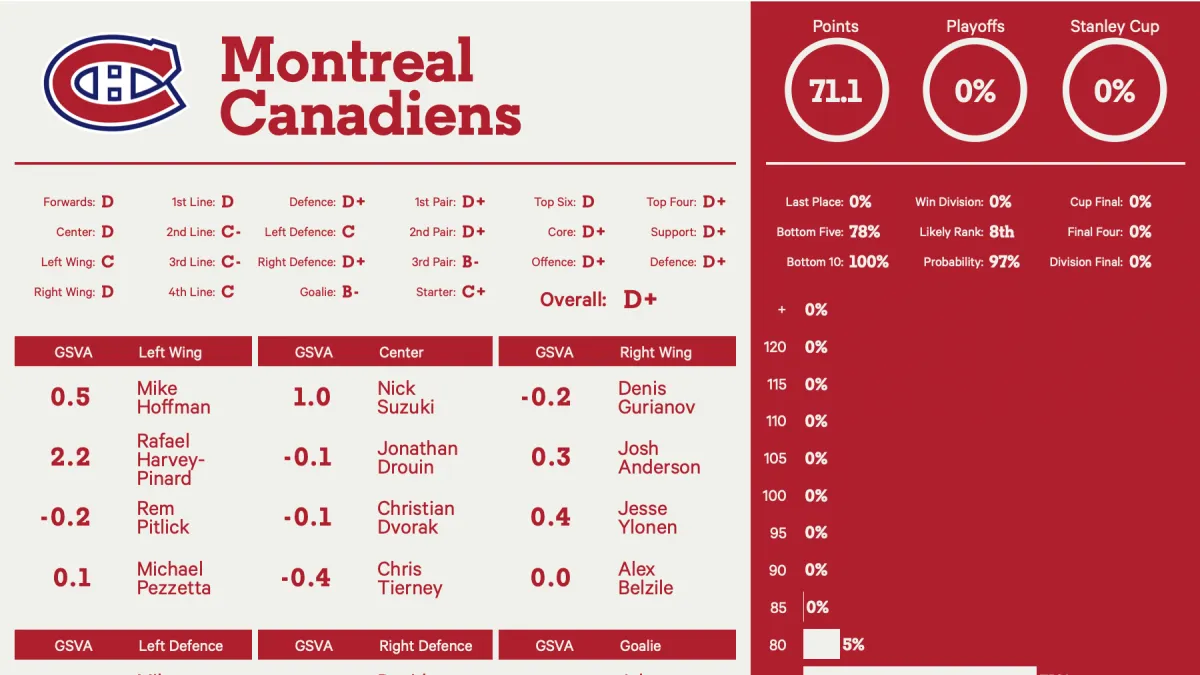
The injury crisis that reshaped Montreal’s roster in 2025
The Canadiens entered November with momentum, but a brutal two-week span saw their medical room fill with cornerstone players. Kirby Dach, the team’s second-line centre, suffered an MCL sprain that will keep him out until after Christmas. Kaiden Guhle, the emerging defensive stalwart, is sidelined with a hairline scapula fracture through the first week of January. Patrik Laine’s persistent lower-body issues will extend to the end of February following the Olympic break, while Alex Newhook faces an even longer absence, targeting a mid-March return.
These aren’t depth players or interchangeable parts. This quartet represents Montreal’s top-six forward group, its power-play quarterback, and its shutdown defenceman. Combined, they account for roughly 30 per cent of the team’s salary cap and an even larger share of its offensive production. Their absence creates a vacuum that few organizations could adequately fill, especially in the hyper-competitive Atlantic Division where points are precious and losing streaks can be fatal.
The impact on Montreal’s performance has been immediate and stark. The team’s power play, which ranked eighth in the league in October, has plummeted to the bottom third without Guhle’s point shot and Laine’s one-timer. Five-on-five possession numbers have similarly cratered, with the Canadiens generating nearly four fewer high-danger chances per game without Dach’s net-front presence and Newhook’s transitional speed. Yet remarkably, the team has managed to stay within striking distance of a wild-card spot, a testament to the structure St. Louis has instilled and the readiness of his replacement players.
Montreal Canadiens players stepping up from the Laval Rocket pipeline
The Laval Rocket has become Montreal’s most valuable asset during this crisis, functioning less like a traditional AHL affiliate and more like a 24-man taxi squad on constant standby. Coach Jean-François Houle runs the same forecheck triggers and neutral-zone schemes as St. Louis, which means players stepping up during this injury-plagued stretch face virtually no learning curve. Through mid-November, Laval leads the AHL in shots-on-goal share at 57.1 per cent and penalty-kill efficiency at 87.9 per cent—metrics that translate directly to the specific roles injured players leave behind.
Logan Mailloux filling the power-play void
When Guhle went down, conventional wisdom suggested the Canadiens would need to trade for a veteran power-play quarterback. Instead, they recalled Logan Mailloux on November 3, and the 21-year-old defenceman has delivered immediately. Averaging 2:43 of power-play time per night, Mailloux has fired nine shots on net and registered two primary assists in his first eight games. His 93.2 mph slapshot already produced a “goal-of-the-week” finalist against the Rangers.
More importantly, his defensive zone exit percentage of 48 per cent is only two points below Guhle’s early-season mark, proving he can handle the puck-moving responsibilities that make Montreal’s system work. Mailloux’s success validates the organization’s patient development approach, as he’s repaid their faith after off-ice issues nearly derailed his career. His emergence means the Canadiens may not need to spend assets on a rental defenceman at the trade deadline.
Emil Heineman’s two-way impact
Often forgotten as the secondary piece in the Tyler Toffoli trade, Emil Heineman has become the perfect injury replacement for Brendan Gallagher’s recurring hand issues. The 23-year-old Swede plays a 200-foot game that fits St. Louis’s identity-based system perfectly. In his eight NHL games during this stretch, Heineman has gone 9-for-16 on inner-slot shot attempts, and his forechecking has created four strip-to-score sequences—exactly the ten-second offence the Canadiens depend on.
Heineman’s $850,000 cap hit has also allowed Montreal to bank an additional $1.3 million in deadline space while Gallagher rehabs. This financial flexibility, combined with his on-ice contributions, demonstrates how the front office’s waiver-exempt veteran signings create strategic advantages during injury crises. Players like Heineman aren’t merely filling roster spots; they’re contributing to wins while preserving the organization’s long-term flexibility.
Young NHL talent seizing bigger roles
Beyond the call-ups from Laval, the injury crisis has forced Montreal’s young NHL players into larger roles that will accelerate their development. This stretch has become a trial by fire for the Canadiens’ most promising prospects, and the results have been mixed but revealing.
Juraj Slafkovsky’s moment to prove his first-overall pick status
The spotlight has never been brighter on Juraj Slafkovsky, the 2022 first-overall selection who has shown flashes of dominance but struggled with consistency. Through the first 19 games of the season, he managed just six goals and three assists—production that falls short of franchise cornerstone expectations. However, with Dach, Laine, and Newhook sidelined, Slafkovsky has been elevated to a line with Ivan Demidov and Oliver Kapanen, giving him the opportunity to drive offence against top competition.
St. Louis has been direct about his expectations, telling reporters, “You’ve got to be responsible, but you”ve also got to be a difference-maker.” The coach’s message reflects the organization’s belief that elite talent must assert itself during adversity. Slafkovsky’s game against Columbus showed both the frustration and potential, as he used his 6’4” frame to win puck battles but still hesitated in high-danger areas. If he can harness this opportunity to play through mistakes and develop confidence, this injury stretch could become the turning point in his career arc.
Zachary Bolduc’s opportunity alongside top linemates
Few players have experienced a sharper reversal of fortune than Zachary Bolduc. After exploding for three goals and an assist in his first three games, the 22-year-old centre managed just one goal and one assist in the subsequent 16 contests. That kind of production drop is difficult for any team to absorb, but it’s catastrophic when the roster is already depleted.
Recognizing Bolduc’s early chemistry, St. Louis recently placed him on a line with Nick Suzuki and Cole Caufield, essentially giving him a master’s class in NHL scoring. “Playing with two of the team’s offensive leaders is an opportunity you cannot afford to waste,” noted one team analyst. Bolduc possesses the skating, shot, and offensive instincts to be a consistent threat, but his defensive zone responsibilities have lagged. The coaching staff has worked with him on positioning and puck support, and his recent improvement in exit transports suggests the lessons are taking hold. The Canadiens don’t need Bolduc to become a star overnight; they need him to contribute reliably during this stretch, and every point he generates helps stabilize the scoring lines until reinforcements arrive.
Veteran presence and coaching adaptation
While the young players grab headlines, Montreal’s veterans and coaching staff have provided the stability necessary to weather this storm. Their leadership has been instrumental in preventing the dressing room from fracturing during a frustrating stretch.
Samuel Montembeault’s critical role in stabilizing the crease
When discussing players stepping up during this injury-plagued stretch, the conversation must start in goal. Samuel Montembeault enters this critical period with a 4-5-1 record, a 3.56 goals-against average, and an .858 save percentage—numbers that fall well below his standard from last season. However, these statistics don’t tell the complete story of a goaltender facing increased shot quality due to defensive absences and structural breakdowns in front of him.
Montembeault’s value lies in his ability to deliver timely saves that preserve momentum in games where the Canadiens are often outshot by double digits. Against Colorado on November 14, he stopped 34 of 36 shots to steal a point in a 3-2 overtime loss, demonstrating the form that made him a fan favourite last season. “When a team is depleted by injuries and confidence dips, a goaltender can make the biggest difference,” one analyst noted. Montembeault has shown he can raise his game during tough stretches before, and the team needs that version of “Monty” now more than ever.
Martin St. Louis’s system allowing seamless integration
The head coach’s impact during this crisis cannot be overstated. St. Louis has maintained his structure-first approach while showing flexibility in how he deploys his makeshift lineups. He deliberately runs the same systems in Laval as he does in Montreal, which means every recalled player already understands their responsibilities without requiring extensive video sessions or practice time.
St. Louis has also mastered the psychological aspect of managing an injury-ravaged roster. He publicly praises effort and process rather than results, which shields his young players from the pressure of replacing established stars. Behind the scenes, he’s implemented a “culture of opportunity” where players understand that injuries, while unfortunate, create pathways to permanent roster spots. This messaging has kept the team’s compete level high even as losses mount, and it’s a primary reason why Montreal remains in the playoff conversation despite fielding what often amounts to an AHL-plus lineup.
The front office strategy making it all possible
General manager Kent Hughes has orchestrated the financial and developmental framework that makes this resilience possible. His approach has transformed what was once an organizational weakness into a competitive advantage.
Salary cap gymnastics and roster flexibility
The Canadiens have banked $4.1 million of cap space by November 17 through a combination of off-season LTIR planning and performance-bonus cushion. Because Carey Price’s $10.5 million hit remains on LTIR, the club can exceed the upper limit, but Hughes has deliberately stayed $1.3 million shy to preserve accrued space for deadline day. Every day a replacement player earns the league-minimum $775,000 instead of an injured $3.5 million forward adds approximately $9,000 in “cap pennies” that roll over like cellphone data.
Montreal has also weaponized the “roster-emergency exception” in article 50.10(e) of the CBA, allowing them to add a 21st skater on game-day mornings without counting the salary against the 23-man limit. This loophole has already been used four times, saving an estimated $260,000 in prorated space—small change that becomes enormous when trying to squeeze in a $2 million rental at the deadline. These financial maneuvers demonstrate how modern NHL management requires legal expertise as much as hockey knowledge.
Laval Rocket’s development system as the foundation
The Canadiens doubled their sports-science budget in 2024, installing force-plate cameras and blood-lactate trackers at Place Bell. This data flags fatigue injuries before they happen, letting Laval coaches micro-manage minutes so call-ups arrive fresh rather than fried—an underrated edge when three-in-threes stack up in February. The Rocket’s lead in AHL shots-on-goal share isn’t accidental; it’s the result of deliberate tactical synchronization with the parent club, ensuring every player stepping up during this injury-plagued stretch is physically and mentally prepared for the NHL’s demands.
This integration extends beyond systems to culture. St. Louis and Houle communicate daily about which players are handling pressure, who needs rest, and who is ready for promotion. That alignment means Montreal isn’t just plugging holes with warm bodies; they’re making strategic personnel decisions based on comprehensive data and personal observation. When Kirby Dach returns after Christmas, the Canadiens will have a clearer picture of which young players can handle playoff-style hockey, creating a competitive depth chart that benefits the organization for years.
What this stretch means for Montreal’s playoff race and future
The Atlantic Division is on pace to send five teams to the postseason for the first time since the 1979-80 Adams Division bloodbath. If the Canadiens can stay within six points of third place by the Olympic break, their schedule softens to the sixth-easiest in the league down the stretch. The internal depth that has kept them afloat thus far will also keep trade prices down; Hughes no longer needs to overpay for a second-line centre because Heineman and Alex Barre-Boulet have proven they can survive 12 minutes a night against soft competition.
This injury crisis has effectively become an early audition for playoff audibles. Every successful recall shortens the bench in April because St. Louis will already know which young legs can handle third-period pressure and which cannot. That information edge is worth at least two standings points—enough to flip a wild-card race that analytics models currently project will be decided by goal-differential tiebreakers on April 16. The Canadiens’ medical room may still be crowded, but for once the waiting list is just as deep. And in a league where health is the only stat you can’t coach, Montreal has finally built a roster that can bleed without flat-lining.
The true measure of success for this injury-plagued stretch won’t be where the Canadiens finish in the standings, but how many of these replacement players become permanent contributors. If Logan Mailloux secures a top-four defence spot, if Emil Heineman establishes himself as a reliable middle-six winger, if Juraj Slafkovsky breaks out under increased responsibility—then this adversity will have accelerated Montreal’s rebuild by a full season. That’s the silver lining the organization is chasing, and it’s why Montreal Canadiens players stepping up during this injury-plagued stretch of 2025 may ultimately define the franchise’s trajectory more than any healthy stretch could have.
Frequently Asked Questions

Par Mike Jonderson
Mike Jonderson is a passionate hockey analyst and expert in advanced NHL statistics. A former college player and mathematics graduate, he combines his understanding of the game with technical expertise to develop innovative predictive models and contribute to the evolution of modern hockey analytics.