















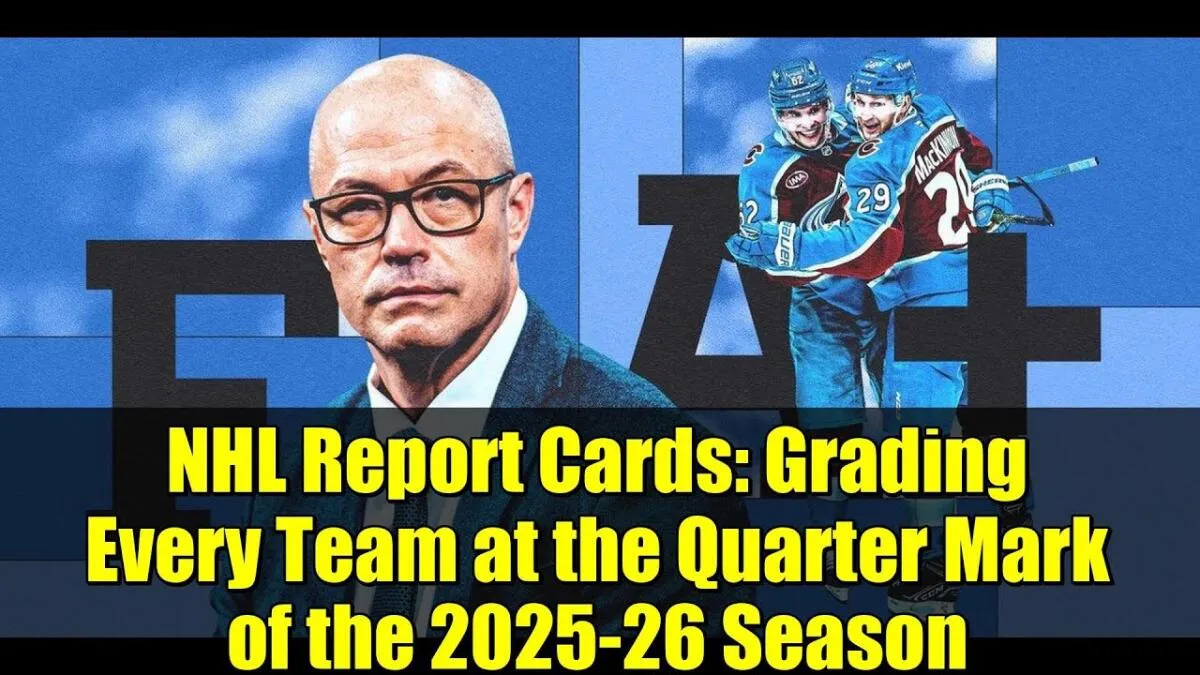
NHL first-quarter report cards 2025-26 for all 32 teams: Complete grades at the season’s quarter mark
As the NHL reaches the quarter pole of the 2025-26 season, it’s time to evaluate all 32 teams and hand out grades based on performance versus expectations. With roughly 20-22 games in the books, we’ve seen surprising contenders emerge, disappointing collapses, and everything in between. These report cards factor in preseason projections, underlying metrics, injury situations, and the eye test to provide a comprehensive assessment of where each franchise stands as we head into the holiday season and beyond.
The methodology remains consistent with previous seasons: teams exceeding expectations receive higher marks regardless of market size, while underperforming rosters with high payrolls face harsher scrutiny. For a deeper dive into individual player performances and advanced analytics, check out our complete NHL 2025-26 first-quarter report cards analysis.
Elite performers: A grades
Winnipeg Jets
The Jets have built on their Presidents’ Trophy success from last season, sitting atop the Central Division with 32 points through 21 games. Connor Hellebuyck continues his Vezina-caliber play, posting a .928 save percentage and three shutouts already. The addition of rookie center Eduard Šalé has provided secondary scoring behind Mark Scheifele and Kyle Connor, while the defensive corps remains the league’s stingiest. Winnipeg’s special teams rank top-five in both categories, and their 5-on-5 expected goals percentage leads the Western Conference. The concern remains playoff performance, but the regular season dominance cannot be ignored.
Vegas Golden Knights
Jack Eichel is making a legitimate Hart Trophy case, pacing the NHL with 35 points in 20 games. Vegas has overcome significant offseason losses, proving their championship window remains wide open. The Knights’ depth has been remarkable, with 11 different players recording double-digit points. Coach Bruce Cassidy has masterfully integrated young talent like defenseman Lukas Dragicevic, while the goaltending tandem of Adin Hill and Ilya Samsonov has been solid. Their 12-3-2 record in one-goal games shows championship mettle. For more on the Knights’ sustained success, see our NHL 2025-26 first-quarter report cards for all 32 teams.
Washington Capitals
Few expected Washington to remain elite after last year’s overachievement, but Alex Ovechkin’s chase for 900 goals has galvanized the roster. Dylan Strome has elevated his game to genuine first-line center status, while Pierre-Luc Dubois finally looks worth his contract with 18 points in 19 games. The Capitals’ powerplay ranks second in the league, converting at 29.4 percent. Their defensive structure under Spencer Carbery has been exceptional, surrendering just 2.38 goals per game. Logan Thompson’s goaltending has been a revelation, posting a 14-4-1 record with a .919 save percentage.
Toronto Maple Leafs
Despite Auston Matthews missing nine games with a nagging injury, Toronto sits comfortably atop the Atlantic Division. Mitch Marner is playing like a man possessed in his contract year, while William Nylander has seamlessly filled the 1C role when needed. The Leafs’ goaltending finally looks solved, with Anthony Stolarz and Joseph Woll forming a reliable tandem. Their penalty kill ranks first in the league, and they’ve allowed the fewest high-danger chances in the NHL. The question isn’t regular season success—it’s whether this version can finally break through in April and May.
Montreal Canadiens
The league’s biggest surprise, Montreal has turned their late-season momentum into legitimate contention. Lane Hutson looks like a generational defenseman, leading all rookies with 22 points. Nick Suzuki has emerged as a true franchise center, while Cole Caufield’s 15 goals put him on pace for 50. The Canadiens’ speed and tenacity have overwhelmed opponents, and their home record at the Bell Centre stands at 11-1-1. Goaltending from Cayden Primeau has been outstanding, but the underlying metrics suggest some regression may come. Still, this young core has exceeded every expectation.
Colorado Avalanche
Injuries to Gabriel Landeskog and Valeri Nichushkin haven’t slowed the Avs, thanks to Nathan MacKinnon’s Hart Trophy-worthy start (38 points in 21 games). Cale Makar remains the NHL’s best defenseman, while Mikko Rantanen has been rejuvenated with 16 goals. The goaltending overhaul has paid dividends, with Mackenzie Blackwood posting a .931 save percentage. Colorado’s 5-on-5 dominance continues, controlling 56 percent of expected goals. Their only blemish is a pedestrian penalty kill ranking 22nd.
Strong contenders: B grades
Dallas Stars
The Stars have navigated the absence of Miro Heiskanen admirably, sitting second in the Central. Jason Robertson continues his elite scoring pace, while Wyatt Johnston has broken out with 12 goals. The goaltending trio of Jake Oettinger, Scott Wedgewood, and Matt Murray has been inconsistent, which keeps them from A-level status. Their special teams rank middle-of-the-pack, but their defensive structure under Peter DeBoer remains sound. The real test comes when Heiskanen returns and the lineup stabilizes.
Carolina Hurricanes
Carolina’s relentless possession game has produced another strong start, though offensive finishing remains a concern. Martin Necas has shouldered the scoring load with 17 goals, while Seth Jarvis continues developing into a top-six fixture. The goaltending has been a revolving door due to injuries, but Pyotr Kochetkov has been solid. Their penalty kill ranks third, and they lead the league in shots per game. However, a 2-5 record in overtime reveals clutch scoring issues.
Edmonton Oilers
Connor McDavid and Leon Draisaitl are their usual spectacular selves, combining for 62 points. The concern is depth scoring, as only three other forwards have reached double digits. Stuart Skinner’s goaltending (.907 SV%) has been adequate but not spectacular. The Oilers’ defensive structure under Kris Knoblauch has improved, ranking 12th in expected goals against. Their powerplay remains lethal at 27.8 percent, but 5-on-5 goal share sits at just 51 percent.
Los Angeles Kings
The Kings continue their methodical climb, fueled by elite defense and strong goaltending from Darcy Kuemper. Kevin Fiala has been their offensive catalyst with 19 points, while Quinton Byfield is finally delivering on his potential. Los Angeles allows the fewest shots per game and has the league’s best penalty kill. Their Achilles heel remains goal scoring, ranking 18th in goals per game. The system works, but they need more finish to reach the next tier.
Middle of the pack: C grades
New Jersey Devils
Jack Hughes’ injury absence has exposed New Jersey’s lack of center depth, yet they remain in playoff position. Jesper Bratt has been magnificent with 24 points, while Jacob Markstrom has solved their goaltending woes. The Devils’ underlying metrics are elite—they rank third in expected goals percentage—but their actual goal share is just 50 percent, indicating poor finishing luck. Once Hughes returns healthy, this team could surge.
Tampa Bay Lightning
The Lightning are treading water at 10-9-2, looking nothing like the powerhouse of recent years. Nikita Kucherov still produces (28 points), but age is showing on the roster. The defense has been porous, allowing 3.12 goals per game, and Andrei Vasilevskiy hasn’t reached his previous heights. Brayden Point and Brandon Hagel provide solid support, but this team lacks the depth to compete with Florida and Toronto in the Atlantic.
Calgary Flames
Dustin Wolf has been the league’s best rookie goaltender, single-handedly keeping Calgary competitive. The forward group is balanced but lacks star power—Jonathan Huberdeau’s 15 points represent a modest bounce-back. The defense has been surprisingly effective, led by MacKenzie Weegar and Rasmus Andersson. Calgary’s playoff hopes hinge on Wolf maintaining his .922 save percentage, as their 5-on-5 play ranks 20th in the league.
Utah Hockey Club
In their second season, Utah has been competitive but inconsistent. Clayton Keller leads the team with 18 points, while Logan Cooley shows flashes of brilliance. The defense has been solid with Mikhail Sergachev anchoring the top pair, but goaltending from Connor Ingram has been average. Utah’s home ice advantage in Salt Lake City has been real (9-3-1), but road struggles (3-8-2) keep them from rising higher. They’re tracking toward their first playoff appearance.
Struggling squads: D grades
Boston Bruins
The Bruins are a mess. Jeremy Swayman’s massive contract looks questionable after a .892 save percentage start, and the defense has been ravaged by injuries to Charlie McAvoy and Hampus Lindholm. Brad Marchand has battled through injuries but can’t carry the offense alone. David Pastrnak’s 8 goals represent a disappointing pace, and the powerplay sits 28th. A recent coaching change hasn’t provided the expected spark. Boston sits outside the playoff picture, a shocking fall for a team that won the Presidents’ Trophy two seasons ago.
Pittsburgh Penguins
Sidney Crosby can’t do everything alone at 38 years old. The Penguins rank 29th in goals against, with Tristan Jarry posting an .885 save percentage. Evgeni Malkin and Rickard Rakell provide some scoring punch, but the defense is among the league’s worst. Pittsburgh’s prospect pipeline finally showing promise—2024 first-rounder Harrison Brunicke looks NHL-ready—but this season is about development, not contention.
Seattle Kraken
Seattle continues searching for identity in their fourth season. Shane Wright has shown progress but hasn’t become the franchise center they hoped. The goaltending from Joey Daccord has regressed, and the defense lacks top-pair talent. Matty Beniers has been solid but not spectacular, while the free-agent additions of Chandler Stephenson hasn’t paid dividends. The Kraken sit near the Pacific Division basement, facing another lost season.
Troubled franchises: F grades
New York Rangers
From Presidents’ Trophy to disaster in eight months. The Rangers own the league’s worst record at 6-14-2, with Igor Shesterkin posting a .895 save percentage. Artemi Panarin and Chris Kreider have been invisible offensively, combining for just 18 points. The defense has been a disaster since trading Jacob Trouba, and coach Peter Laviolette appears to have lost the room. Kaapo Kakko’s trade to Carolina for pennies on the dollar represents the organization’s panic. This could be a full teardown by March.
Nashville Predators
After massive free-agent spending on Steven Stamkos and Jonathan Marchessault, Nashville sits dead last in the Central. Stamkos has just 7 goals, while the defense has been historically bad, allowing 3.74 goals per game. Juuse Saros faces more shots than any goalie in the league, and the special teams rank bottom-three in both categories. General manager Barry Trotz may need to reverse course and sell at the deadline, admitting the win-now approach failed spectacularly.
Chicago Blackhawks
Connor Bedard has been good (20 points in 21 games) but not yet great, while the supporting cast remains woeful. The Blackhawks allow a league-worst 4.11 goals per game, with Petr Mrázek posting an .872 save percentage. The rebuild shows promise with Oliver Moore and Frank Nazar showing potential, but this team is years away from competitiveness. Coach Anders Sorensen is already on the hot seat after replacing Luke Richardson.
Buffalo Sabres
The playoff drought will extend to 15 years. Tage Thompson and Rasmus Dahlin produce individually, but the team defense is nonexistent. Ukko-Pekka Luukkonen has struggled mightily in net, and the forward depth is among the league’s worst. Buffalo’s 5-on-5 expected goals percentage sits at 44.2 percent, better only than Chicago. General manager Kevyn Adams faces mounting pressure as the organization continues spinning its wheels.
Looking ahead to the season’s second quarter, several trends bear watching. Will Montreal’s magic continue, or will regression hit hard? Can the Rangers salvage anything from their disastrous start? Will Winnipeg finally translate regular season dominance into playoff success? And perhaps most intriguingly, can Connor Bedard elevate the Blackhawks enough to make them competitive? The NHL season is long, and these report cards will undoubtedly shift dramatically by the midseason mark.
The quarter pole has revealed which teams have legitimate Stanley Cup aspirations and which face difficult decisions about their direction. For franchises at the bottom, the focus shifts to development and draft positioning. For those at the top, every point matters in the race for playoff positioning. With American Thanksgiving behind us, we have a clearer picture of the NHL landscape—and it’s shaping up to be one of the most competitive seasons in recent memory.
Frequently Asked Questions

Par Mike Jonderson
Mike Jonderson is a passionate hockey analyst and expert in advanced NHL statistics. A former college player and mathematics graduate, he combines his understanding of the game with technical expertise to develop innovative predictive models and contribute to the evolution of modern hockey analytics.