











The Toronto Maple Leafs are spiraling. With a 15-13-5 record through 33 games, the team sits third-worst in the Eastern Conference, their power play cratering to an anemic 14.1 percent despite boasting offensive weapons like Auston Matthews, William Nylander, and John Tavares. Head coach Craig Berube, hired to bring structure and accountability after last season’s playoff disappointment, now finds himself squarely on the hot seat as questions mount about whether his message is still reaching a fractured locker room.
What makes this situation particularly alarming isn’t just the losses—it’s the lifeless manner in which they’re occurring. Following a 4-0 humiliation in Washington where the Capitals treated the Leafs’ neutral zone like a highway, Berube appeared to run out of answers. When asked point-blank why his team lacked the desperation and urgency of their opponents, the typically blunt coach passed the buck with a telling response: “Ask those guys, not me.”
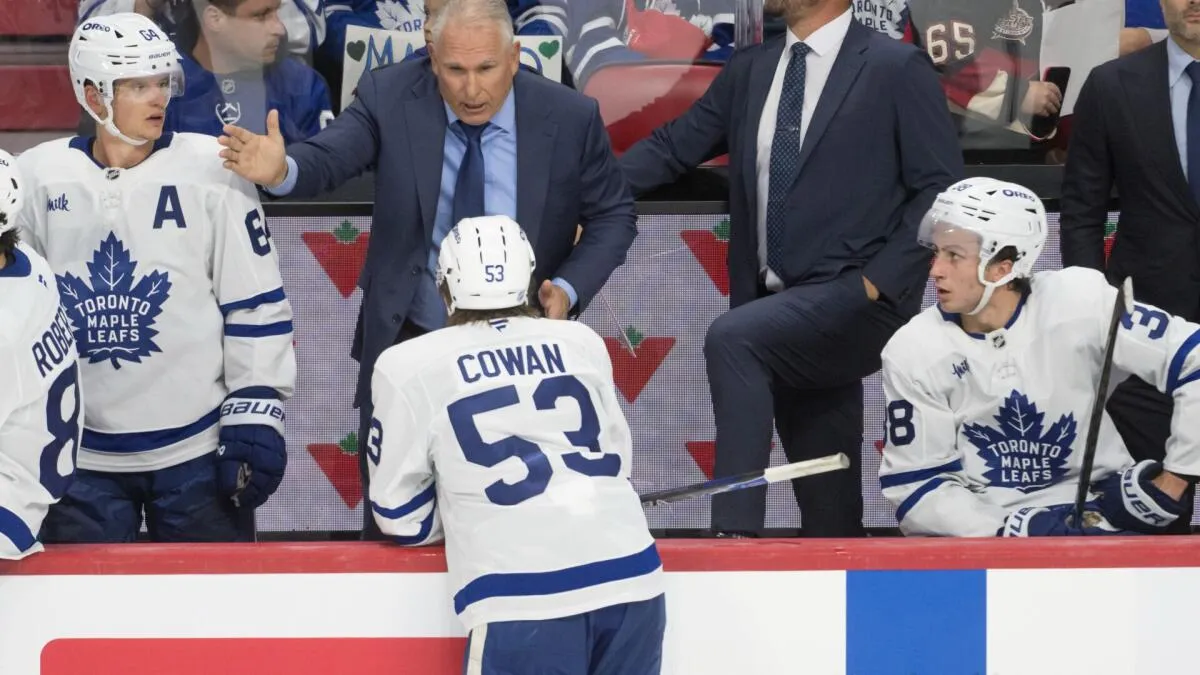
Craig Berube’s mounting pressure as Maple Leafs coach in 2025
The statistics paint a damning picture of a team losing its identity. Toronto ranks 29th in offensive zone time and 27th in preventing opponent offensive zone time—numbers that reveal a squad being dominated at both ends of the ice. Last season’s elite goaltending masked these systemic issues, but this year, even-strength save percentage has plummeted from second overall to 23rd, exposing every structural flaw.
Berube’s frustration boiled over during a tense practice session in mid-December, where his attempts to re-energize a tentative group seemed to fall flat. The coach has hammered away at defensive-zone coverage and neutral-zone forecheck, but his players continue to sag back, allowing opponents to dictate play. “We can’t go out and play with the fear of mistakes,” Berube emphasized. “We’re too tentative. We have to be on our toes more.”
The disconnect between Maple Leafs players and coaching staff
Perhaps most concerning for Toronto’s front office is the growing disconnect between the coaching staff and the star players. Following the Washington loss, captain Auston Matthews openly criticized the team’s structure, stating, “The neutral zone was a highway for them to get through. I don’t know, we just made it so easy for them.” When the team’s $13.25 million centerpiece is publicly questioning the system, alarm bells should be ringing in the executive suites.
William Nylander, who has gone cold alongside Matthews, couldn’t even pinpoint why the team’s compete level had vanished. “I don’t know, it’s a tough question,” he admitted when pressed for explanations. John Tavares, ever the diplomat, tried to strike an optimistic tone: “Well, clearly we’re not in the spot we want to be in. But we’re not far off from being in a really good spot.” Yet even his measured positivity rings hollow when the same issues persist week after week.
The tension reached a breaking point when Berube, normally confident in his messaging, was asked if he was concerned his message wasn’t getting through. “I don’t think I’m concerned about that. I mean, the message is the message,” he said defensively. “They need to take it and go with it, but I’m not concerned with it, no.” The denial felt less like genuine confidence and more like a coach trying to convince himself.
Toronto Maple Leafs coaching history repeating itself
This isn’t the first time Toronto has faced a coaching crisis. The franchise has cycled through numerous bench bosses in recent years, each promising to be the one to finally unlock the potential of a star-studded roster. Berube’s situation echoes patterns seen with his predecessors—initial success followed by diminishing returns as players either tune out the system or fail to execute it consistently.
General manager Brad Treliving now faces an existential dilemma. Having already fired one coach in Sheldon Keefe, does he have the right to pull the trigger again when the roster he constructed continues to underperform? As Elliotte Friedman noted, “If things don’t straighten out, the organization will be forced into existential questions they didn’t think they’d have to consider—beyond the coach, beyond management, into the core of their lineup.”
The parallel to last season’s catastrophic playoff loss to Florida looms large. Toronto held a 2-0 series lead and a 3-1 edge in Game 3, appearing poised for advancement. Three straight defeats later, including a Game 5 meltdown at home, the series loss felt like it shattered something fundamental within the group. As one analyst wondered, “Did it all end then? Did that loss smash the group’s belief in him and each other?”
What the statistics reveal about Berube’s coaching challenges
Beyond the eye test and internal strife, advanced metrics confirm the Leafs’ systemic breakdown. The team that once dominated possession and offensive-zone time now struggles to establish any territorial advantage. Their inability to prevent opponents from entering the zone with speed has turned every game into a track meet they’re ill-equipped to win.
Consider these concerning trends through 33 games:
- Power play efficiency: 14.1% (down from previous seasons)
- Offensive zone time: 29th in NHL
- Defensive zone prevention: 27th in NHL
- Even-strength save percentage: 23rd (down from 2nd last season)
- Record against playoff teams: 6-11-3
The decline in even-strength save percentage is particularly telling. Last season, elite goaltending from Joseph Woll and his partners covered defensive lapses. This year, those same lapses are resulting in goals against at an alarming rate. Berube’s system, designed to limit high-danger chances, simply isn’t being executed, leaving goaltenders vulnerable to quality shots from dangerous areas.
Can Craig Berube survive the 2025 Toronto Maple Leafs season?
With 49 games remaining, Berube theoretically has time to right the ship. The Eastern Conference remains tight enough that Toronto isn’t mathematically eliminated from anything yet. However, the psychological damage may already be irreversible. When a coach begins publicly questioning his players’ commitment and those same players appear confused by the system, the fracture lines become too deep to simply paper over.
Berube’s morning meeting message after the Washington loss revealed his approach: “All that matters is playing for each other, playing aggressively, and playing on our toes. Let’s play the way we can play.” Yet even he acknowledged the team hasn’t reached that standard. “We haven’t done that. We are going to make mistakes—every team does—but definitely, we can’t make mistakes by sitting back and letting teams come at us as they have been.”
The former Stanley Cup champion coach with St. Louis has experience navigating rough patches. “I’m sure I could draw on a lot of them,” he said when asked about comparable situations. “It happens all the time, right? There is a lot of experiences—as a player and as a coach—where I have gone through this type of situation before. I truly believe we are going to get out of it. I do.”
But belief alone may not be enough in Toronto’s pressure-cooker environment. The Maple Leafs organization, from ownership down, has invested too much capital and patience into this core to accept mediocrity. If Berube cannot rapidly turn results around, particularly against division rivals, management may decide a new voice is required—regardless of whether fair or not.
Toronto Maple Leafs leadership faces its biggest test
The core leadership group finds itself caught between supporting their coach and acknowledging obvious failures. Matthews, as captain, must walk the fine line of accountability without throwing teammates or staff under the bus. His “highway” comment, while accurate, subtly undermined the coaching staff’s ability to prepare the team defensively.
Tavares, the veteran presence, continues preaching patience and perspective: “You don’t need to look at the underlying analytics to see the Leafs are struggling; this was the type of contest that likely gets a team booed off the ice had they played at home.” His honesty about the potential for fan backlash shows an awareness of the ticking clock this organization faces.
For management, the decisions extend beyond Berube’s job security. Treliving’s trade history suggests he won’t hesitate to make bold moves, but with the core players locked into massive contracts, his flexibility remains limited. The existential questions Friedman referenced cut to the heart of whether this group, as constructed, can ever win when it matters.
The road ahead for the struggling Maple Leafs
Toronto’s upcoming schedule offers no respite. A brutal back-to-back against Nashville and Dallas looms, followed by a stretch of games against division opponents that will likely determine the season’s fate. Every loss intensifies the scrutiny on Berube and increases the likelihood of organizational upheaval.
The players, for their part, seem to understand the stakes. Matthews noted, “We have to realize night in and night out just how much more consistent we have to be with our game.” Nylander, despite his earlier confusion, remains part of a top line that Berube has kept together, hoping familiarity breeds success rather than contempt.
Yet hope isn’t a strategy, and the same mantras about execution and compete level are wearing thin. When Berube says, “Mistakes will happen. Let’s make them being aggressive,” it sounds like a coach who knows his system requires perfect execution to work—and perfect execution is precisely what this group has failed to deliver.
The Maple Leafs have 49 games to rewrite their story. They possess the talent to compete with anyone when engaged and structured. What they lack is time, trust, and perhaps most critically, a clear identity. Whether Craig Berube can restore all three before the clock runs out will determine not just his future, but potentially the future of Toronto’s championship aspirations.
The pressure on Craig Berube will only intensify as the calendar flips toward 2026. The Toronto Maple Leafs organization has reached a crossroads where every decision carries franchise-altering consequences. With declining performance metrics, apparent locker-room fractures, and a fan base growing increasingly restless, the window for turning this season around narrows by the day. Whether it’s fair or not, NHL coaches on the hot seat rarely survive when their star players publicly question the system and the general manager faces his own existential crisis about roster construction. Berube’s championship pedigree bought him goodwill, but in Toronto, goodwill expires quickly when results don’t follow. The next 20 games will likely determine whether he’s leading this team into the playoffs or joining the long list of coaches who couldn’t solve the Maple Leafs’ perpetual puzzle.
Frequently Asked Questions

Par Mike Jonderson
Mike Jonderson is a passionate hockey analyst and expert in advanced NHL statistics. A former college player and mathematics graduate, he combines his understanding of the game with technical expertise to develop innovative predictive models and contribute to the evolution of modern hockey analytics.