


















Now I have enough information to write the comprehensive blog post. Let me create the article about NHL goaltenders who found success after leaving the Calgary Flames.
The Calgary Flames have a long history of developing goaltenders, but not all of them found their greatest success while wearing the flaming C. Throughout the franchise’s history, several netminders have left Alberta only to flourish elsewhere in the NHL, capturing Stanley Cups, winning individual awards, and establishing themselves as elite goaltenders. These departures serve as a reminder that sometimes a change of scenery is exactly what a player needs to unlock their full potential. From Hall of Famers to playoff heroes, the list of goalies who excelled after their time in Calgary tells a fascinating story about timing, development, and the unpredictable nature of goaltending careers.
Understanding which goaltenders thrived after leaving Calgary provides valuable insight into both the challenges of evaluating netminding talent and the franchise’s historical struggles to maintain consistent goaltending over the decades. While some of these departures were necessary at the time, others represent significant missed opportunities that altered the trajectory of both the Flames and the goalies themselves.
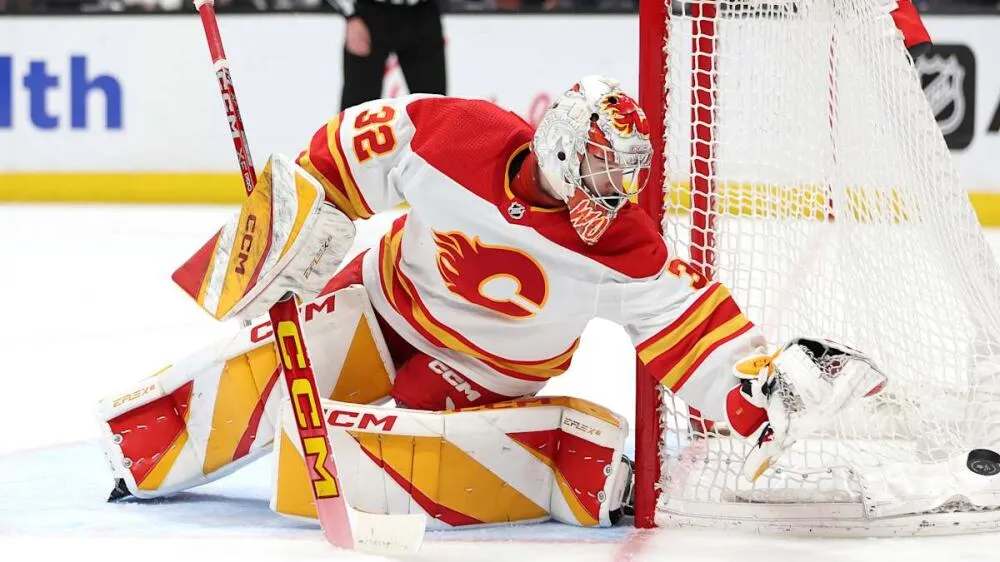
Mike Vernon: from Calgary champion to Detroit legend
Mike Vernon’s story stands out as one of the most successful examples of NHL goaltenders who found success after leaving the Calgary Flames. Vernon spent the first 11 seasons of his career in Calgary, where he became a franchise icon by backstopping the team to their only Stanley Cup championship in 1989. During his tenure with the Flames, Vernon appeared in 484 games, establishing himself as one of the most dependable netminders in franchise history.
Despite his success in Calgary, Vernon was traded to the Detroit Red Wings in June 1994 in exchange for Steve Chiasson. Many questioned whether the veteran goaltender still had elite hockey left in his game. Vernon initially served as the backup to Chris Osgood during the 1996-97 season, but when the playoffs arrived, Red Wings head coach Scotty Bowman made the crucial decision to start Vernon.
What followed was one of the most remarkable playoff performances in recent memory. Vernon dominated throughout the postseason, going 16-4 with a 1.76 goals-against average as the Red Wings captured their first Stanley Cup since 1955. His stellar play earned him the Conn Smythe Trophy as playoff MVP, cementing his legacy as one of the premier clutch goaltenders of his era. The championship run proved that Vernon’s best hockey wasn’t behind him when he left Calgary.
Vernon’s post-Calgary success extended beyond just one magical playoff run. He continued to be a reliable presence in net for Detroit before finishing his career with stops in San Jose and Florida. By the time he retired in 2002, Vernon had accumulated over 300 NHL wins and two Stanley Cup rings. His enshrinement in the Hockey Hall of Fame in 2023 recognized a career that reached its pinnacle after leaving Alberta, demonstrating that elite goaltenders can reinvent themselves in different environments.
Jean-Sébastien Giguère: the one who got away
Few departures haunt the Flames organization more than Jean-Sébastien Giguère. The Montreal native arrived in Calgary in 1997 via trade from the Carolina Hurricanes and spent three seasons in the organization. However, he managed to appear in only 22 NHL games with the Flames, posting a disappointing 7-10-2 record with a 3.07 goals-against average and .902 save percentage. The Flames, convinced that “Jiggy” wasn’t going to develop into a reliable NHL starter, traded him to the Mighty Ducks of Anaheim for a second-round pick in the 2000 offseason.
The decision to give up on Giguère proved catastrophic for Calgary. Once he arrived in Anaheim, his career trajectory changed dramatically. By the 2001-02 season, Giguère had secured the starting job with the Ducks and held it for the next seven years. His regular season numbers improved substantially, but it was his otherworldly performance in the 2003 Stanley Cup Playoffs that announced him as one of the game’s elite netminders.
During that historic postseason run, Giguère posted a 15-6 record with a stunning 1.62 goals-against average and .945 save percentage. Although the Ducks ultimately fell to the New Jersey Devils in Game 7 of the Stanley Cup Final, Giguère’s brilliance was undeniable. He became only the fifth player in NHL history to win the Conn Smythe Trophy despite his team losing in the final, joining Roger Crozier, Glenn Hall, Reggie Leach, and Ron Hextall in that exclusive club.
Giguère’s success in Anaheim continued for years after that remarkable playoff run. He helped the Ducks capture the franchise’s first Stanley Cup championship in 2007, finally getting his hands on the trophy that had eluded him four years earlier. Over his career with the Ducks, he became one of the most respected goaltenders in the Western Conference. After being traded to Toronto in 2009, he finished his career with the Colorado Avalanche in 2014, retiring with a 262-216-75 record, a 2.53 goals-against average, and a .913 save percentage. For the Flames, watching Giguère become a star elsewhere remains one of the organization’s most painful “what if” scenarios.
Dwayne Roloson: the late bloomer who found his stride
Dwayne Roloson represents perhaps the quintessential late-bloomer among NHL goaltenders who found success after leaving the Calgary Flames. An undrafted free agent, Roloson signed with Calgary and spent time developing in their farm system before earning a call-up during the 1996-97 season. Over two seasons with the Flames, “Roli the Goalie” posted a respectable but unspectacular 19-30-9 record with a 2.89 goals-against average on a rebuilding team.
The Flames decided to move on from Roloson in 1998, trading him to the Buffalo Sabres where he spent two years backing up legendary goaltender Dominik Hasek. This period proved crucial to his development, as learning from one of the game’s all-time greats helped Roloson refine his technique and mental approach. However, it wasn’t until he joined the Minnesota Wild in 2001 that his career truly took off.
At age 34, an age when many goaltenders are considering retirement, Roloson appeared in his first NHL All-Star Game and recorded the league’s best save percentage during the 2003-04 season. His remarkable late-career ascension continued after he was traded to the Edmonton Oilers in March 2006. With Edmonton, Roloson became the driving force behind one of the most unexpected Stanley Cup runs in recent history.
During the 2006 playoffs, Roloson posted a sensational 12-5 record through the first three rounds and was considered the front-runner for the Conn Smythe Trophy. Tragically, he suffered a third-degree MCL sprain in Game 1 of the Stanley Cup Final against Carolina, ending his playoff run and severely hampering Edmonton’s chances. Despite the heartbreaking injury, Roloson had proven he could perform at hockey’s highest level. He played three more seasons in Edmonton before finishing his career with stops in New York and Tampa Bay. When he retired in 2012 at age 42, Roloson had appeared in 606 NHL games with a 227-257-82 record, proving the Flames had given up too early on a goaltender who would enjoy over a decade of NHL success.
Roman Turek: a brief window of excellence in St. Louis
Roman Turek’s path away from Calgary led to one of the most impressive individual seasons any former Flames goaltender has ever produced. The Czech netminder came to Calgary in 2001 as part of a trade from the St. Louis Blues, but before his time with the Flames, Turek had enjoyed tremendous success with St. Louis that the organization hoped he could replicate in Alberta.
During his time with the Blues from 1999 to 2001, Turek was nothing short of spectacular. In the 1999-2000 season, he recorded 42 wins and posted a remarkable 1.95 goals-against average, helping St. Louis achieve a franchise-record 114 points. His performance that season established him as one of the league’s premier goaltenders and made him a hot commodity when the Blues eventually decided to trade him.
After arriving in Calgary, Turek’s numbers never quite matched his St. Louis peak. He played parts of four seasons with the Flames, recording 221 fewer games than Miikka Kiprusoff, who would later become Calgary’s franchise goaltender. While Turek was serviceable in Calgary, posting some solid seasons including a strong 2003-04 campaign, he never recaptured the magic that made him so dominant in St. Louis.
The Turek story serves as a reminder that goaltending success is often tied to the team in front of the netminder and the specific system they play within. While he came to Calgary after his best days in St. Louis rather than finding success after leaving the Flames, his career trajectory demonstrates how dramatically a goaltender’s fortunes can change depending on their environment. His exceptional 1999-2000 season in St. Louis remains one of the best statistical years any goaltender has produced in the past quarter-century.
Curtis McElhinney: patience rewarded with Stanley Cup glory
Curtis McElhinney’s journey stands as one of the most inspiring stories among NHL goaltenders who found success after leaving the Calgary Flames. Drafted by the Flames in the sixth round of the 2002 NHL Entry Draft, McElhinney spent years toiling in the organization’s farm system, appearing in just a handful of NHL games during his time with Calgary. The presence of Miikka Kiprusoff, who started 70-plus games in seven of his nine seasons with the Flames, meant there was virtually no opportunity for McElhinney to establish himself at the NHL level.
Despite playing only sparingly with Calgary, McElhinney refused to give up on his NHL dream. After leaving the Flames organization, he embarked on a journeyman career that saw him serve as a backup goaltender for multiple teams over 13 seasons. His persistence and professionalism earned him respect throughout the league, even as he never became a full-time starter.
McElhinney’s dedication was ultimately rewarded in the most meaningful way possible. He joined the Tampa Bay Lightning and became part of their back-to-back Stanley Cup championships in 2020 and 2021. While he wasn’t the starting goaltender during those playoff runs, his contributions during the regular season and his presence as a veteran mentor proved invaluable to Tampa Bay’s success.
When McElhinney retired in 2021 at age 38, he had appeared in 249 NHL games and won two Stanley Cup rings – accomplishments that seemed unlikely during his limited time in Calgary’s system. His career serves as a testament to perseverance and the value of being a consummate professional. The fact that a sixth-round pick who barely played for the Flames went on to enjoy such a long NHL career and win championships speaks to both his character and his abilities. McElhinney’s story reminds us that success in hockey isn’t always measured by statistics or starting roles, but by the impact a player has on winning teams.
Lessons from NHL goaltenders who found success after leaving the Calgary Flames
The pattern of goaltenders flourishing after departing Calgary raises important questions about player development, organizational patience, and the unpredictable nature of evaluating netminding talent. Each case study presents unique circumstances – from Mike Vernon’s veteran leadership paying dividends in Detroit to Jean-Sébastien Giguère finally getting the opportunity he deserved in Anaheim to Dwayne Roloson’s remarkable late-career emergence.
What these stories collectively demonstrate is that goaltending development rarely follows a linear path. Unlike skaters who may show consistent improvement year over year, goaltenders often experience dramatic fluctuations in performance based on factors like confidence, team defense, coaching systems, and personal maturity. The Flames’ inability to accurately predict which goaltenders would eventually succeed elsewhere isn’t unique to their franchise – every NHL team has similar stories of the ones who got away.
The challenge for any organization is balancing patience with pragmatism. Should the Flames have given Giguère more time to develop? Was trading Vernon at the right moment, even though he went on to win another Cup? Could Roloson have been the answer if given more opportunities in Calgary? Could Roloson have been the answer if given more opportunities in Calgary? These questions don’t have easy answers, but they provide valuable lessons for current and future management.
Moving forward, the Flames and other organizations must continue refining their goaltending evaluation processes while recognizing that sometimes a fresh start is exactly what a struggling netminder needs to reach their potential. The success of these former Flames goaltenders in other markets doesn’t necessarily mean Calgary made wrong decisions at the time, but it does highlight how dramatically circumstances can impact a goaltender’s career trajectory. As the NHL continues to evolve, understanding these patterns becomes increasingly important for building sustainable success in the most volatile position in professional sports.

Par Mike Jonderson
Mike Jonderson is a passionate hockey analyst and expert in advanced NHL statistics. A former college player and mathematics graduate, he combines his understanding of the game with technical expertise to develop innovative predictive models and contribute to the evolution of modern hockey analytics.