




In the NHL, consistency is often harder to achieve than a championship itself. Making the playoffs year after year requires not just talent, but organizational excellence, depth, and a winning culture that transcends roster changes and coaching transitions. Throughout the league’s storied history, several franchises have managed to string together remarkable playoff streaks that defined entire eras of hockey dominance. These consecutive postseason appearances represent the pinnacle of sustained success, showcasing teams that remained competitive through different generations of players and coaches.
From the Original Six era through the modern salary cap landscape, the longest Stanley Cup playoff streaks in NHL history reveal fascinating stories about hockey’s most successful organizations. These runs required rebuilding on the fly, adapting to rule changes, and maintaining excellence through economic shifts in the sport. Let’s examine the most impressive playoff streaks ever recorded in professional hockey.
The Boston Bruins’ record-setting 29 consecutive seasons
The Boston Bruins own the NHL record for the longest Stanley Cup playoff streaks in NHL history, qualifying for the postseason in an astounding 29 consecutive seasons from 1967-68 through 1995-96. This unprecedented run began during the NHL’s first major expansion and continued through nearly three decades of hockey evolution, encompassing multiple coaching changes, roster overhauls, and shifts in playing style.
The streak started with legendary defenseman Bobby Orr revolutionizing the position alongside sharpshooter Phil Esposito. These Hall of Famers led the Bruins to Stanley Cup championships in 1970 and 1972, establishing a culture of winning that would endure for generations. As Orr’s career was cut short by knee injuries and Esposito eventually moved on, the Bruins seamlessly transitioned to a new era led by defenseman Ray Bourque, who would become the face of the franchise for over two decades.
During this remarkable 29-year stretch, Boston finished first in their division 12 times and collected over 100 points in 15 seasons. The Bruins reached the Stanley Cup Final seven times during the streak, though they only captured those two championships early in the run. They came agonizingly close on multiple occasions, losing in the Final in 1974, 1977, 1978, 1988, and 1990.
What made this streak particularly impressive was the Bruins’ ability to remain competitive through major changes in the game. They navigated the transition from six teams to thirty, adapted to new divisions and playoff formats, and remained relevant through the high-scoring 1980s and the defensive-minded early 1990s. According to ESPN, this run represented “one of the league’s most consistent” performances in hockey history.
The streak finally ended after the 1996-97 season, a year after Bourque had carried the team to their 29th consecutive playoff appearance. The record still stands today and appears virtually unbreakable in the modern salary cap era, where parity has made sustained excellence exponentially more difficult to achieve.
The Chicago Blackhawks’ 28-year playoff dynasty
Just one year behind the Bruins are the Chicago Blackhawks, who qualified for the Stanley Cup playoffs in 28 consecutive seasons from 1969-70 through 1996-97. This remarkable streak, among the longest Stanley Cup playoff streaks in NHL history, began with legends Stan Mikita, Bobby Hull, and goaltender Tony Esposito leading the charge in red and black.
The Blackhawks’ streak is unique in that it represents the longest run by any Original Six franchise without capturing a championship. Despite reaching the Stanley Cup Final three times during this period—in 1971, 1973, and 1992—Chicago fell short each time. This made their quarter-century of consistency bittersweet, as they remained competitive without achieving ultimate glory.
Throughout their 28-year run, the Blackhawks won their division 13 times and surpassed the 100-point mark on six occasions. The team featured numerous Hall of Fame players throughout the decades, including Denis Savard in the 1980s and Chris Chelios and Ed Belfour in the 1990s. Their ability to transition from one era of stars to another kept them in playoff contention for nearly three decades.
The streak showcased Chicago’s organizational stability and scouting prowess. They consistently identified and developed talent that could compete at the highest level, even as the league expanded and competition increased. The Blackhawks maintained a winning culture that made playoff appearances the expectation rather than the exception.
When the streak finally ended after the 1996-97 season—just one year after the Bruins’ record run concluded—it marked the end of an era for one of hockey’s most storied franchises. The Blackhawks would eventually break through with three championships in 2010, 2013, and 2015, but that came after enduring some of the darkest years in franchise history.
Detroit’s dual dynasties: 25 years twice
The Detroit Red Wings hold the unique distinction of appearing twice among the longest Stanley Cup playoff streaks in NHL history, each time with a 25-year run. These two separate eras showcase the franchise’s remarkable ability to build sustainable success across different generations of hockey.
The first streak ran from 1938-39 through 1957-58, making the Red Wings the first team in league history to qualify for the playoffs in 20 consecutive seasons. This accomplishment came during a time when the NHL transitioned from a multi-team league into the Original Six era (1942-1967). The streak included four Stanley Cup championships in 1943, 1950, 1952, and 1954, with the legendary Gordie Howe winning all but the 1943 title. Howe qualified for the playoffs in his first 12 NHL seasons, establishing himself as one of the game’s all-time greats.
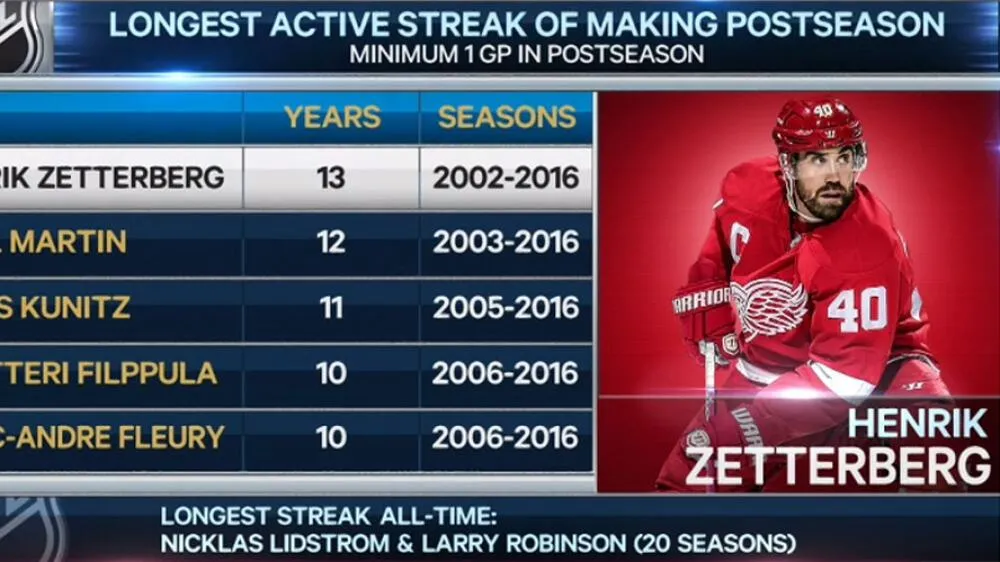
The Red Wings’ second 25-year streak from 1990-91 through 2015-16 may be even more impressive given the increased competition and salary cap constraints. This modern era featured one of the most dominant runs in sports history, with Detroit capturing four Stanley Cup championships in 1997, 1998, 2002, and 2008. The team was led by Hall of Famers Steve Yzerman, Nicklas Lidstrom, Sergei Fedorov, Pavel Datsyuk, and Henrik Zetterberg.
During this second streak, the Red Wings won eight consecutive division titles from 2000 to 2008 and posted 17 seasons with more than 100 points, including every year from 1999 to 2012. They became known as “Hockeytown” and set the standard for organizational excellence, with legendary general manager Ken Holland and coach Scotty Bowman creating a system that identified overlooked European talent and developed players through their farm system.
The Hockey Writers notes that Detroit’s ability to “bridge two generations of hockey” with stars like Yzerman passing the torch to Zetterberg demonstrated remarkable continuity. Few franchises have managed one 25-year playoff streak, but the Red Wings accomplished it twice, cementing their status as one of hockey’s most successful organizations.
Montreal Canadiens: excellence defined in two different eras
The Montreal Canadiens, hockey’s most decorated franchise with 24 Stanley Cup championships, appear twice on the list of the longest Stanley Cup playoff streaks in NHL history. Their success in maintaining extended playoff runs speaks to the organizational culture that made them the “New York Yankees of hockey.”
The first streak lasted 21 seasons from 1948-49 through 1968-69, during which the Canadiens captured an incredible 10 Stanley Cup championships. This run came during the Original Six era when Montreal dominated the league with legendary players like Maurice “Rocket” Richard, Jean Beliveau, Henri Richard, and goaltender Jacques Plante. Under coaches Dick Irvin and Toe Blake, both Hall of Famers, the Canadiens established a dynasty that included five consecutive championships from 1956 to 1960.
The Canadiens’ second lengthy streak began just one season after the first ended. From 1970-71 through 1993-94, Montreal qualified for the playoffs in 24 consecutive seasons, matching the number of Stanley Cup banners hanging in what is now the Bell Centre. During this second run, the team captured eight more championships, with their most dominant stretch coming from 1976 to 1979 when they won four titles in a row led by Guy Lafleur, Larry Robinson, and Ken Dryden.
This second era showcased Montreal’s ability to adapt to expansion and increased competition. The Canadiens won 13 division titles during the streak, including eight in a row at one point, and posted 100 points or more in 13 seasons, including a stretch of eight consecutive campaigns. The list of Hall of Famers who wore the bleu, blanc et rouge during these years could fill its own article.
The 1993 championship, led by Patrick Roy’s goaltending heroics and captain Guy Carbonneau’s leadership, remains the last time a Canadian team has won the Stanley Cup. The Canadiens’ ability to maintain excellence across four decades, from the 1940s through the 1990s, demonstrates why they remain the gold standard in professional hockey.
St. Louis Blues: 25 years without a final appearance
The St. Louis Blues hold a unique place among the longest Stanley Cup playoff streaks in NHL history as the only non-Original Six franchise in the top five. Their 25-year run from 1979-80 through 2003-04 represents sustained competitiveness, though it came with a frustrating caveat—they never reached the Stanley Cup Final during this entire quarter-century stretch.
This makes the Blues the only franchise to qualify for the playoffs in more than 15 consecutive seasons without a single Final appearance, a testament to both their consistency and their inability to break through when it mattered most. The streak began with Hall of Famer Bernie Federko as the team’s offensive catalyst and ended with another Hall of Fame defenseman, Chris Pronger, anchoring the blue line.
During their 25-year run, St. Louis won just four division titles and eclipsed 100 points on only four occasions, suggesting they were often competitive but rarely dominant. The team made several deep playoff runs, reaching the Conference Finals multiple times, but could never overcome the final hurdle to reach the championship series.
The Blues’ streak demonstrated the franchise’s organizational stability and commitment to icing competitive teams year after year. They navigated coaching changes, roster turnover, and the transition to the modern salary cap era while maintaining their playoff streak. Notable players during this period included Brett Hull, Al MacInnis, and Grant Fuhr, all Hall of Famers who contributed to keeping St. Louis in playoff contention.
Ironically, the Blues would finally capture their first Stanley Cup championship in 2019, more than a decade after their historic playoff streak ended. That championship drought that lasted through their entire 25-year playoff run only made the eventual victory sweeter for the franchise and its long-suffering fans.
Current playoff streaks and the challenge of sustained success
As of the 2025-26 season, the Toronto Maple Leafs own the longest active playoff streak in the NHL with nine consecutive postseason appearances since 2017. This represents a dramatic turnaround for a franchise that endured a lengthy playoff drought before rebuilding around stars like Auston Matthews and Mitch Marner. Following closely behind are the Colorado Avalanche and Tampa Bay Lightning, each with eight-year streaks dating back to 2018.
The Carolina Hurricanes have qualified for seven straight playoffs since 2019, while the Edmonton Oilers and Florida Panthers each sit at six consecutive appearances since 2020. The Dallas Stars and Los Angeles Kings round out the teams with notable active streaks at four seasons each. These current runs pale in comparison to the historical streaks, highlighting how much more difficult sustained success has become in the modern NHL.
The salary cap era, which began in 2005-06, has fundamentally changed how teams build and maintain rosters. Unlike the dynasties of the past, modern teams face strict financial constraints that make it nearly impossible to keep core groups together for extended periods. Star players command massive contracts that limit depth, and teams that succeed often face difficult decisions about which players to retain and which to let go.
The Pittsburgh Penguins’ 16-year streak from 2006-07 through 2021-22 stands as the longest playoff run in the salary cap era and may represent the ceiling for sustained success under current roster construction rules. During that period, the Penguins won three Stanley Cups (2009, 2016, 2017) while consistently navigating the challenges of building around superstars Sidney Crosby and Evgeni Malkin.
When the Boston Bruins failed to make the playoffs in 2025 after eight consecutive appearances, it handed the mantle of longest active streak to Toronto and further demonstrated the difficulty of maintaining excellence. The modern game’s parity, with more teams competing for playoff spots and less separation between good and great teams, makes the historical streaks even more remarkable in retrospect.
Why historical playoff streaks may never be matched
The longest Stanley Cup playoff streaks in NHL history stand as monuments to organizational excellence that may never be replicated. While winning the Cup requires a magical combination of talent, health, and timing concentrated into a few weeks, maintaining playoff appearances for decades demands sustained organizational excellence. The Bruins, Blackhawks, Red Wings, Canadiens, and Blues proved that building a winning culture matters as much as assembling star-studded rosters.
These historic streaks remind us that consistency itself is a form of greatness. As the modern NHL continues to evolve with salary caps, expanded rosters, and increased parity, fans can look back at these remarkable runs with appreciation for accomplishments that defined eras of hockey excellence. Today’s teams face challenges their predecessors never encountered, making every playoff appearance more precious and every extended streak that much more impressive. The record may stand forever, but the pursuit of sustained success remains the ultimate goal for every NHL franchise.

Par Mike Jonderson
Mike Jonderson is a passionate hockey analyst and expert in advanced NHL statistics. A former college player and mathematics graduate, he combines his understanding of the game with technical expertise to develop innovative predictive models and contribute to the evolution of modern hockey analytics.