





The towering presence of Owen Power on the Buffalo Sabres blue line has become one of the most debated topics among fans and analysts as the 2025 season approaches. At 6-foot-6 and 226 pounds, the first-overall pick from the 2021 draft carries expectations that match his considerable frame. Yet despite signing a seven-year contract extension that will keep him in Buffalo through the 2030-31 season, Power enters the 2025-26 campaign with more questions surrounding his game than at any point in his young career.
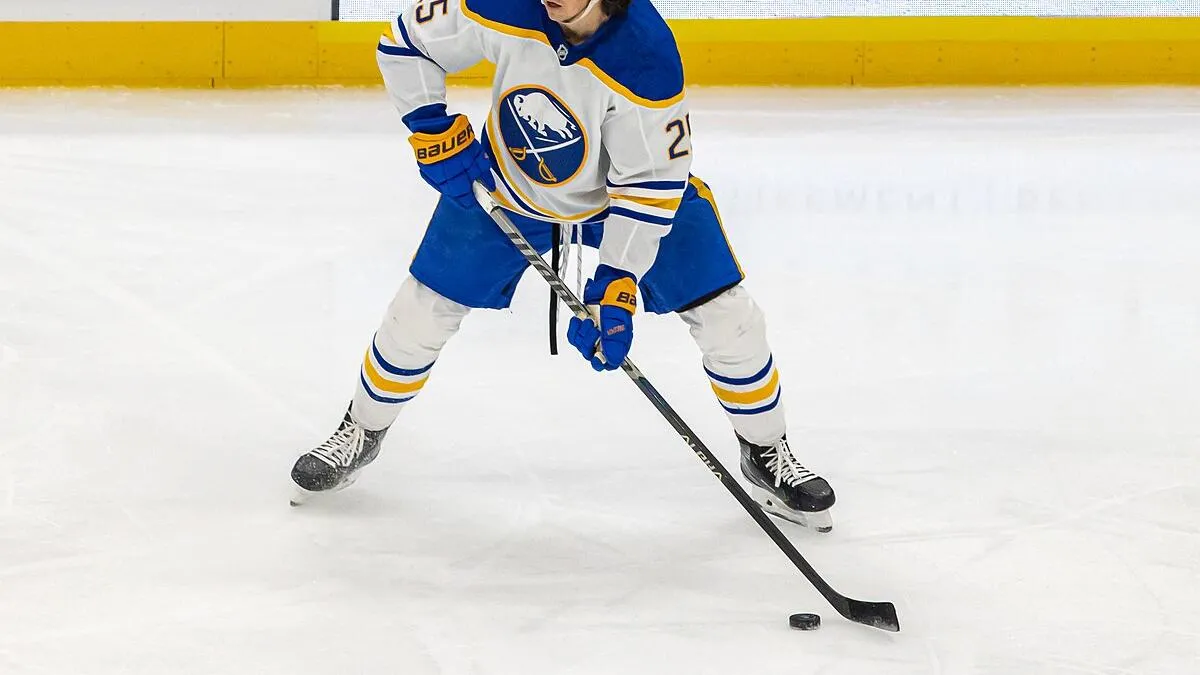
The physicality gap in Owen Power’s game
Owen Power’s struggles with Buffalo Sabres 2025 season expectations begin with his most obvious deficiency: an unwillingness to utilize his elite physical tools. Standing as one of the largest defensemen in the entire NHL, Power plays with the demeanor of a diminutive puck-mover rather than the imposing shutdown force his frame suggests he could become.
Mattias Samuelsson, a less heralded teammate, has surpassed Power in both production and physical presence through the early portions of the season. The sight of Samuelsson outscoring the first-overall pick has become a regular talking point among broadcast crews and podcasters covering the team. Power’s reluctance to engage along the boards or clear the front of the net has transformed from a developmental quirk into a serious liability that opponents actively exploit.
The eye test reveals a player who consistently loses puck battles he should dominate and allows smaller forwards to establish position in dangerous areas. As one scout noted in a recent evaluation, Power receives more criticism than perhaps warranted, but the critiques about his failure to leverage his size are entirely legitimate. This fundamental aspect of his game isn’t just a preference issue—it’s costing the Sabres goals on a weekly basis.
Offensive flashes mask defensive concerns
Owen Power struggles with Buffalo Sabres 2025 season defensive responsibilities despite his noticeable improvement in the offensive zone. His 40 points in 2024-25 set a new career high, and his playmaking ability from the back end remains among the best on the roster. Power’s vision and passing touch create legitimate scoring chances, particularly on the power play where his quarterbacking skills shine.
The defensive numbers tell a bleaker story. Power posted a minus-13 rating last season, the first negative plus/minus mark of his career. More concerning, this downturn occurred while his offensive production increased, suggesting his defensive positioning and awareness have actually regressed. Replays of goals against Buffalo have become a wicked exercise in spotting number 25 and identifying how far out of position he drifted.
His advanced metrics offer some reason for optimism. Power ranks second among regular Buffalo defensemen in 5-on-5 expected goals for percentage at 51.4%, trailing only Samuelsson’s 54.2%. He also limits scoring chances against effectively, allowing just 24.5 per 60 minutes at even strength. These underlying numbers indicate a player who can drive possession and limit quality opportunities when engaged.
The contract dilemma facing Buffalo management
The seven-year deal paying Owen Power significant money has transformed his development from a patient process into an urgent organizational priority. General manager Kevyn Adams faces mounting pressure to build a playoff contender after a 14-year absence from postseason hockey, and Power’s contract represents both a cornerstone commitment and a potential albatross if his play doesn’t elevate.
Buffalo’s front office must weigh Power’s potential against the reality of his current performance. The contract contains no trade protection until the 2029-30 season, giving the Sabres flexibility if they decide to move in a different direction. This reality has fueled speculation about whether Buffalo would be better served exploring the trade market for Power while his value remains relatively high.
The emergence of Bowen Byram as a more complete two-way defender has complicated Power’s standing within the organization. Byram’s physical edge and defensive reliability have made him a fan favorite and a more trusted option in critical situations. With J.J. Peterka and Devon Levi requiring new contracts in the coming years, Buffalo may face a difficult decision about whether they can afford to keep both Power and Byram long-term.
System fit and coaching challenges
Head coach Lindy Ruff entered the season with a stated goal of extracting more physicality from Power’s game, yet the results have been minimal. The coaching staff has experimented with different defensive partners, trying to find a complementary player who can cover for Power’s deficiencies while maximizing his offensive gifts.
The experiment of pairing Power with more defensively responsible partners has shown mixed results. When skating alongside veterans like Connor Clifton, Power’s offensive numbers have dipped as he focuses more on his own zone coverage. When paired with offensive-minded defensemen, the pair has created chances but also surrendered numerous odd-man rushes and high-danger opportunities.
Ruff’s system demands active defensemen who can make quick decisions under pressure, a skill set that should theoretically suit Power’s skating and puck-handling abilities. Yet Power’s hesitation in physical confrontations and occasional lapses in positioning have sometimes made him look like a poor fit for the aggressive style Buffalo wants to play.
Development timeline and external pressures
Owen Power struggles with Buffalo Sabres 2025 season expectations that stem directly from his draft pedigree. Selected first overall in a class that included future stars like Matty Beniers and Luke Hughes, Power’s development has been steady but unspectacular. At 22 years old, he still has time to grow, but the window for patience is closing rapidly in a results-driven league.
The Sabres’ recent trend of late-game collapses has put additional scrutiny on Power’s defensive zone coverage. In a recent 4-3 overtime loss to Columbus, Power’s positioning and decision-making came under fire from analysts, with some questioning whether he possesses the mental makeup to handle high-pressure situations. These moments, where the team needs its highest-paid players to deliver, have become defining tests for Power’s future in Buffalo.
External analysis has grown increasingly critical. NHL scouts have openly questioned whether Power can ever become the franchise defenseman the Sabres envisioned when they called his name first in 2021. The phrase “prove-it year” has been attached to this season repeatedly, creating a pressure cooker environment that has sometimes led Power to press rather than play his natural game.
What the numbers really say about Power
A deeper dive into Owen Power’s statistical profile reveals a more nuanced picture than the surface-level criticism suggests. His 40 points represented a significant step forward in production, and his shot generation (139 shots on goal) indicates a willingness to contribute offensively that should not be dismissed.
The disconnect between his advanced metrics and traditional stats tells a story of a player caught between two worlds. Power excels at generating expected goals and limiting chances against on a per-minute basis, but his actual on-ice results have lagged behind these indicators. This gap often suggests a player experiencing bad luck or playing through lineup instability, but in Power’s case, it may point to a fundamental issue with finishing plays defensively.
His playoff statistics remain a mystery, as Buffalo has failed to qualify for the postseason during his entire tenure. The organization and its fanbase have waited 14 years for playoff hockey, and every young player is measured by their ability to help end that drought. Power’s regular season development has been incremental, but the true test—performing on hockey’s biggest stage—remains an unanswered question.
The combination of age, size, and skill means Power still owns one of the higher ceilings in the organization. However, the gap between that ceiling and his current production has become a source of frustration for a fanbase desperate for any sign that the rebuild is finally bearing fruit. Recent performances suggest improvement, but the consistency required of top-pairing defensemen remains elusive.
Buffalo’s path forward with their young defenseman
The Buffalo Sabres front office must decide whether to double down on Owen Power’s development or explore alternative options while his trade value remains viable. The organization’s history of impatience with young talent complicates this decision, as does the reality that Power’s contract makes him a significant financial commitment regardless of his role.
Trading Power would represent a massive admission of defeat on a first-overall pick, but keeping him through the duration of his deal if he plateaus as a middle-pairing defender could hamstring the team’s ability to build a championship-caliber roster. The presence of younger, cheaper alternatives in the system adds another layer of complexity to the decision-making process.
Internal development must remain the priority. Power’s skating ability and hockey IQ are elite tools that cannot be taught, while his physical play and defensive positioning can be improved through coaching and experience. The Sabres have invested heavily in player development staff, and Power represents the ultimate test case for whether those investments are paying dividends.
The upcoming season will likely determine Power’s long-term future in Buffalo. Another year of statistical improvement without meaningful defensive growth may force management’s hand, while a true breakout campaign could validate their patience and cement his status as a foundational piece for the next decade. The stakes have never been higher for both the player and the organization.
For the Sabres to finally end their playoff drought and become legitimate contenders, they need Owen Power to evolve from a promising young defenseman into a legitimate number-one option. The talent is there, the opportunity is there, but the results have not followed. Time is running out for Power to prove he can be the player Buffalo thought they drafted, and the entire organization is watching to see if he can answer the call.
Frequently Asked Questions

Par Mike Jonderson
Mike Jonderson is a passionate hockey analyst and expert in advanced NHL statistics. A former college player and mathematics graduate, he combines his understanding of the game with technical expertise to develop innovative predictive models and contribute to the evolution of modern hockey analytics.