









The Pittsburgh Penguins have made another calculated move in their ongoing roster transformation, acquiring forward Yegor Chinakhov from the Columbus Blue Jackets in exchange for forward Danton Heinen and a package of draft picks. The trade, announced by president of hockey operations and general manager Kyle Dubas, sends a 2026 second-round pick and a 2027 third-round pick to Columbus while bringing the 24-year-old Russian winger to Pittsburgh.
This transaction represents the latest example of Dubas’s methodical approach to retooling the Penguins roster, balancing the need for youthful NHL-ready talent with his well-documented strategy of accumulating draft capital. Chinakhov, a former first-round selection who has shown flashes of offensive brilliance but struggled with consistency and coaching relationships in Columbus, now gets a fresh start with an organization that has successfully revitalized several careers in recent seasons.
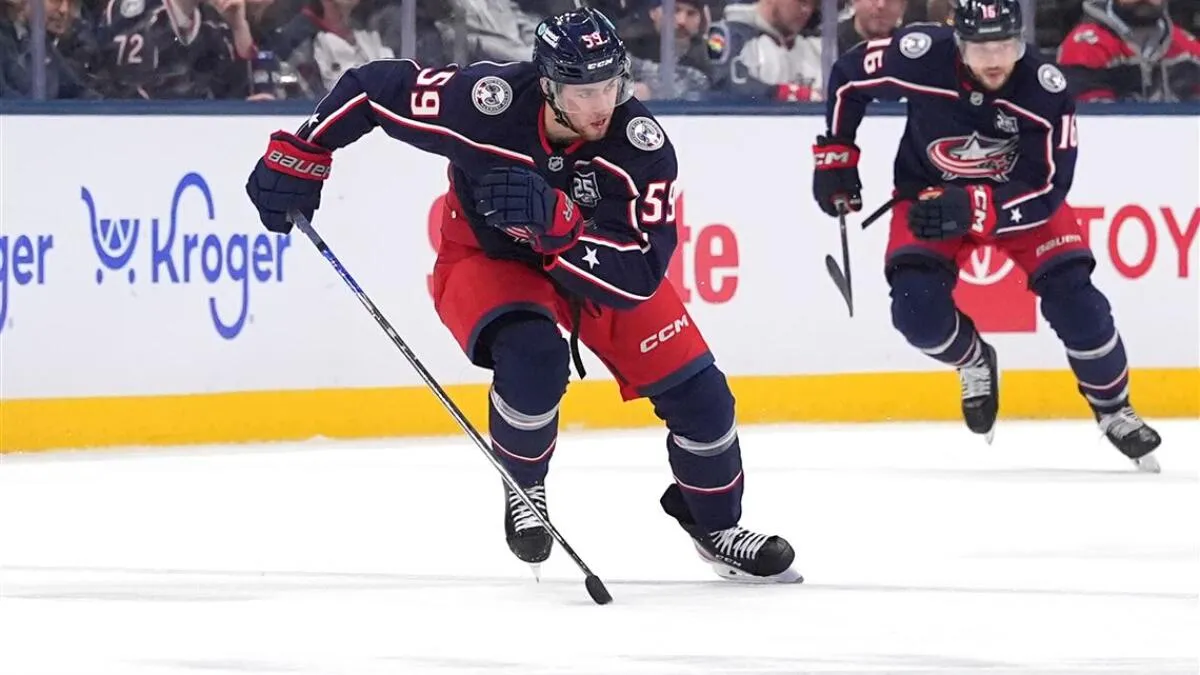
Breaking down the Pittsburgh Penguins acquisition of Yegor Chinakhov from Columbus Blue Jackets
Trade details and assets exchanged
The complete package finalized by the Pittsburgh Penguins to acquire Yegor Chinakhov from Columbus Blue Jackets includes three components: veteran forward Danton Heinen, who had just cleared waivers and was destined for AHL assignment; a 2026 second-round draft pick originally belonging to the St. Louis Blues; and a 2027 third-round selection that initially came from the Washington Capitals. This combination of an NHL-caliber player and mid-round future picks reflects the nuanced valuation of a young player with untapped potential.
Chinakhov arrives with a contract carrying a $2.1 million cap hit through the 2025-26 season, after which he will become a restricted free agent. This manageable financial commitment gives Pittsburgh flexibility while allowing them to evaluate his fit within their system before making long-term decisions. The Russian winger brings a physical profile at 6-foot-1 and 203 pounds, with the versatility to play either wing position and a left-handed shot that complements Pittsburgh’s existing forward group.
Who is Yegor Chinakhov?
Yegor Chinakhov’s hockey journey began in his hometown of Omsk, Russia, where he developed into a highly-touted prospect before catching the attention of NHL scouts. The Columbus Blue Jackets selected him 21st overall in the 2020 NHL Draft, betting on his combination of offensive skill and physical tools. His pre-North American resume includes a standout season in the KHL with Avangard Omsk, where he recorded 17 points (10 goals, 7 assists) in 32 games as a 19-year-old and earned the Alexei Cherepanov Award as the league’s top rookie.
Internationally, Chinakhov has represented Russia with distinction, capturing a silver medal at the 2019 World Under-18 Championship before competing at the 2021 World Junior Championship. These experiences against elite peer competition helped shape his development and provided exposure to high-pressure situations that translate to NHL readiness. His statistical production across five professional seasons in North America shows 37 goals and 40 assists in 204 NHL games, with an additional 13 points in 11 AHL contests.
Why the Pittsburgh Penguins targeted Yegor Chinakhov in this trade
Chinakhov’s skill set and playing style
Scouting reports consistently highlight Chinakhov’s exceptional shooting ability, with some assessments noting his shot velocity reaching the 99th percentile among NHL players. His offensive toolkit features quick puck movement, intelligent positioning, and strong play anticipation that allows him to disrupt opposition strategies effectively. The Penguins’ pro scouting department clearly identified these attributes as transferable to their system, where creating space for skilled shooters remains a priority.
What makes this acquisition particularly intriguing is Chinakhov’s underlying metrics that suggest greater potential than his counting stats indicate. His ability to generate scoring chances, particularly from high-danger areas, exceeds what his 3 goals and 3 assists in 29 games this season might suggest. Pittsburgh’s coaching staff, led by Mike Sullivan, has a track record of unlocking such potential by putting players in positions to succeed. The system’s emphasis on puck possession and structured zone entries could maximize Chinakhov’s natural shooting talent.
Intangibles and pedigree
Beyond the physical tools, Chinakhov brings a professional pedigree that aligns with Pittsburgh’s organizational standards. His experience in the KHL as a teenager demonstrates maturity and adaptability, qualities that the Penguins value highly. The fact that he earned rookie of the year honors in Russia’s top league indicates an ability to compete against older, more experienced competition—an attribute that should serve him well in the Metropolitan Division.
However, the move also comes with acknowledged challenges. Reports from Columbus indicated a strained relationship with head coach Dean Evason, with Chinakhov reportedly requesting a trade multiple times over recent months. While such situations can raise red flags, Pittsburgh’s management has shown confidence in their ability to integrate players from various backgrounds. The organization’s veteran leadership core, featuring Sidney Crosby and Evgeni Malkin, provides a stable environment for young players adjusting to new expectations.
How Yegor Chinakhov fits into the Penguins’ rebuilding strategy
Kyle Dubas’s long-term vision
The Pittsburgh Penguins acquisition of Yegor Chinakhov from Columbus Blue Jackets exemplifies Kyle Dubas’s broader strategy of acquiring undervalued assets while maintaining financial flexibility. Following the recent trade of goaltender Tristan Jarry that netted a 2029 second-round pick, Dubas has now positioned Pittsburgh with an remarkable 24 draft selections over the next three summers, including 19 in the first three rounds. No franchise possesses more premium draft capital in this window, giving the Penguins unprecedented options.
This approach mirrors successful rebuilds executed by other franchises, where accumulating picks provides both direct prospect acquisition and trade ammunition for impactful moves. As detailed in our analysis of previous trade negotiations, the Penguins previously resisted overpaying for young talent. The Chinakhov deal represents the opposite—acquiring a former first-rounder at a discount due to circumstances rather than performance.
Salary cap implications and roster flexibility
Chinakhov’s $2.1 million cap hit fits comfortably within Pittsburgh’s current structure, representing less than 2.5% of the total salary cap. This modest investment allows the Penguins to continue evaluating their roster without committing significant long-term money, preserving space for future extensions and free agent pursuits. The one-and-a-half seasons remaining on his deal align perfectly with the team’s competitive timeline, potentially bridging the gap between the current veteran core and the next wave of drafted talent.
The departure of Danton Heinen, while primarily a salary-matching move, also clarifies Pittsburgh’s forward depth chart. Heinen’s waiver clearance indicated he had fallen out of the immediate plans, making him expendable in a way that facilitated this trade. This efficient use of roster spots and cap space demonstrates Dubas’s ability to extract value from situations where other teams might see dead weight, a skill that will prove crucial as the Penguins navigate their transition.
What this trade means for both franchises
Pittsburgh’s perspective: Low-risk, high-upside move
From the Penguins’ standpoint, acquiring Yegor Chinakhov represents a calculated gamble with significant potential payoff. The investment—essentially two mid-round draft picks and a player headed to the minors—pales in comparison to the potential return if Chinakhov develops into a consistent top-nine forward. His age, physical profile, and draft pedigree suggest untapped potential that Pittsburgh’s development system is well-equipped to unlock.
The strategic timing also deserves attention. By adding Chinakhov now, the Penguins get an extended evaluation period before his restricted free agency, allowing them to make an informed decision about his long-term fit. If he thrives, they control his rights and can negotiate from a position of knowledge. If he struggles, the organization has lost minimal assets while maintaining their draft pick treasure chest. This asymmetric risk profile defines smart asset management in the modern NHL.
Columbus’s perspective: Turning discontent into assets
For Columbus, trading a former first-round pick who had requested multiple times to leave the organization represents a necessary, if disappointing, conclusion to a rocky relationship. The Blue Jackets convert a disgruntled player into tangible future assets, adding to their own collection of draft picks while bringing back Danton Heinen as a serviceable NHL depth option. General manager Don Waddell’s statement likely emphasized the importance of moving forward with players fully committed to the program.
The return also reflects the reality of trading a player whose value has diminished due to circumstances beyond pure on-ice performance. While Columbus fans might lament seeing a first-rounder depart for less than premium value, the alternative—keeping an unhappy player—often proves more damaging to team culture and individual development. The additional picks give the Blue Jackets more opportunities to find talent that fits their rebuilding timeline and coaching philosophy under Dean Evason.
Looking ahead, the Pittsburgh Penguins acquisition of Yegor Chinakhov from Columbus Blue Jackets could be remembered as a pivotal moment where Dubas’s patient strategy began yielding tangible results. The move adds youth, skill, and potential to a roster in transition without sacrificing the flexibility that makes Pittsburgh’s rebuild sustainable. For Chinakhov, the change of scenery offers a chance to prove his NHL capabilities in an environment that has historically embraced Russian talent and maximized offensive skill. As the Penguins continue accumulating assets and evaluating their young players, this trade may prove to be the model for how they bridge the gap between their championship past and their uncertain future.
Frequently Asked Questions

Par Mike Jonderson
Mike Jonderson is a passionate hockey analyst and expert in advanced NHL statistics. A former college player and mathematics graduate, he combines his understanding of the game with technical expertise to develop innovative predictive models and contribute to the evolution of modern hockey analytics.