

The Philadelphia Flyers franchise has cultivated a rich history spanning over five decades, producing some of the NHL’s most memorable players and moments. From the Broad Street Bullies era that defined toughness in the 1970s to the skilled offensive juggernauts of the late 1990s and 2000s, Philadelphia has consistently showcased elite talent that has left an indelible mark on hockey. Assembling an all-time roster from this storied franchise means selecting from Hall of Famers, Hart Trophy winners, and players who elevated the orange and black to championship glory.
Building the Philadelphia Flyers all-time lineup requires balancing different eras, playing styles, and positions to create the ultimate dream team. The franchise’s two Stanley Cup championships in 1974 and 1975 anchor much of this roster, but contributions from subsequent decades cannot be ignored. This comprehensive lineup examines the greatest Flyers players at every position, creating a team that would dominate any era of hockey.
First line: the legendary LCB combination
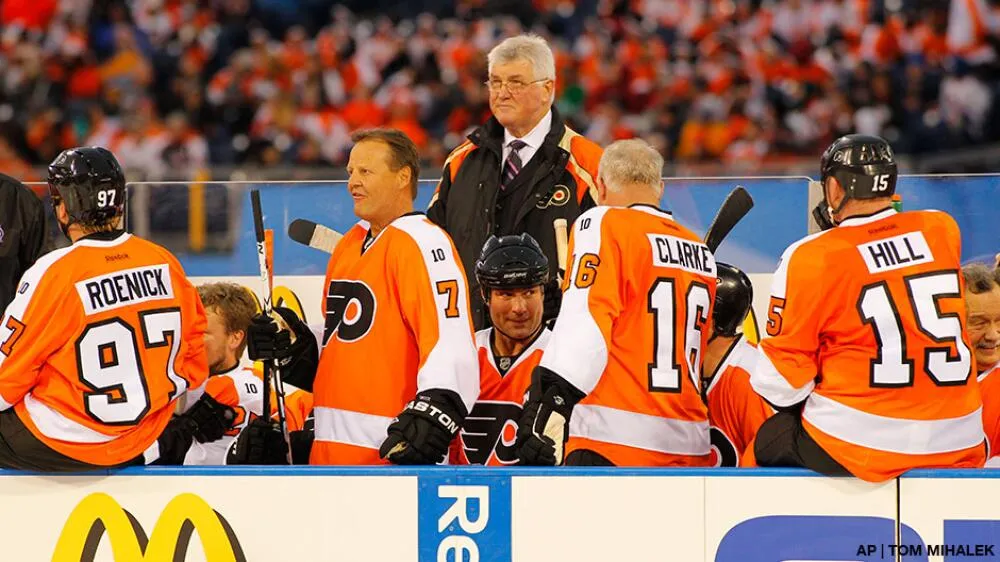
The Philadelphia Flyers all-time lineup begins with arguably the most famous line in franchise history—the LCB Line featuring Bill Barber, Bobby Clarke, and Reggie Leach. This trio combined chemistry, scoring prowess, and grit in a way few lines in NHL history have matched.
Bill Barber spent his entire 12-year career in Philadelphia, amassing 420 goals and 883 points in 903 games. His consistency as a goal-scorer made him one of the most reliable wingers of his generation. Barber’s ability to finish plays and his willingness to go to the dirty areas made him the perfect complement to Clarke’s playmaking abilities. He was inducted into the Hockey Hall of Fame in 1990, cementing his legacy as one of the game’s greats.
Bobby Clarke stands as the greatest player in Philadelphia Flyers history, a sentiment few would dispute. The heart and soul of the franchise during its championship years, Clarke won three Hart Trophies as the NHL’s Most Valuable Player and captained both Stanley Cup-winning teams. His 1,210 points in 1,144 games with Philadelphia remain a franchise record. Clarke’s two-way excellence, leadership, and competitive fire set the standard for what it meant to be a Flyer.
Reggie Leach provided the pure goal-scoring punch on this line. His 61-goal campaign in 1975-76 remains one of the most impressive offensive performances in franchise history. More remarkably, Leach won the Conn Smythe Trophy that season despite the Flyers losing in the Stanley Cup Final, scoring 19 goals in just 16 playoff games. His ability to find the back of the net from anywhere on the ice made him a constant threat alongside his linemates.
Second line: the Legion of Doom plus one
The Philadelphia Flyers all-time lineup’s second line combines the legendary Legion of Doom duo with one of the franchise’s most skilled and consistent performers. John LeClair and Eric Lindros dominated the mid-to-late 1990s, and adding Claude Giroux creates an almost unstoppable offensive unit.
John LeClair remains one of the most underappreciated American-born goal-scorers in NHL history. He became the last American player to score 50 goals in three consecutive seasons (1995-96 through 1997-98), accumulating 51, 50, and 51 goals in that stretch. During those campaigns, LeClair finished in the top five in league scoring and was consistently among the NHL’s elite wingers. His combination of size, speed, and finishing ability made him a nightmare for opposing defenders.
Eric Lindros would have been the undisputed greatest Flyer of all time had injuries not derailed his career. When healthy, Lindros was the most dominant power forward in hockey, winning the Hart Trophy in 1994-95 and recording a staggering 1.36 points per game with Philadelphia. His physical dominance, combined with elite offensive skills, revolutionized the power forward position. The infamous Scott Stevens hit in the 2000 playoffs fundamentally altered his career trajectory and the franchise’s fortunes.
Claude Giroux carried the Flyers organization through much of the 2010s, finishing top-three in league scoring three times during his tenure. His 1,000 points with Philadelphia place him second all-time in franchise history, trailing only Clarke. Giroux’s elite playmaking, combined with underrated goal-scoring ability, would make him the perfect setup man for LeClair and Lindros. This line would feature overwhelming size, skill, and hockey intelligence.
Third line: multi-era excellence
The third forward line in the Philadelphia Flyers all-time lineup showcases talent from three different decades, each player bringing unique qualities that made them franchise cornerstones.
Brian Propp deserves more recognition in Flyers lore than he typically receives. His 849 points rank fourth all-time in franchise history, and he was a consistent offensive producer who helped lead Philadelphia to three Stanley Cup Finals appearances. Propp’s ability to produce in big games and his consistency over 11 seasons with the club made him one of the most reliable forwards in team history.
Rick MacLeish often gets overlooked when discussing the Broad Street Bullies era, but his offensive contributions were vital to those championship teams. MacLeish became the first Flyer to record 100 points in a season alongside Clarke in 1972-73, and his 50-goal campaign that year helped establish Philadelphia as an offensive powerhouse. His 741 points with the Flyers place him among the franchise’s all-time leaders.
Mark Recchi holds the record for most points in a single season for the Flyers with 123 in 1992-93. Though he played for several teams during his Hall of Fame career, Recchi accumulated more points with Philadelphia than any other franchise. His vision, hockey IQ, and playmaking ability would make him the perfect center for this line, distributing pucks to dangerous finishers while contributing offensively himself.
Fourth line: skill meets sandpaper
The Philadelphia Flyers all-time lineup’s fourth line maintains offensive punch while adding physicality and two-way reliability that would wear down opponents.
Tim Kerr might be the most tragic “what if” story in Flyers history. Injuries limited him to just 655 career games, but when healthy, Kerr was one of the most dangerous goal-scorers in hockey. His 34 power-play goals in 1985-86 remains an NHL record, showcasing his dominance around the net. Had Kerr maintained his health throughout his career, he would likely be remembered among the greatest goal-scorers in NHL history.
Rod Brind’Amour exemplified two-way excellence during his time in Philadelphia, recording 601 points in 633 games before moving to Carolina, where he would win a Stanley Cup. His 200-foot game, faceoff prowess, and leadership made him one of the most complete centers in franchise history. Brind’Amour’s work ethic and defensive responsibility would anchor this line’s two-way play.
Rick Tocchet brought a rare combination of skill and toughness that perfectly embodied Flyers hockey. With 508 points and 1,815 penalty minutes in 621 games across multiple stints with Philadelphia, Tocchet could beat opponents with his fists or his stick. His physical presence and offensive ability made him one of the most versatile players in team history, and he was valued highly enough that the Flyers traded him away and then reacquired him years later.
Top defensive pairing: elite on both ends
The Philadelphia Flyers all-time lineup’s top defensive pairing features two players who dominated during their respective eras with the franchise.
Chris Pronger only played 145 games with Philadelphia, but his impact was profound. Despite the limited sample size, he finished in the top 10 for Norris Trophy voting twice and was the anchor of the defensive corps that reached the 2010 Stanley Cup Final. When Pronger suffered his career-ending injury in 2011-12, the Flyers never recovered, struggling to find a true number-one defenseman ever since. His physical presence, shutdown ability, and offensive contributions made him one of the most complete defensemen in hockey.
Eric Desjardins spent nearly a decade as the Flyers’ top defenseman, recording 396 points in 738 games while playing the majority of his tenure during the low-scoring dead puck era. He finished in the top 10 for Norris Trophy voting five times, showcasing his consistency as an elite two-way defenseman. Desjardins’ ability to move the puck, contribute offensively, and play sound defensive hockey made him one of the most reliable players in franchise history.
Second defensive pairing: balanced brilliance
The second pairing in the Philadelphia Flyers all-time lineup combines arguably the best defenseman in franchise history with a modern-era stalwart.
Mark Howe is widely considered the finest defenseman to ever wear a Flyers uniform. He finished second in Norris Trophy voting three times during his tenure and recorded 480 points in 594 games—an exceptional rate for a defenseman in any era. Howe’s hockey intelligence, skating ability, and two-way excellence made him a complete player who could dominate games without the physical intimidation of players like Pronger.
Kimmo Timonen provided steady, reliable defense throughout his eight seasons in Philadelphia. While he never won a Norris Trophy, Timonen was consistently among the league’s best all-around defensemen. His mobility, hockey sense, and underrated offensive abilities made him the perfect partner for Howe. Timonen’s professionalism and consistency earned him universal respect throughout the organization and fanbase.
Third defensive pairing: championship pedigree
The third defensive pairing features two brothers who were instrumental in Philadelphia’s Stanley Cup championships.
Jimmy and Joe Watson combined for 1,359 games in Flyers uniforms, providing stable, reliable defense throughout the 1970s. While neither possessed elite offensive skills, both played crucial roles on the championship teams of 1974 and 1975. Their understanding of one another as brothers translated to on-ice chemistry that helped solidify the Flyers’ defensive structure during their most successful era. Multiple All-Star appearances validated their contributions to the franchise.
Goaltending: championship excellence
The goaltending position in the Philadelphia Flyers all-time lineup features the greatest netminder in franchise history backed by a fierce competitor.
Bernie Parent remains the gold standard for Flyers goaltenders and may never be surpassed. His back-to-back Stanley Cup championships in 1974 and 1975 were driven by his exceptional goaltending. Parent posted a .932 and .918 save percentage in those regular seasons, then elevated his game further in the playoffs with a .933 and .924 save percentage. He won two Vezina Trophies and two Conn Smythe Trophies, making him the only player in NHL history to win the Conn Smythe in consecutive seasons.
Ron Hextall serves as the backup, though his credentials would make him the starter for most franchises. The winningest goaltender in Flyers history with 240 victories, Hextall brought an intensity and competitive fire that defined his era. He won the Conn Smythe Trophy in 1987 despite the Flyers losing in the Stanley Cup Final, becoming just the fifth player to win the award on a losing team. His willingness to fight and his exceptional puck-handling skills revolutionized the position.
Behind the bench: the architect of success
Fred Shero stands as the most important coach in Philadelphia Flyers history and deserves to lead this all-time lineup. His 308-151-95 regular-season record and two Stanley Cup championships remain unmatched in franchise history. Shero’s innovative approach to the game, including detailed scouting reports and morning skates, changed how hockey was coached. His ability to manage the personalities on the Broad Street Bullies teams while maintaining discipline and structure made him one of the greatest coaches in NHL history.
While other excellent coaches have patrolled the Flyers bench—including Pat Quinn, Mike Keenan, and Ken Hitchcock—none achieved the sustained success that Shero accomplished. His legacy extends beyond his championship victories to the way he fundamentally changed coaching methodology throughout the sport. Modern coaching still bears Shero’s fingerprints.
Honorable mentions and difficult omissions
The depth of talent throughout Philadelphia Flyers history means several exceptional players didn’t crack this all-time lineup. Simon Gagne was a consistent 40-goal threat and beloved for his loyalty to the franchise. Pelle Lindbergh won the Vezina Trophy in 1985 before his tragic death cut short what appeared destined to be a Hall of Fame career. Mark Streit, Danny Briere, and Keith Primeau all contributed significantly during their tenures but couldn’t unseat the legends ahead of them.
On defense, players like Derian Hatcher and Shayne Gostisbehere had strong periods with the team but lacked the sustained excellence of those selected. The forward depth proved particularly challenging, with legitimate stars like Rick MacLeish and Mark Recchi relegated to third-line duty on this all-time roster.
The goaltending position saw Roman Čechmánek’s brief but brilliant tenure fall short of the sustained excellence required. Steve Mason and Carter Hart have had their moments, but neither established the legacy necessary to challenge Parent or Hextall. The reality is that goaltending has been a position of relative weakness for Philadelphia compared to their forward and defensive depth.
The Philadelphia Flyers all-time lineup represents decades of hockey excellence, combining championship pedigree with individual brilliance across every position. From the Broad Street Bullies who established the franchise’s identity through sheer will and toughness to the skilled offensive stars who thrilled fans in subsequent decades, this roster captures what has made the Flyers one of the NHL’s most storied franchises. While modern iterations struggle to match the glory of past eras, today’s projected lineups continue building toward future success, hoping to add new legends who might one day crack this elite group.
This dream team would dominate any era with its combination of skill, toughness, and championship experience. Bobby Clarke centering Bill Barber and Reggie Leach would terrorize opposing defenses just as they did in the 1970s. The Legion of Doom enhanced by Claude Giroux’s playmaking would be virtually unstoppable. Behind them, Mark Howe and Chris Pronger would shut down the opposition’s best players while contributing offensively. And Bernie Parent, quite simply the best goaltender in franchise history, would provide the last line of defense. The Flyers faithful can take pride knowing their franchise has produced enough talent to compete with any organization’s all-time roster, a testament to over 50 years of hockey excellence in the City of Brotherly Love. When examining current lineup decisions, the legacy of these legends continues to influence how the modern team is built and evaluated.

Par Mike Jonderson
Mike Jonderson is a passionate hockey analyst and expert in advanced NHL statistics. A former college player and mathematics graduate, he combines his understanding of the game with technical expertise to develop innovative predictive models and contribute to the evolution of modern hockey analytics.