


The Philadelphia Flyers find themselves navigating a complex season with plenty of talent on the roster but inconsistent deployment across the lineup. Head coach John Tortorella has never been shy about tinkering with his lines, and November presents a critical month for the organization to maximize its assets. With the team hovering around playoff positioning in a brutally competitive Eastern Conference, identifying which players deserve expanded roles could be the difference between postseason hockey and another year on the outside looking in.
Several Flyers have shown flashes of brilliance but remain shackled by limited ice time or inconsistent lineup placement. Whether due to roster constraints, waiver exemptions, or coaching philosophy, talented players continue to watch significant portions of games from the bench. As the season progresses and injuries inevitably strike, the team needs to be proactive rather than reactive in recognizing who can contribute more consistently with increased opportunities.
Emil Andrae deserves a permanent roster spot among Philadelphia Flyers players who deserve more ice time in November
The Swedish defenseman has spent more time shuttling between Philadelphia and the American Hockey League than establishing himself as an NHL regular, despite compelling evidence that he belongs at the top level. Through limited appearances this season, Andrae has demonstrated precisely what the Flyers’ defense corps desperately needs: mobility, puck-moving ability, and intelligent decision-making in the breakout.
In his sparse 25 minutes of ice time across just two games early in the season, Andrae posted impressive underlying numbers that should have earned him a longer look. His expected goals percentage exceeded 70% in one contest, meaning the Flyers dominated possession and scoring chances when he was on the ice. Even more remarkably, he wasn’t on the ice for a single expected goal against in his other appearance, showcasing defensive responsibility to complement his offensive instincts.
Tortorella himself acknowledged Andrae’s value after one of those performances, noting that “his breakouts are really helping that part (of our game). Because sometimes we struggle getting that puck out with some execution, and he’s added that.” For a coach known for his defensive principles and reluctance to hand minutes to young players without earning them, that’s high praise indeed. The Flyers rank near the bottom of the NHL in offensive production, making Andrae’s ability to transition the puck from defense to offense even more valuable.
The primary obstacle keeping Andrae in the press box has been his waiver-exempt status. As the only defenseman on the roster who can be sent to the AHL without risking losing him to another team, he’s become the easy roster casualty whenever the Flyers need flexibility. However, this short-term thinking may be costing the team wins. Adam Ginning, a 25-year-old with minimal NHL experience, would almost certainly clear waivers if exposed, yet he’s occupied a roster spot over the more dynamic Andrae.
At 23 years old, Andrae needs consistent NHL minutes to continue his development. The constant yo-yo between leagues doesn’t benefit anyone—not the player, not the organization, and certainly not the Flyers’ playoff chances. November should mark the month where Philadelphia commits to giving their young defenseman the opportunity to prove he’s a legitimate top-six defenseman rather than organizational depth.
The concern about size—with Andrae joining Cam York and Jamie Drysdale as smaller defensemen—is overblown, especially since the three rarely play together. Modern NHL hockey increasingly values skating and transition ability over pure size, and Andrae possesses both qualities in abundance. His positioning and active stick compensate for any physical disadvantages, and his offensive instincts could unlock scoring chances for a team averaging the fewest shots per game in the league.
Matvei Michkov’s ice time situation needs addressing for Philadelphia Flyers players who deserve more ice time in November
The Russian rookie sensation arrived in Philadelphia with enormous expectations, and while his start has been bumpy, recent performances suggest he’s finding his rhythm precisely when the Flyers need offense most. Yet despite improved play, Michkov continues to receive limited minutes that don’t reflect either his talent level or his growing effectiveness.
Through the first portion of the season, Michkov has cleared 16 minutes of ice time just twice, with one of those barely exceeding the threshold by 15 seconds. His 13:41 against Calgary represented his third-lowest single-game total despite posting solid underlying numbers. For context, under former coach John Tortorella last season, Michkov averaged nearly 19 minutes through his first dozen games and exceeded 18 minutes four times—significantly more than his current deployment under the new regime.
The coaching staff’s initial hesitance made sense. Reports of a summer ankle injury emerged, and Michkov’s early performances showed a player still finding his way at the NHL level. Tortorella, who didn’t witness Michkov’s promising rookie campaign firsthand, understandably wanted to see sustained excellence before committing to expanded minutes. However, the tide has turned in recent weeks, with Michkov collecting four points in five games and demonstrating improved defensive awareness.
“He’s there, knocking on the door and he’s watching,” Tortorella observed after a victory over Nashville. “I give him a lot of credit… you know, sometimes you have to go get players all the time, but he’s there. That’s a great sign that he wants information. Then I can play him the last two minutes, three minutes of a game because he’s in his spot (defensively).”
Despite this praise, Michkov found himself starting a subsequent game alongside Christian Dvorak—a center who hasn’t reached 12 goals in any of his last four full seasons—and Rodrigo Abols, a 29-year-old journeyman with just five career NHL points. Asking a skilled offensive player to generate production with minimal supporting talent is counterproductive for both individual and team success.
Michkov’s advanced metrics paint a picture of a player trending in the right direction. After struggling with expected goals percentages below the team average in five of his first six contests, he’s posted numbers above that benchmark in three of his last six games. He’s adapting to the NHL’s pace and physicality while maintaining the creative playmaking ability that made him such a coveted prospect. Now the Flyers need to give him the ice time and linemates to maximize that talent.
The organization invested heavily in Michkov’s development, navigating complex international circumstances to bring him to North America ahead of schedule. Artificially limiting his opportunities with restrictive minutes and weak linemates wastes that investment. November represents a perfect opportunity to gradually increase his responsibilities, building toward the 18-20 minutes per night he’ll eventually handle as a franchise cornerstone. Every game spent playing 13-14 minutes is a missed opportunity for development and production.
Bobby Brink’s offensive instincts are being underutilized among Philadelphia Flyers players who deserve more ice time in November
Few players on the Flyers roster have demonstrated more natural scoring ability than Bobby Brink, yet he continues to find himself as a healthy scratch or relegated to bottom-six minutes despite producing whenever given opportunities. The 2019 second-round pick has posted 27 points in just 37 career NHL games, an impressive rate that suggests legitimate top-six potential if deployed consistently in that role.
Brink’s offensive awareness and finishing ability make him a natural complement to playmakers, yet he’s frequently found himself on third-line combinations with defensively-oriented centers. This deployment doesn’t leverage his strengths—Brink succeeds when he has quality centermen who can create space and distribute pucks to dangerous areas. Stuck on checking lines, his goal-scoring talent becomes marginalized.
The Flyers’ struggles generating offense make Brink’s healthy scratches particularly puzzling. When a team ranks last in shots per game and near the bottom in scoring chances created, every skilled offensive player should be in the lineup, not watching from the press box. Brink’s shooting percentage might not be sustainable over a full season, but his ability to get into scoring positions and convert chances is exactly what Philadelphia needs.
Like Andrae, Brink has suffered from being waiver-exempt, making him an easy roster move when the team needs flexibility. However, this organizational convenience shouldn’t trump on-ice merit. Veterans occupying roster spots haven’t consistently outperformed Brink, yet they receive preferential treatment due to contract status rather than current production.
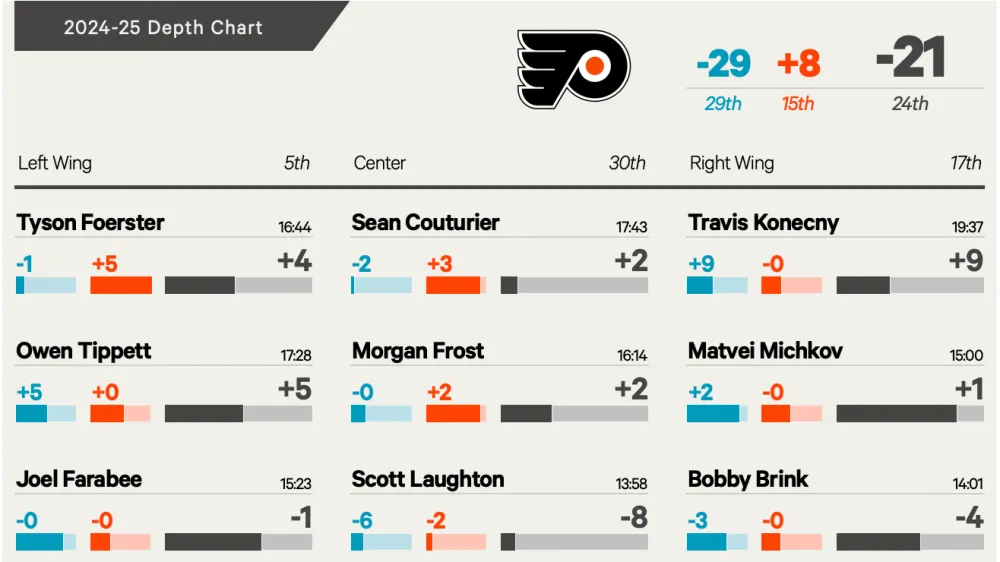
November should mark a shift in philosophy. Rather than viewing Brink as the 13th or 14th forward who rotates in and out of the lineup based on matchups, the Flyers need to commit to him as a top-nine fixture. This means pairing him with centers who can maximize his talents—players like Morgan Frost, whose playmaking ability could unlock Brink’s scoring touch. Consistency breeds confidence, and confidence breeds production, particularly for young offensive players still establishing themselves.
The longer the Flyers wait to fully integrate Brink into regular duty with quality linemates, the more they risk stunting his development. He’s reached the stage where he needs consistent NHL minutes to continue improving, not sporadic appearances that prevent him from finding any rhythm. If the organization truly believes he’s part of their future, November needs to be when they prove it with ice time and opportunity.
Egor Zamula’s steady presence warrants more trust for Philadelphia Flyers players who deserve more ice time in November
While not flashy, Egor Zamula has quietly become one of the Flyers’ most reliable defensemen, yet his ice time doesn’t always reflect his consistent contributions. The 24-year-old Russian has collected four points in five games during one stretch, demonstrating an ability to contribute offensively while maintaining defensive responsibility—exactly the type of two-way production Philadelphia needs from its blue line.
Zamula’s advanced statistics consistently place him among the team’s better defensemen in puck possession metrics. He doesn’t make spectacular plays that generate highlight reels, but he makes the simple, correct decisions that keep the puck moving in the right direction. In an era where analytics increasingly validate the importance of transition defense and controlled exits, Zamula’s skill set becomes more valuable than traditional evaluation might suggest.
The Flyers’ defensive corps features several players with higher profiles and larger contracts, which sometimes results in Zamula receiving fewer minutes despite comparable or superior performance. This organizational hierarchy based on investment rather than merit can be counterproductive, especially when the goal is winning games rather than justifying past decisions. Zamula has earned the right to play 18-20 minutes per night based on his body of work.
His chemistry with various defensive partners has been noteworthy, as Zamula adapts his game to complement whoever he’s paired with. This versatility makes him valuable throughout the lineup—he can anchor a second pairing or provide stability to a third pairing depending on the situation. Players who make their partners better should be rewarded with expanded opportunities, not taken for granted.
November’s increased schedule intensity will test the Flyers’ defensive depth, making Zamula’s reliability even more crucial. Rather than being the defenseman who absorbs reduced minutes when the coaching staff wants to ride their top pairs harder, Zamula should be trusted as a legitimate top-four option capable of handling tough matchups. His steady presence won’t generate headlines, but it will contribute to winning hockey.
Morgan Frost needs a legitimate opportunity among Philadelphia Flyers players who deserve more ice time in November
Few Flyers have experienced more dramatic fluctuations in deployment than Morgan Frost, whose role seems to change weekly despite possessing clear NHL talent. The skilled center has shown flashes of being a legitimate second-line pivot with playmaking ability that creates chances for linemates, yet he continues to receive inconsistent ice time that prevents him from establishing any rhythm or confidence.
Frost’s situation epitomizes the challenge facing the Flyers’ forward group—plenty of skill but no clear structure for maximizing it. He’s capable of running a power play, distributing pucks in transition, and creating offense through the neutral zone, yet he’s frequently deployed in checking roles alongside grinding wingers. This mismatch between player strengths and lineup deployment wastes talent the Flyers can’t afford to squander.
The coaching staff’s concerns about Frost’s defensive consistency and physical play aren’t entirely unfounded. He’ll never be mistaken for a Selke Trophy candidate, and his slight frame limits his effectiveness in board battles. However, these limitations shouldn’t overshadow his offensive contributions, particularly for a team desperately needing goals. The solution isn’t benching Frost or limiting his minutes—it’s surrounding him with complementary players who can cover his weaknesses while he leverages his strengths.
Tortorella acknowledged trying various combinations with Frost, noting “Frosty, I tried all three of those together, and I tried two of them together. It just hasn’t worked right now.” This constant line juggling, however, prevents anyone from developing chemistry. Offensive players often need 10-15 games together to build the timing and anticipation that generates sustained production. Changing combinations every few games guarantees mediocrity.
November should represent a fresh start for Frost, with the coaching staff committing to a specific role and linemates for an extended period. Whether that’s as a second-line center with skilled wingers or a third-line center tasked with driving offense in a sheltered role, the key is consistency. Let Frost play 15-17 minutes per night with the same linemates for three weeks and evaluate the results. The constant shuffling serves no one’s interests and prevents the team from accurately assessing what they have.
The Flyers’ season hangs in the balance as November unfolds, with playoff positioning in a tightly-packed Eastern Conference coming down to maximizing every available resource. The players discussed here represent untapped potential—talent that could elevate the team’s performance if given appropriate opportunities. Emil Andrae’s puck-moving ability, Matvei Michkov’s offensive creativity, Bobby Brink’s finishing touch, Egor Zamula’s steady reliability, and Morgan Frost’s playmaking skills all address specific team needs. The question is whether the coaching staff and management will recognize these solutions before inconsistent deployment costs valuable points in the standings. November offers the perfect opportunity to make these adjustments before the playoff race intensifies further.

Par Mike Jonderson
Mike Jonderson is a passionate hockey analyst and expert in advanced NHL statistics. A former college player and mathematics graduate, he combines his understanding of the game with technical expertise to develop innovative predictive models and contribute to the evolution of modern hockey analytics.