






The Buffalo Sabres ventured into Ball Arena on Thursday night knowing they faced an uphill battle against the NHL’s best team. What transpired was a familiar story for a franchise mired in mediocrity: flashes of competitiveness overshadowed by critical mistakes and an inability to close out games. The Colorado Avalanche, riding a wave of momentum with four consecutive wins entering the contest, extended their streak to five with a convincing 6-3 victory over the struggling Sabres.
Despite erasing an early three-goal deficit and briefly tying the game in the second period, Buffalo’s valiant effort crumbled in the final frame. The loss marked the team’s fifth consecutive defeat and fourth straight in regulation, plunging them deeper into the Eastern Conference basement. With just six wins through their first 18 games, the Sabres’ playoff drought threatens to extend to an unconscionable 15th season.
Defensive breakdowns plague the Sabres’ road struggles in three-takeaways-from-Sabres-6-3-loss-to-Avalanche
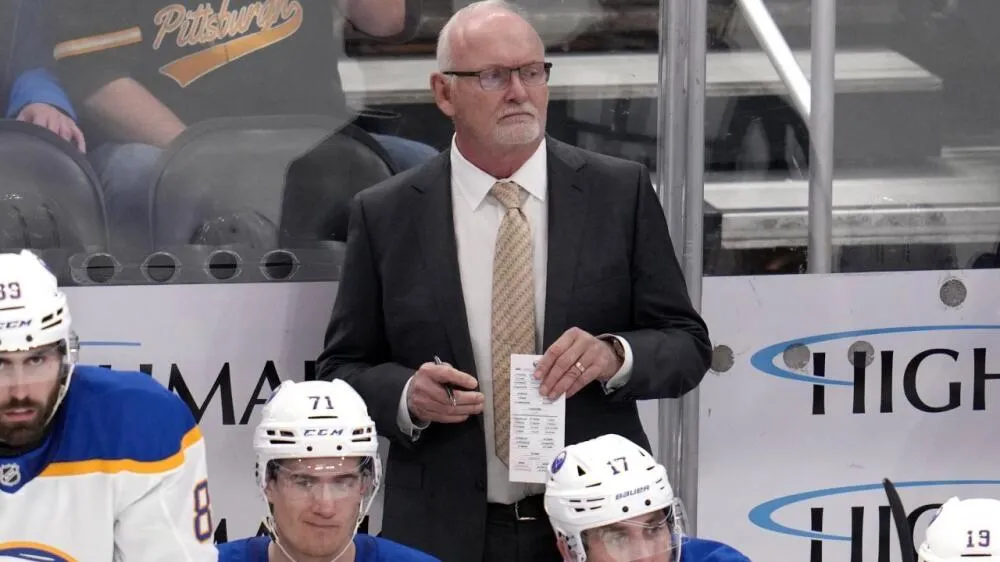
The opening minutes of the game set an ominous tone that would ultimately define Buffalo’s evening. Just 52 seconds into the first period, Martin Necas exploited a defensive miscue to score on a breakaway, catching the Sabres flat-footed. Before the team could regain its composure, Artturi Lehkonen doubled Colorado’s advantage at the 5:47 mark, prompting head coach Lindy Ruff to pull starting goaltender Alex Lyon in favor of Ukko-Pekka Luukkonen.
Ruff’s decision wasn’t an indictment of Lyon’s performance but rather a tactical timeout disguised as a goalie change. “Taking the goalie out was to buy me some time and talk to the team for a second, to get organized and say, ‘We’re going to get back in this game,’” Ruff explained post-game. The move provided the necessary jolt, as Bowen Byram scored less than two minutes later to cut the deficit to one.
However, defensive lapses continued to haunt the visitors throughout the contest. Brock Nelson restored Colorado’s two-goal cushion before Jordan Greenway responded with his first goal of the season, assisted by Owen Power’s well-placed chip-in. The pattern of trading goals showcased Buffalo’s offensive capabilities but also highlighted their defensive fragility against elite competition.
The most costly breakdown occurred late in the second period, just 1:26 after Tage Thompson’s power-play goal had tied the game at 3-3. Gavin Brindley scored on a rush that saw the puck deflect off Power’s stick, changing direction and befuddling Luukkonen. “It’s tough to read those, because you have a read on the guy where he’s shooting it, then it goes somewhere completely different,” Luukkonen lamented. That goal proved to be the dagger, as Buffalo never recovered the momentum.
The Sabres’ road woes have become a defining characteristic of their season. They remain winless away from KeyBank Center, consistently finding themselves within striking distance but unable to deliver the knockout punch. Similar to their recent 5-2 collapse at Utah, Buffalo showed flashes of competitiveness before succumbing to their opponent’s superior execution.
Ruff acknowledged the pattern after the game, noting, “We’ve been, in every road game, within a goal (late), and haven’t pushed through yet.” For a team desperately seeking answers, close losses offer little consolation. The defensive breakdowns that plagued them in Denver are symptomatic of larger systemic issues that have prevented the Sabres from taking the next step in their development.
Young players step up amid injury adversity in three-takeaways-from-Sabres-6-3-loss-to-Avalanche
While the final score tells a disappointing story, the performance of Buffalo’s younger players provided glimpses of hope amid the gloom. Isak Rosen, thrust into an elevated role due to injuries to Jason Zucker, Rasmus Dahlin, Zach Benson, and Jiri Kulich, has responded admirably to the increased responsibility. Against Colorado, Rosen logged a season-high 17:33 of ice time and recorded an assist on Thompson’s power-play goal, bringing his total to five points in six games.
Ruff showed confidence in his young forward by inserting him onto the first power-play unit alongside fellow youngster Noah Ostlund. The gamble paid immediate dividends, as Rosen delivered a precise feed to Thompson for a one-timer from the top of the circle that tied the game at three. The connection between the veteran sniper and the emerging playmaker demonstrated the chemistry that can develop when young players are given meaningful opportunities.
“We changed things around, we moved the puck quicker, we were a lot more direct,” Ruff said of the revamped power play. “That’s a lot of pressure on two young kids to play on the power play, but I thought they did a good job.” The unit’s success snapped an 0-for-13 drought dating back to October 30, providing a rare bright spot in an otherwise frustrating stretch.
Rosen’s emergence comes at a critical juncture for the organization. With key veterans sidelined and the team hemorrhaging points in the standings, younger players must accelerate their development curves. Rosen has embraced the challenge, showcasing the offensive instincts and playmaking ability that made him a first-round selection. His willingness to attack space and create opportunities for linemates has earned him additional ice time and power-play responsibilities.
Beyond Rosen, other young contributors have tried to keep the team afloat during this tumultuous period. The injuries have forced Ruff to rely on depth players who might otherwise be seasoning in the AHL. While the results haven’t translated into wins, these extended looks at prospects could prove valuable for long-term roster construction. The organization needs to identify which young players can handle regular NHL minutes and which require additional development time.
The challenge moving forward will be balancing the developmental needs of young players with the urgency of salvaging a rapidly deteriorating season. Buffalo cannot afford to punt on 2025-26 entirely, yet asking rookies and sophomores to carry the offensive load against teams like Colorado is unrealistic. Finding that equilibrium will determine whether the Sabres can stabilize their season or whether they’ll spiral into another lost year.
Third-period collapses and finishing issues define three-takeaways-from-Sabres-6-3-loss-to-Avalanche concerns
Perhaps the most troubling trend for Buffalo has been their inability to finish games with any semblance of competitiveness. The Sabres entered Thursday’s contest with a -8 goal differential in third periods, a damning statistic that reflects their tendency to fade down the stretch. Against Colorado, they managed to keep the game within one goal until the final three minutes, but Necas’s empty-net insurance goal at 18:11 and Gabriel Landeskog’s empty-netter with 1:49 remaining sealed their fate.
Thompson acknowledged the team’s improved puck possession after the disastrous start, noting, “We did a good job on our breakouts, possessing the puck. I think we had some shifts where we were possessing in the O-zone, had bodies and traffic at the net and had some second opportunities.” Yet possession without results is merely an exercise in moral victories, something a franchise in its 14th consecutive season without playoff hockey cannot afford to celebrate.
The late power play in the third period represented Buffalo’s best opportunity to tie the game and force overtime. With the Avalanche defending a one-goal lead, the Sabres generated a pair of quality scoring chances but couldn’t convert. Moments later, Necas capitalized on the momentum shift, burying his second goal of the game to effectively end any hopes of a comeback. For a team desperate for confidence-building wins, these missed opportunities carry compounding consequences.
Jordan Greenway summed up the collective frustration in his post-game comments: “We’ve been fighting it a little bit the past couple of games, so, yeah, two points would’ve been huge for us. Couldn’t find a way to do it, so we’ve got to move on to Detroit.” The sentiment captures Buffalo’s current predicament—close enough to taste success but unable to actually achieve it. In the NHL’s hyper-competitive landscape, moral victories mean nothing. Teams either find ways to win or they find themselves picking in the lottery once again.
The inability to close out games traces back to multiple factors: inexperience, lack of finishing talent, questionable lineup decisions, and perhaps most concerningly, a losing culture that has permeated the organization for over a decade. When adversity strikes, championship-caliber teams lean on veteran leadership and proven systems. The Sabres, by contrast, seem to retreat into familiar patterns of passive play and defensive breakdowns.
Colorado’s late surge exemplified the difference between contenders and pretenders. While the Avalanche have their own concerns following earlier losses, they’ve addressed those issues during their current five-game winning streak. They possess the depth, talent, and championship pedigree to execute in crucial moments. Buffalo, lacking all three elements, continues to search for an identity that can translate potential into tangible results.
Power-play adjustments provide temporary reprieve in three-takeaways-from-Sabres-6-3-loss-to-Avalanche analysis
One of the few positives to emerge from Thursday’s defeat was the power play’s temporary resurgence. After enduring an 0-for-13 slump spanning five games, the Sabres finally cracked through with Thompson’s one-timer from the left circle. The goal came courtesy of Ruff’s personnel changes, which saw Rosen and Ostlund join the top unit to inject fresh energy and movement.
The revamped configuration emphasized puck movement and shooting mentality over the perimeter passing that had plagued previous attempts. Rosen’s quick feed to Thompson demonstrated the potential benefits of incorporating younger, more dynamic players into special teams units. The goal provided a much-needed jolt of confidence for a power play that had become predictable and stagnant.
However, context matters when evaluating special teams success. Buffalo went 1-for-2 on the power play, but their failure to convert the late third-period opportunity proved costly. Against elite teams, special teams excellence isn’t measured by occasional success—it requires consistency and clutch execution. The Sabres showed improvement in structure and puck movement, but translating those process gains into consistent results remains an ongoing challenge.
Thompson’s performance deserves special attention, particularly given his positional switch back to center. After struggling at wing during the previous game in Utah, where he was moved to accommodate Ryan McLeod, Thompson reclaimed his natural position and delivered a two-point night. He won 11 of 17 faceoffs and looked significantly more comfortable with the puck on his stick. “For me, I like being in the middle,” Thompson stated emphatically. “You can carry the puck and kind of dictate the pace of the game, and I feel like it just gets me involved in the play more.”
The decision to move Thompson away from center had been puzzling from the outset, as he’s demonstrated his effectiveness at that position throughout his career. Thursday’s performance validated the importance of utilizing your best players in their optimal roles—a lesson Ruff seemed to relearn in real-time. Moving forward, keeping Thompson at center should be non-negotiable, especially given the team’s desperate need for offensive production.
The existential crisis facing Buffalo hockey
Beyond the X’s and O’s of Thursday’s loss lies a more profound crisis threatening the franchise’s foundation. At 6-10-2 through 18 games, the Sabres sit eight points out of an Atlantic Division playoff spot and six points behind the Wild Card cutline. Given their current trajectory, both deficits could balloon to double digits before Thanksgiving. The playoff drought, now guaranteed to reach at least 14 seasons, shows no signs of ending.
The real concern transcends this season’s results and touches on the long-term viability of the core. Will Thompson or Dahlin eventually request trades, unwilling to sacrifice their prime years to a perpetually rebuilding franchise? Can the organization convince Alex Tuch to re-sign with the team he grew up supporting, or will he seek greener pastures elsewhere? These questions loom larger with each passing loss, threatening to unravel years of patient roster construction.
The pattern of extended losing streaks has become a defining characteristic of Sabres hockey. Fans remember the 18-game skid in 2020-21, the 14-game disaster during the Connor McDavid lottery year, and last season’s 13-game collapse that extinguished playoff hopes in December. Now, having lost eight of their last nine games with five consecutive defeats, another season-defining streak appears inevitable unless drastic changes occur.
The leadership void within the locker room is palpable. Championship teams feature veterans who can steady the ship during turbulent stretches, but Buffalo’s roster lacks those proven winners. Players who have experienced sustained success at the NHL level can draw upon that experience to guide younger teammates through adversity. The Sabres, by contrast, have assembled a group that knows only losing, creating a self-perpetuating cycle of mediocrity that’s proven nearly impossible to escape.
The franchise stands at a crossroads. Management must decide whether to double down on the current core, acknowledging that patience has worn dangerously thin, or begin the painful process of tearing down and rebuilding once again. Neither option offers immediate gratification, but continuing the status quo guarantees more of the same disappointing results that have characterized the past decade and a half.
As the Sabres prepare for Saturday’s game in Detroit, the immediate focus must be on finding any way to secure two points and halt the bleeding. But the larger questions facing the organization—about leadership, culture, roster construction, and competitive viability—demand answers that extend far beyond a single game’s outcome. Until those fundamental issues are addressed, Buffalo’s hockey fans will continue watching their team find new and creative ways to disappoint, one painful loss at a time. The game recap and official NHL coverage provide additional details on a night that perfectly encapsulated the franchise’s current predicament: competitive enough to tease hope, but ultimately lacking the finishing ability to turn potential into reality.
Frequently Asked Questions

Par Mike Jonderson
Mike Jonderson is a passionate hockey analyst and expert in advanced NHL statistics. A former college player and mathematics graduate, he combines his understanding of the game with technical expertise to develop innovative predictive models and contribute to the evolution of modern hockey analytics.