







The San Jose Sharks’ decision to make John Klingberg a healthy scratch in November 2025 sent ripples through the hockey community, raising questions about the veteran defenseman’s future and the team’s strategic direction. At 33 years old and signed to a one-year, $4 million contract, Klingberg finds himself at a crossroads—not just with the Sharks, but potentially with his NHL career. The benching against the Utah Mammoth wasn’t merely punitive; it represented a carefully calibrated move by head coach Ryan Warsofsky to address both on-ice performance and locker room dynamics during an unexpectedly competitive season.
Through 14 games this season, Klingberg has posted modest numbers: two goals, three assists, and a concerning minus-5 rating. For a player brought in specifically to quarterback the power play and stabilize the transition game, these statistics fall short of expectations. The scratching reflects the Sharks’ commitment to a merit-based system where reputation doesn’t guarantee ice time, especially as the franchise balances rebuilding with a surprising flirtation with the playoff picture at 10-8-3 through 21 games.
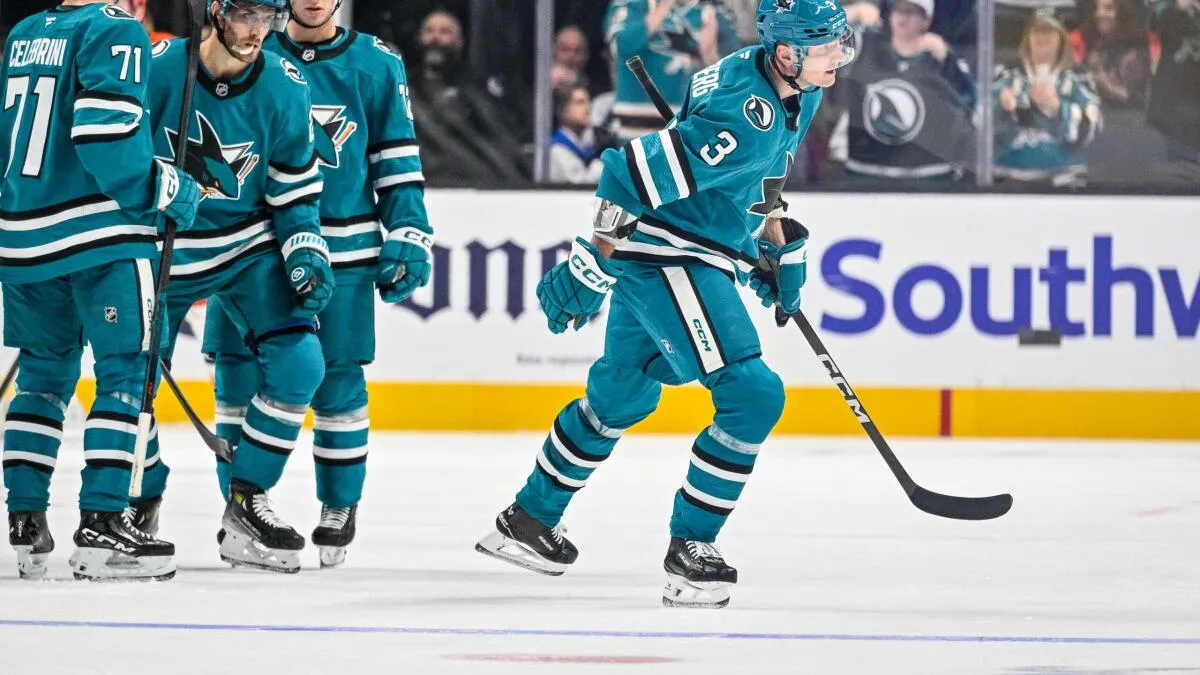
The context behind the healthy scratch decision
Warsofsky’s choice to sit Klingberg emerged after a particularly difficult performance against the Seattle Kraken, where the defenseman finished minus-3 and the power play sputtered at 1-for-6. These moments crystallized concerns about Klingberg’s style clashing with modern NHL systems. The league has evolved toward a relentless north-south game, emphasizing speed, direct transitions, and getting pucks deep—areas where Klingberg’s traditional east-west approach has created friction.
The veteran himself showed remarkable self-awareness in post-scratch interviews. “It looks careless from the outside,” Klingberg admitted candidly, adding that his attempts to force plays have occasionally looked like “shit.” This honesty reveals a player who understands his struggles but hasn’t yet found the solution. He identified his primary issue as “chasing the game”—pressing too hard to create offense when patience would serve him better.
Warsofsky’s “earn it” philosophy in action
The Sharks’ head coach has established a clear meritocracy since taking over, and the Klingberg benching serves as the most public example of this principle. Warsofsky described Klingberg accurately as a “risk-and-reward type of defenseman,” but noted bluntly: “We really haven’t got a lot of that reward.” This assessment reflects the harsh mathematics NHL coaches must perform daily: when offensive production stalls, defensive liabilities become impossible to ignore.
The timing also sent a message to the entire roster. With several NHL-caliber defensemen competing for limited spots, scratching a veteran of Klingberg’s stature demonstrated that internal competition is genuine. It allowed prospect Sam Dickinson to draw back into the lineup, showcasing the organization’s commitment to player development alongside winning games. The move proved Warsofsky’s “earn it” mantra from training camp wasn’t just empty rhetoric.
Technical breakdown: Where Klingberg’s game has faltered
Klingberg’s struggles stem from a fundamental disconnect between his instincts and the modern NHL’s demands. Historically a player who thrives on lateral movement, walking the blue line, and creating lanes through patience, he now faces forechecking systems that punish such hesitation. As he noted in his self-assessment, “The game has changed a little bit since I came into the league. There’s so much more north-south now.”
The Sharks’ system under Warsofsky particularly emphasizes limiting high-danger chances against. When Klingberg attempts to create from the defensive blue line, turnovers frequently result in odd-man rushes the other way. These obvious mistakes—beloved by highlight reels but loathed by coaches—have forced Warsofsky to reevaluate deployment strategies.
Power play performance and underlying metrics
While Klingberg remains on the Sharks’ top power-play unit alongside Macklin Celebrini, Will Smith, Alexander Wennberg, and William Eklund, the results haven’t matched the talent on paper. The defenseman acknowledged the power play has been “okay” but stressed the need for more secondary opportunities. His observation that “we’re getting in the zone” but not creating enough subsequent chances points to a larger systemic issue.
At five-on-five, the problems compound. His minus-5 rating reflects not just isolated mistakes but a pattern of getting caught in transition. The 33-year-old recognizes this: “I’m trying to create a little bit too much, and that’s when those obvious mistakes happen. The puck goes the other way.”
The human element and psychological reset
Beyond the X’s and O’s, the healthy scratch addressed crucial psychological factors. Klingberg admitted the benching “sucks”—exactly the reaction Warsofsky wanted. A content player in the press box signals acceptance of mediocrity, whereas frustration indicates competitive fire remains. The coach welcomed Klingberg’s disappointment, viewing it as essential friction for a competitive culture.
Self-awareness and mental approach
Klingberg’s introspection reveals a player at war with his own instincts. “I know my game. It’s the same for every player; if you think too much, it doesn’t work,” he explained. “That’s when you play at your best—when you don’t think at all.” This wisdom, however, conflicts with his admission that he’s been overthinking and forcing plays.
The mental reset Warsofsky imposed forced Klingberg to confront these contradictions. Rather than dwelling on mistakes, the veteran now focuses on simplifying his approach. His plan moving forward centers on “playing the simple game and then just letting the game take over,” building confidence gradually rather than seeking immediate glory.
Asset management and organizational strategy
General manager Mike Grier’s masterplan adds another layer to the Klingberg situation. Signed as a one-year bridge piece, Klingberg serves two purposes: helping the team remain competitive while developing young talent, and accumulating trade assets for the future. He represents one of five Sharks defensemen on expiring contracts, making his performance critical for deadline flexibility.
Trade value implications
If Klingberg continues struggling, his trade value evaporates—disastrous for a franchise executing a strategic rebuild. A healthy scratch in November, however, provides an opportunity to rehabilitate his game before February’s trade deadline. The Sharks need him to demonstrate enough value to contenders seeking offensive defensemen for playoff runs.
The organization can’t afford another season where veteran assets depreciate to zero. Previous deadline decisions have left the Sharks asset-poor, and Grier’s regime is determined to maximize return on every investment. Klingberg’s $4 million cap hit is manageable for contenders if he can produce at even a 40-point pace while limiting egregious errors.
What the reset means for San Jose’s future
Klingberg’s return to the lineup against Los Angeles—immediately restored to the top power-play unit—signals the scratching achieved its purpose. Warsofsky sent his message, Klingberg received it, and now both parties move forward with clarified expectations. The slate isn’t just clean; it’s been recalibrated with specific parameters for success.
The road ahead for player and team
For Klingberg, the path forward requires embracing a paradox: the star defenseman must play a smaller game to make a bigger impact. By putting pucks deep and letting forwards create offense, he can reduce catastrophic mistakes while still contributing offensively through supporting play. His joy for the game, previously discussed with media, must now manifest in disciplined simplicity rather than highlight-reel creativity.
For the Sharks, this situation tests Warsofsky’s ability to manage veteran personalities while maintaining team-first culture. If Klingberg responds positively, it validates the coaching staff’s methods and strengthens internal competition. If struggles persist, it may force Grier’s hand earlier than anticipated, potentially exploring trade options before the deadline rather than at it.
Broader implications for rebuilding teams
San Jose’s handling of Klingberg offers a case study in modern team-building. Rebuilding franchises often sign veterans as placeholders, but the Sharks are demanding more than mere competence. They’re using each roster spot, regardless of contract or reputation, to reinforce cultural standards. This approach—competitive rebuilding—might become a blueprint for other organizations caught between development and contention.
The Sharks’ surprising competitiveness adds urgency to every decision. At 10-8-3, they’re not in tank mode; they’re pursuing a playoff spot while developing young talent. This dual mandate requires difficult conversations and bold moves, exactly what Warsofsky demonstrated with the Klingberg scratch. It proves that rebuilds needn’t accept losing as inevitable, but can instead demand excellence throughout the process.
John Klingberg’s healthy scratch represents more than a single player’s reset—it’s a statement about organizational culture and strategic patience. The Sharks are betting that a November intervention can transform a struggling veteran into a valuable asset, both for their playoff push and potential trade return. As Klingberg himself noted, “It might not happen in one or two games, but just keep building on that game.” That incremental approach, embraced by player and organization alike, could define whether this reset succeeds where previous attempts have failed. The hockey world will be watching to see if 33-year-old Klingberg can evolve his game for today’s NHL, or if this marks the beginning of the end of his tenure in San Jose.
Frequently Asked Questions

Par Mike Jonderson
Mike Jonderson is a passionate hockey analyst and expert in advanced NHL statistics. A former college player and mathematics graduate, he combines his understanding of the game with technical expertise to develop innovative predictive models and contribute to the evolution of modern hockey analytics.