


Team USA captured its first men’s Olympic ice hockey gold medal in 46 years, defeating Canada 2-1 in overtime during the gold medal game at the 2026 Milan-Cortina Winter Olympics.[1][2] Jack Hughes scored the game-winner at 1:41 of 3-on-3 overtime, assisted by Zach Werenski, past Jordan Binnington. Matt Boldy tallied for the U.S. in regulation, matched by Cale Makar for Canada. Connor Hellebuyck’s 41 saves, including clutch stops on Devon Toews and Macklin Celebrini, anchored the victory.[3]
This triumph ends a long drought since the Miracle on Ice, transforming a lopsided rivalry into a true contest. For more on the buildup, check our pre-Olympic roster grades for USA and Canada. Hughes’ heroics capped a tournament where he rose from the fourth line to stardom.
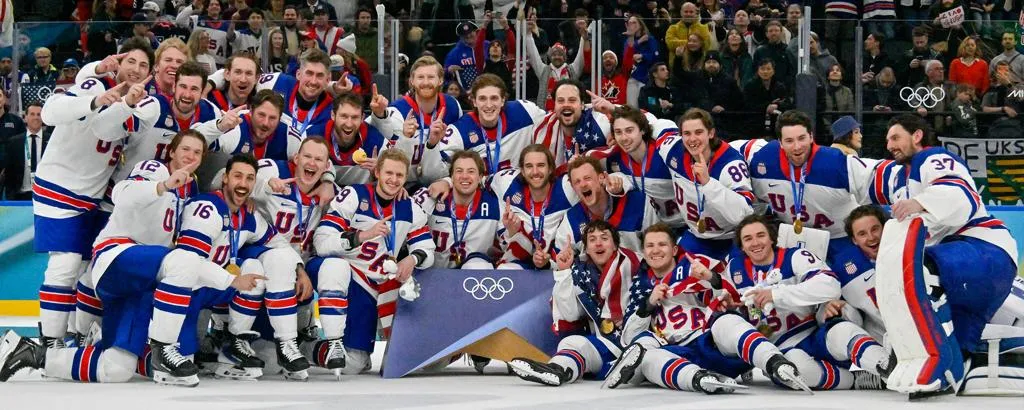
Why Team USA prevailed
Connor Hellebuyck delivered a masterclass in the net, stopping 41 of 42 shots, with 27 from the slot and 17 from the inner slot. His paddle save on Toews and breakaway denial of Celebrini ranked among the tournament’s best. As the reigning NHL MVP and Vezina winner, Hellebuyck outshone legends like Jim Craig and Ryan Miller.[4]
Team USA’s penalty kill shone, surviving a 5-on-3 for 1:42 in the second period and another power play late. Despite Canada’s 33-18 shot edge in the final two periods, the U.S. bent but didn’t break. Hellebuyck bailed them out repeatedly.
The 3-on-3 overtime format favored skill, and few match Jack Hughes’ speed and creativity. With nine NHL overtime winners, he buried Werenski’s pass after the defenseman stripped Nathan MacKinnon. Werenski’s forecheck set it up perfectly.
The Americans honored the late Johnny Gaudreau by displaying his jersey during celebrations. Werenski, a close friend and teammate, added emotional depth. Hughes emerged as the tournament’s U.S. star, overcoming early criticism from the 4 Nations Face-Off.
This win wasn’t a miracle but a testament to depth and clutch play. Hellebuyck was the game’s best player, but the team’s resolve sealed gold. It proves USA Hockey’s talent pipeline has matured.
Factors in Canada’s defeat
Canada dominated possession but couldn’t solve Hellebuyck, who “goalied” them out of victory. MacKinnon missed a gaping net, and Celebrini managed no goals despite six shots and a breakaway. Coach Jon Cooper shuffled lines without sparking offense.
Team USA’s defense disrupted early and held firm later, prioritizing their zone over activation. This depth trumped Canada’s stars. Still, Sidney Crosby’s lower-body injury absence loomed large—he missed the semifinal and final despite promotion hype.
Nick Suzuki struggled in Crosby’s spot, losing six of seven faceoffs alongside Mitch Marner and Mark Stone. Crosby’s power-play prowess (607 NHL points) might have converted chances. His leadership, including a prior OT golden goal vs. USA, was missed.
Fans grumbled about officiating—a missed slash on Connor McDavid and too-many-men non-call—but Canada had opportunities. They controlled overtime puck possession yet faltered. Hellebuyck’s brilliance decided it.
Canada deserved gold for effort, but USA capitalized. Crosby’s absence and goaltending gap proved decisive. This loss levels the field.
Connor Hellebuyck named gold medal game MVP
Hellebuyck’s .947 save percentage entering rose to .956, with 5.92 goals saved above average—the tournament’s best. He entered as starter after Jeremy Swayman’s group-stage audition. Jack Hughes praised him postgame: “He was our best player today by a mile. That was a ballsy, gutsy win.”[5]
Critics once questioned his big-game play, but Olympics silenced them. Expected U.S. goaltending edge over Binnington materialized massively. He carried the team solo.
Postgame, Hughes highlighted brotherhood alongside Hellebuyck’s impact. The Winnipeg Jets star redefined American netminding. His performance echoed through history.
Hellebuyck’s tournament solidified his legacy. Beyond stats, his poise won gold. As Hughes noted, American hockey grit prevailed.
Evolution of the USA-Canada rivalry
Historically lopsided since 1998 NHL Olympics, Canada dominated—gold in 2002 vs. USA, Crosby’s 2010 OT winner, Sochi bronze force, 2016 World Cup, 2025 4 Nations. USA managed prelim wins but little else. They entered as underdogs.
USA’s pipeline changed that: six IIHF junior golds since 2010 vs. Canada’s five. Stars like the Hughes brothers, Tkachuks, Eichel, Matthews, Kane emerged—not grinders, but elites. 4 Nations near-upset built belief.
This gold cements equality, mirroring women’s rivalry. Canada cites Crosby and Hellebuyck; USA owns the medal. Hughes said: “We wanted to go through Canada and beat them.”
Fans will debate asterisks, fueling fire. Rivalry now even-footed. For a full recap of the drama, see our detailed overtime win analysis.
Looking ahead to hockey’s renewed battle
Team USA’s victory reshapes men’s hockey narratives. No longer the “annoying little brother,” they’re peers. Canada’s arrogance meets reality—next best-on-best will intensify.
Youth pipelines promise sustained clashes. USA Hockey’s development yields skill; Canada’s depth endures. Expect packed arenas, heated talk.
This gold inspires a generation. As in women’s game, outcomes stay unpredictable. The dance continues, fiercer than ever. What means for NHL playoffs? Stars return battle-tested.
Frequently Asked Questions

Par Mike Jonderson
Mike Jonderson is a passionate hockey analyst and expert in advanced NHL statistics. A former college player and mathematics graduate, he combines his understanding of the game with technical expertise to develop innovative predictive models and contribute to the evolution of modern hockey analytics.