






Russia’s absence from the 2026 Winter Olympics in Milan-Cortina remains a stark reality. The International Olympic Committee suspended the Russian Olympic Committee in 2022 over violations tied to the invasion of Ukraine. While a handful of neutral athletes competed in Paris 2024, no full team will represent Russia in hockey. Yet, with NHL stars returning to the Olympics for the first time since 2014, imagining Russia’s roster sparks endless debate.
This hypothetical lineup draws from NHL and KHL talent dominating the league this season. Wings loaded with superstars. A golden age of goaltending. Depth that could challenge any nation. For context on the real contenders, check breakdowns of Canada’s 2026 Olympic hockey roster and predictions for USA and Canada.
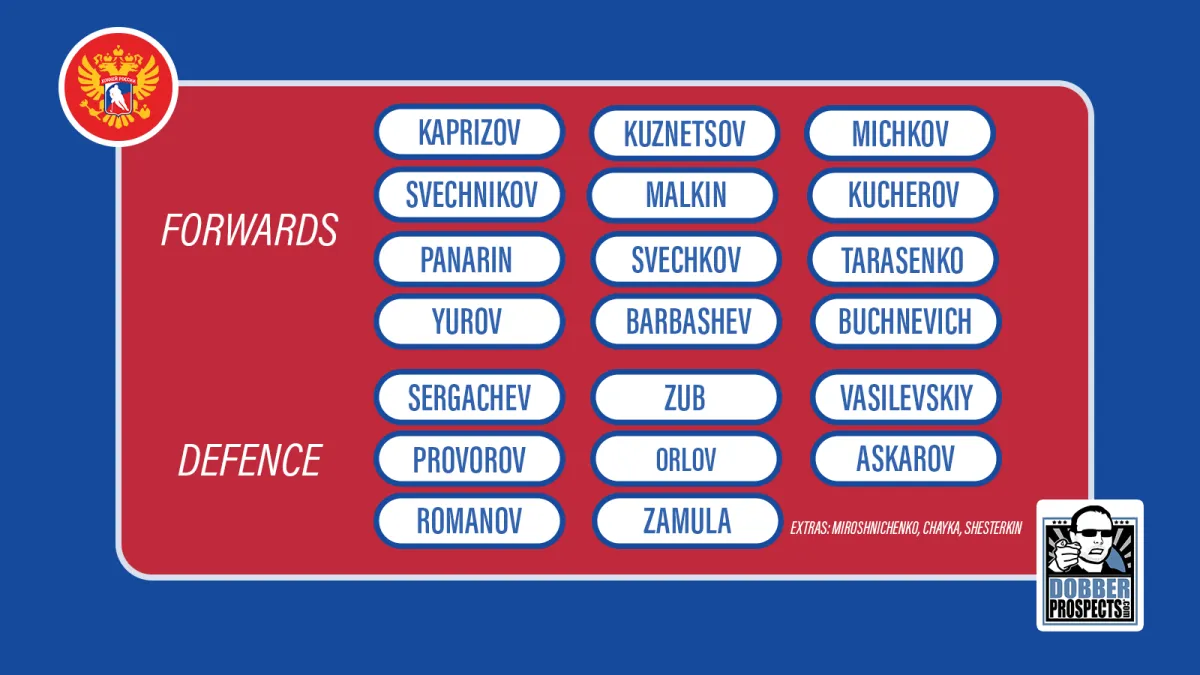
Forwards: Wing wizards and center conundrums
Russia’s forward group would terrify opponents, anchored by elite wingers. Alex Ovechkin chases history with his scoring touch. Nikita Kucherov dazzles with playmaking. Kirill Kaprizov brings speed and snarl. Artemi Panarin adds finesse. This quartet alone could carry lines.
Centers pose the biggest puzzle. Evgeni Malkin leads at 1.12 points per game before injury, returning strong with a 45.2% faceoff win rate. He’s the clear No. 1, proven in clutch moments. But depth thins out. Only five Russians top 100 faceoffs this season, and options beyond Malkin lack punch.
Rookie Danila Yurov emerges as a contender, centering Minnesota’s top line with six goals and 16 points in 39 games. Vladislav Namestnikov and Fedor Svechkov offer penalty-kill reliability but modest offense—projected at 16 and 17 points. Yurov’s upside edges them, despite limited PK time.
KHL stars tempt selectors. Ruslan Abrosimov averages 0.84 points per game, wins 50.2% of draws, and logs shorthanded minutes. Roman Kantserov posts 1.20 points but transitioned to center recently. Abrosimov’s balance fits best, pairing with Malkin, Yurov, and Namestnikov for faceoff strength and versatility.
Extra forwards add flexibility. Pavel Buchnevich brings penalty-kill experience and 20-goal seasons. Pavel Dorofeyev eyes 30 goals. Prospects like Ivan Demidov and Matvei Michkov intrigue, echoing lessons from the 4 Nations Face-Off. Russia could flex wingers or centers game-to-game.
- Top line potential: Panarin-Malkin-Kucherov
- Second line: Kaprizov-Abrosimov-Ovechkin
- Depth options: Buchnevich, Dorofeyev for adjustments
Defense: NHL depth minus one key piece
Russia boasts nine NHL defensemen averaging 19-plus minutes per game. Selection would be luxurious, blending mobility, size, and shot-blocking. Alexander Romanov’s November shoulder injury simplifies it—he’d miss the Games.
Pairs could feature Mikhail Sergachev’s offense with Dmitry Orlov’s steadiness. Andrei Gavrikov and Nikita Zadorov anchor physically. Depth like Vladislav Gavrikov ensures shutdown reliability. This blue line matches any tournament foe.
The group’s puck-moving ability stands out. High-minute players handle transitions seamlessly. Penalty kill and power play balance emerges naturally. Fewer headaches here than up front.
Injuries aside, Russia’s D-core exemplifies modern hockey demands. Averaging heavy loads translates to Olympic intensity. They’d stifle top lines while jumping into plays.
This setup positions Russia as medal threats defensively. Paired with forward flash, balance shines.
Goaltending: A luxury dilemma
Russia’s crease represents its deepest strength—a golden era of netminders. Three Vezina winners: Sergei Bobrovsky, Igor Shesterkin, Andrei Vasilevskiy. Ilya Sorokin lurks with top-six Vezina finishes.
Evgeni Nabokov, ex-NHL goalie and potential 2022 coach, captured it in 2023: “It’s almost like you can dream of having that many good goaltenders… You can probably say three of them are among the five best in the world.” Picking three feels impossible.
Current form guides choices. Shesterkin leads GSAA at 18.13 over 600 minutes. Sorokin ranks fourth at 12.34, fueling Islanders’ playoff push. Vasilevskiy sits 15th at 6.45. Bobrovsky struggles at minus-11.69 amid Panthers’ injuries.
Shesterkin goes week-to-week after January 5, but assume health. Tandem of Shesterkin, Vasilevskiy, Sorokin prioritizes hot hands. Sorokin’s regular-season dominance—third in save percentage and GSAA over 4,000 minutes—edges Bobrovsky’s playoff heroics.
Playoff pedigree matters: Bobrovsky’s .919 save percentage over 47 games shines. Yet Russia’s depth allows mixing workload. This trio could rotate flawlessly.
- Starter: Shesterkin (elite metrics)
- Backup: Vasilevskiy (proven winner)
- Third: Sorokin (regular-season rock)
Looking ahead to Milan-Cortina
Russia’s hypothetical squad screams contender—wing stars, goaltending riches, defensive solidity. Center questions linger, but solutions exist. They’d push Canada, USA, Sweden in best-on-best play.
Without them, the tournament loses sizzle. Discussions rage on ESPN’s full breakdown. Fans dream of Ovechkin hoisting gold before retirement. For now, it’s fantasy fueling hockey passion. What path for Russian stars next?
Frequently Asked Questions

Par Mike Jonderson
Mike Jonderson is a passionate hockey analyst and expert in advanced NHL statistics. A former college player and mathematics graduate, he combines his understanding of the game with technical expertise to develop innovative predictive models and contribute to the evolution of modern hockey analytics.