





The 2014 NHL Draft stands as one of the most fascinating classes in recent memory, not just for the talent it produced, but for the remarkable journeys its top 10 selections have taken over the past decade. Held at the Wells Fargo Center in Philadelphia, this draft class has delivered multiple Stanley Cup champions, Hart Trophy winners, and franchise cornerstones. A decade later, examining where these players are now reveals a mix of superstardom, solid contributions, and unexpected disappointments that showcase just how unpredictable player development can be in professional hockey.
What makes the 2014 draft particularly unique is that four of the top five picks—Aaron Ekblad, Sam Reinhart, Leon Draisaitl, and Sam Bennett—all participated in the 2024 Stanley Cup Final, with three of them ultimately hoisting the Cup with the Florida Panthers. This unprecedented convergence of early draft picks in a championship series demonstrates both the quality of scouting at the top of this draft and the unpredictable paths players take to achieve their ultimate goal.
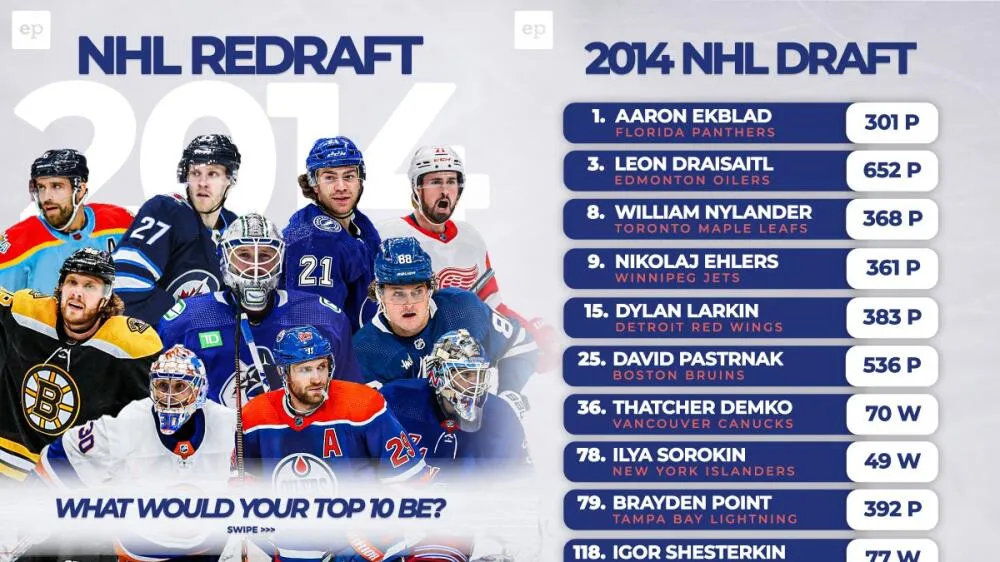
Aaron Ekblad: the defensive anchor who delivered championship glory
As the first overall selection by the Florida Panthers, Aaron Ekblad carried the weight of franchise expectations from day one. The consensus top defenseman in his draft class, Ekblad was tabbed as a player the Panthers could build their blue line around for the next decade. At just 18 years old, he made an immediate impact, posting 12 goals and 39 points in his rookie campaign while earning a spot in the 2015 All-Star Game and capturing the Calder Trophy.
Ekblad’s early career progression showed promise as he followed up his rookie season with another All-Star appearance in 2015-16, notching 15 goals and 36 points. However, the next phase of his development proved challenging. His offensive production plateaued over the following seasons, never quite reaching the 50-point threshold that many expected from a first-overall defenseman. Injuries also became a concern, most notably when he suffered a gruesome leg injury during the 2020-21 season that threatened to derail his career.
The narrative around Ekblad shifted dramatically as the Panthers evolved into a championship contender. While his point totals may not have matched the lofty offensive expectations, his value became clear in his defensive reliability and leadership. During Florida’s historic 2024 Stanley Cup run, Ekblad averaged over 22 minutes per game, providing the steady presence the team needed. He followed that up with 13 points in 19 games during the Panthers’ 2025 championship defense, showcasing his ability to elevate his game when it matters most.
Now in his 12th NHL season, Ekblad has validated the Panthers’ faith in him as their franchise defenseman. His two-way play, physical presence, and ability to log heavy minutes in crucial situations have made him exactly what Florida needed, even if the journey took longer than expected. The fact that he helped deliver the franchise’s first Stanley Cup makes any debate about whether he lived up to his billing largely academic.
Sam Reinhart: from Buffalo disappointment to Florida’s scoring sensation
Selected second overall by the Buffalo Sabres, Sam Reinhart was considered by many scouts to be the best forward in the 2014 draft class. His exceptional hockey IQ and scoring ability with the Kootenay Ice made him a tantalizing prospect, and the rebuilding Sabres believed they had found a cornerstone piece for their future. However, Reinhart’s path to stardom would prove far more winding than anyone anticipated.
After playing just nine games during his draft year, Reinhart returned to junior hockey before establishing himself as an NHL regular in 2015-16. His time in Buffalo was marked by steady but unspectacular production. His best season with the Sabres came in 2018-19 when he recorded 22 goals and 65 points—solid numbers, but below the expectations for a second-overall pick. The 2020-21 campaign proved to be his last in Buffalo, as he posted 25 goals but finished with a troubling minus-28 rating on a struggling team.
The trade to Florida in 2021 transformed Reinhart’s career. Freed from the dysfunction that plagued Buffalo and surrounded by elite talent, he blossomed into the elite scorer everyone had projected him to become. Playing alongside top-tier linemates and within a winning culture, Reinhart has consistently posted career-high numbers season after season, establishing himself as one of the league’s most dangerous offensive threats.
Reinhart’s production with the Panthers has been nothing short of spectacular. He’s become a consistent 50-plus goal threat and a driving force behind Florida’s championship runs. His performance during the team’s back-to-back Stanley Cup Final appearances cemented his status as one of the draft’s biggest success stories, even if it took a change of scenery to unlock his full potential. For those analyzing the 2020 NHL Draft top 10 where are they now, Reinhart’s career trajectory serves as a reminder that sometimes elite prospects need the right environment to truly flourish.
Leon Draisaitl: the Hart Trophy winner who became a generational talent
When the Edmonton Oilers selected Leon Draisaitl third overall, they made him the highest-drafted German-born player in NHL history. The expectation was for Draisaitl to develop into a big-bodied, skilled power forward who could complement the Oilers’ collection of young offensive talent. What they got instead was arguably the best player from the entire 2014 draft class—a legitimate superstar who has established himself among the NHL’s elite.
Draisaitl’s ascent to superstardom has been remarkable. While he may live in Connor McDavid’s shadow within the Oilers organization, his individual accomplishments speak for themselves. The 2019-20 season represented his breakthrough campaign, as he captured the Hart Trophy as league MVP, the Ted Lindsay Award as the players’ choice for most outstanding player, and the Art Ross Trophy as the league’s leading scorer. That trifecta of hardware validated what scouts saw in him and then some.
The German center’s consistency has been staggering. His 2022-23 season featured 52 goals and 128 points, cementing his status as one of the league’s most dangerous offensive weapons. He followed that up by winning the Rocket Richard Trophy in 2024-25 with another 52-goal campaign, leading the entire NHL in goals scored. At just 30 years old, Draisaitl remains in his prime and shows no signs of slowing down.
What makes Draisaitl’s success particularly impressive is how he’s carved out his own identity despite playing alongside a generational talent in McDavid. He’s proven he can carry an offensive attack on his own, dominate in all situations, and deliver in the biggest moments. The Oilers’ investment in Draisaitl has paid off exponentially, as he’s become the kind of franchise-defining player that teams dream of landing at any draft position, let alone third overall.
His $112-million contract extension signed during the 2024-25 season reflects his status as one of the game’s premier players. For the Oilers, Draisaitl represents the perfect complement to McDavid and a cornerstone piece as they pursue their first Stanley Cup since 1990. The only thing missing from his resume is that championship ring, though he’s come agonizingly close in recent playoff runs.
Sam Bennett: the late bloomer who found his game in Florida
Sam Bennett’s pre-draft story became famous for all the wrong reasons when he failed to complete a single pull-up at the 2014 NHL Combine. Despite that embarrassing moment, scouts still viewed him as arguably the most talented all-around forward in the draft class, blessed with exceptional vision, playmaking ability, and a complete skill set. The Calgary Flames selected him fourth overall, expecting him to develop into a top-line center.
Bennett’s early years in Calgary were frustrating for both player and organization. After debuting during the 2015 playoffs, he posted 18 goals and 36 points in his first full NHL season in 2015-16—a promising start. However, his development stalled dramatically over the next three seasons as he failed to break the 30-point mark while posting a combined minus-40 rating. Questions swirled about whether he could ever fulfill his potential or if he was destined to be labeled a draft bust.
The 2021 trade to Florida proved to be the career-saving move Bennett desperately needed. Like Reinhart, Bennett found new life with the Panthers, finally securing a consistent top-six role and thriving in their up-tempo system. His physical, aggressive style of play meshed perfectly with Florida’s identity, and he became an invaluable piece of their championship puzzle.
Bennett’s contributions during the Panthers’ 2024 Stanley Cup run were crucial. His ability to play a hard, gritty game while chipping in offensively made him exactly the type of complementary player that championship teams need. The fact that three of the top four picks from 2014—Ekblad, Reinhart, and Bennett—all won the Cup together in Florida created one of the draft’s most unique storylines.
While Bennett may never become the elite first-line center Calgary envisioned, he’s carved out a successful NHL career as a valuable middle-six forward who brings intangibles that don’t always show up on the scoresheet. His journey demonstrates that sometimes players need to find the right system and role to maximize their abilities, and that a change of scenery can be transformative for a struggling prospect.
Michael Dal Colle: the playmaker who never found his footing
Selected fifth overall by the New York Islanders, Michael Dal Colle entered the NHL with immense expectations. His 95-point season with the Oshawa Generals showcased elite playmaking ability and stick-handling skills that made him one of the draft’s most exciting offensive prospects. The Islanders envisioned him as the perfect top-six forward to complement their star center John Tavares.
Unfortunately, Dal Colle’s NHL career never materialized as hoped. Through the 2018-19 season, he had appeared in just 32 games with the Islanders, managing only seven points. The 2019-20 campaign offered slightly more opportunity with 53 games played, but he still mustered just 10 points while struggling to secure a consistent roster spot. His offensive gifts simply didn’t translate to the professional level the way scouts had projected.
The writing was on the wall when Dal Colle appeared in just one NHL game during the 2021-22 season. Unable to crack a roster in North America, he made the decision to continue his career overseas. He first landed in Finland’s Liiga before eventually settling in Germany’s DEL, where he’s found more success playing at a lower level of professional hockey.
Dal Colle’s story serves as a sobering reminder of how difficult it is to project junior success to the NHL level. Despite possessing elite skills in junior hockey, he couldn’t adapt his game to the speed, size, and defensive structure of professional hockey. His inability to establish himself represents one of the bigger disappointments from the 2014 top 10, as he never came close to justifying his draft position.
Jake Virtanen: from power forward prospect to cautionary tale
The Vancouver Canucks held high hopes when they selected Jake Virtanen sixth overall in 2014. After a disastrous season that saw them miss the playoffs and fire both their general manager and head coach, the Canucks desperately needed an injection of young talent. Virtanen’s profile as a skilled power forward with the physical tools to dominate seemed like the perfect addition to help turn the franchise around.
Virtanen’s development proved frustratingly inconsistent. An injury derailed his rookie campaign in 2015-16, and he spent the following season bouncing between the AHL and NHL, never finding stable footing. Even when he secured consistent ice time starting in 2017-18, Virtanen failed to develop into the dominant power forward Vancouver had envisioned on draft day.
As the Canucks accumulated elite young talent through subsequent drafts and trades, Virtanen’s future with the organization grew increasingly uncertain. A combination of poor on-ice performance and off-ice issues, including a sexual misconduct allegation, led to the team buying out his contract in 2021. The decision effectively ended his NHL career, as no other team showed interest in signing him.
Virtanen left North America to play in the KHL before settling in Germany’s DEL, where he’s spent the past three seasons. His career trajectory stands as one of the most disappointing from the 2014 draft, as he never came close to fulfilling his potential despite possessing all the physical tools scouts covet. His story serves as a reminder that talent alone isn’t enough—character, work ethic, and off-ice conduct all play crucial roles in NHL success.
The middle of the pack: Fleury, Nylander, and Ehlers find varying levels of success
Haydn Fleury, selected seventh overall by the Carolina Hurricanes, represents a classic case of a prospect stuck behind organizational depth. As a big, physical defenseman with decent offensive skills, Fleury checked many boxes for NHL teams. However, breaking through Carolina’s impressive blue line depth proved impossible. After playing just 67 games with limited ice time in 2017-18, Fleury bounced between the AHL and NHL while dealing with injuries.
The Hurricanes eventually traded Fleury to Anaheim in 2021, who then exposed him at the expansion draft where Seattle claimed him. After brief stints with Tampa Bay, he signed with Winnipeg in 2022. While Fleury has carved out an NHL career, he’s never established himself as the top-four defenseman Carolina envisioned when they drafted him. His journey mirrors patterns seen in other draft classes, similar to how Pittsburgh Penguins 2016 draft class where are they now shows varying development paths for prospects.
William Nylander, taken eighth by Toronto, has become one of the genuine success stories from this draft class. After a strong rookie season alongside Auston Matthews in 2016-17 where he posted 61 points, Nylander established himself as a legitimate top-line offensive talent. His 2017-18 campaign featured another 61-point performance that cemented his value to the Maple Leafs.
Nylander’s career took an interesting turn during the 2018 offseason when contract negotiations stalled dramatically. His holdout lasted until December, shocking the NHL and creating a new benchmark for RFA negotiations. The six-year, $41.4-million deal he eventually signed became a reference point for subsequent RFA contract talks across the league. Nylander has more than justified that investment, posting four consecutive 80-point seasons and earning an eight-year, $92-million extension in January 2024. At 29 years old, he remains a cornerstone of Toronto’s offensive attack.
Nikolaj Ehlers, selected ninth by Winnipeg, has enjoyed a quietly successful NHL career. After an adjustment year, the Danish forward broke out in 2016-17 with 25 goals and 64 points, prompting the Jets to sign him to a seven-year, $42-million extension. Ehlers posted 29 goals and 60 points in 2017-18, establishing himself as one of Winnipeg’s most reliable offensive weapons. After becoming a free agent following the 2024-25 season, he signed with Carolina, continuing his career as a proven top-six forward.
Nick Ritchie: when size and skill don’t translate
The Anaheim Ducks selected Nick Ritchie 10th overall based on a simple premise: you can’t teach size. At 6-foot-3 and over 230 pounds, Ritchie possessed the physical frame and skill combination that NHL teams covet. The Ducks, built around gritty veterans like Ryan Getzlaf, seemed like the perfect environment for a young power forward to develop his game.
Ritchie established himself in Anaheim’s lineup during the 2016-17 season, posting 14 goals and 28 points in 77 games. However, rather than developing into an offensive force, Ritchie became better known for his physical play and propensity for taking penalties. While his toughness made him difficult to play against, his offensive production never matched his draft position.
The Ducks traded Ritchie to Boston at the 2020 deadline, where he played significant minutes during the 2020-21 season. Unfortunately, his tendency to take bad penalties often negated his positive contributions. After leaving Boston for Toronto, he took on a depth role before being traded to Arizona at the 2022 deadline, then to Calgary in 2023. Following the 2022-23 season, no NHL team offered him a contract.
Ritchie joined Finland’s Liiga to continue his career, another member of the 2014 top 10 who couldn’t establish long-term NHL success. His trajectory shows that physical tools and junior success don’t guarantee professional achievement, and that the mental and tactical aspects of the game matter just as much as size and skill.
The 2014 NHL Draft top 10 picks demonstrate the unpredictable nature of player development at hockey’s highest level. While stars like Draisaitl and Nylander have exceeded expectations and players like Ekblad, Reinhart, and Bennett eventually found championship success, others like Dal Colle, Virtanen, and Ritchie never fulfilled their potential. The fact that four of the top five picks competed together in a Stanley Cup Final represents an unprecedented convergence of talent from a single draft class.
Looking back a decade later, the 2014 draft produced multiple franchise players, championship contributors, and cautionary tales about projection and development. While some GMs hit home runs with their selections, others watched their high picks struggle to establish NHL careers. The contrast between the brightest stars and biggest disappointments reminds us why the draft remains such a fascinating and unpredictable event, where even consensus top-10 talents can take wildly different paths to success or failure.

Par Mike Jonderson
Mike Jonderson is a passionate hockey analyst and expert in advanced NHL statistics. A former college player and mathematics graduate, he combines his understanding of the game with technical expertise to develop innovative predictive models and contribute to the evolution of modern hockey analytics.