






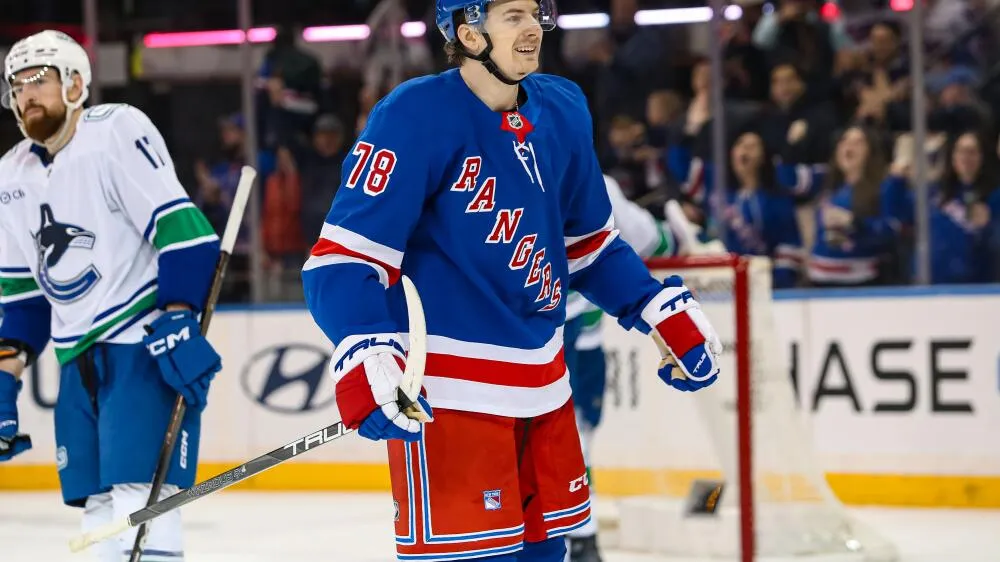
The 2025 season has brought unexpected turbulence for the New York Rangers, and at the center of the swirling speculation sits 22-year-old forward Brennan Othmann. The former first-round pick from the 2021 NHL Draft finds himself in a precarious position, caught between organizational depth and unfulfilled potential. After failing to secure a spot on the Rangers’ opening night roster and being sent down to the Hartford Wolf Pack in the AHL, Othmann has become one of the most talked-about names in early-season trade discussions.
What makes the situation particularly intriguing is the timing. The Rangers recalled Othmann following Matt Rempe’s upper-body injury, but many within hockey circles view this as more of a showcase opportunity than a genuine belief in his immediate NHL readiness. With general manager Chris Drury reportedly fielding calls from multiple teams and establishing a clear asking price, the New York Rangers Brennan Othmann trade rumors 2025 have evolved from whispers to legitimate possibilities. As the young winger navigates this uncertain chapter, the hockey world watches to see whether he’ll prove his worth in Manhattan or find success elsewhere.
What’s driving the New York Rangers Brennan Othmann trade rumors 2025?
The fundamental issue facing Othmann is simple mathematics. The Rangers possess a surplus of talented wingers, both at the NHL level and within their prospect pipeline. Players like Gabe Perreault, Brett Berard, Noah Laba, and Adam Edstrom all represent varying degrees of organizational depth that have effectively blocked Othmann’s path to consistent NHL minutes. After three professional seasons, the organization appears to have reached a crossroads regarding his development trajectory.
Othmann’s NHL performance to date hasn’t demanded a permanent roster spot. In 26 career games with the Rangers, he’s managed just two assists without registering a single goal. Last season told a tale of two different players—completely invisible in 22 NHL contests with only those two assists, yet productive in the AHL with 12 goals and 20 points in 27 games for Hartford. This disparity suggests either a player who needs more seasoning or one who might flourish in a different organizational structure with clearer opportunities.
The Rangers’ current competitive window adds another layer of complexity. New York entered the 2025 season with championship aspirations, making patience with developing prospects a luxury they may not be able to afford. After embarrassing losses, including a 5-1 defeat to the struggling Calgary Flames and a 6-5 overtime loss to the previously winless San Jose Sharks, the team’s identity appears fractured. Captain J.T. Miller didn’t mince words after the Sharks debacle, stating, “Just not good enough. Not the identity we’re trying to build here… Not ready to play. Didn’t really respect our opponent today.”
The organization’s willingness to entertain offers signals a pragmatic approach to roster construction. Rather than letting Othmann languish in the AHL while his trade value potentially diminishes, Drury appears ready to capitalize on whatever interest exists. According to Sportsnet’s Elliotte Friedman, multiple teams have already made inquiries, suggesting the market for the young forward is more robust than some might expect.
Chris Drury’s surprising asking price for Brennan Othmann
In most trade scenarios involving a struggling prospect, teams typically seek draft picks or immediate NHL help to bolster their roster. The New York Rangers Brennan Othmann trade rumors 2025 have taken an unexpected turn, however, with Drury’s asking price defying conventional expectations. According to Friedman’s reporting, “When asked, the Rangers have requested good AHL prospects in exchange for Brennan Othmann.”
This request has raised eyebrows across the hockey landscape. For a team ostensibly in win-now mode, seeking AHL prospects rather than NHL-ready players or premium draft picks seems counterintuitive. However, the strategy reveals something about how the Rangers view both Othmann and their own organizational needs. By targeting prospects who are excelling at the AHL level, New York appears to be looking for a change-of-scenery swap—players with upside who might thrive in different environments.
The asking price also preserves Othmann’s perceived value. Requesting quality prospects rather than late-round picks or cap dumps suggests the Rangers still believe in his long-term potential, even if it won’t be realized in their system. Teams calling about Othmann reportedly cite his “dangerous shot and ability to win back the puck” as attractive qualities, according to The Athletic’s Chris Johnston. These attributes remain valuable commodities, particularly for organizations with clearer paths to playing time.
From a practical standpoint, acquiring good AHL prospects allows the Rangers to maintain organizational depth while potentially upgrading at positions of need. With their glut of wingers, swapping Othmann for a high-quality AHL defenseman or center could address future needs without sacrificing immediate competitiveness. The Rangers’ prospect pool includes several players close to NHL-ready, making the addition of another promising AHL player a strategic move rather than a short-sighted one.
It remains unclear whether any team has come close to meeting Drury’s threshold for “good AHL prospects.” The vague terminology leaves significant room for interpretation and negotiation. What one organization considers a good AHL prospect might differ dramatically from another’s evaluation, creating potential friction in trade discussions.
Brennan Othmann’s perspective on the swirling trade speculation
While executives and insiders dissect his future, Othmann himself has attempted to maintain focus on what he can control. The young forward addressed the trade rumors directly, demonstrating a mature approach to an uncomfortable situation. “I can’t really focus on that stuff,” Othmann said. “That stuff’s really all online, and I don’t know what’s true. I don’t know what’s false. I’ve just been super focused with Hartford and trying to get back up here.”
His measured response reflects the reality facing many prospects in similar situations. The internet age has amplified trade speculation to unprecedented levels, with every insider report and social media post dissected endlessly. For players trying to develop their games and prove their worth, the constant noise can become overwhelming. Othmann acknowledged that teammates in Hartford had asked him about the rumors, but emphasized his day-by-day approach to handling the situation.
The initial disappointment of being cut from training camp—with over a week still remaining in evaluation periods—clearly stung. “It was definitely a little disappointing,” Othmann admitted. “I wasn’t really expecting it, to be honest, but you kind of just take that and you use that as motivation.” This early dismissal, coupled with the decision to give the final roster spot to Noah Laba instead, sent a clear message about where Othmann stood in the organizational hierarchy.
His recall to face the Calgary Flames provided his first NHL action of the season, though the circumstances were less than ideal. Logging 12:31 of ice time with one shot on goal and a minus-one rating in a 5-1 blowout loss wasn’t the showcase performance that might quiet trade speculation. Slotted into the third line alongside Will Cuylle and Noah Laba, Othmann received a fair opportunity but couldn’t make a decisive impact. Given that this followed a modest four-game stint in Hartford that produced just one assist, questions about his current form persist.
The mental challenge of playing while knowing your name circulates in trade rumors cannot be understated. Every shift becomes auditioned, every mistake magnified. Yet Othmann’s comments suggest he’s internalized the professional reality that his future may lie elsewhere. “I’m still a young player and still a player that has got some potential. I mean, I’m still happy with my game. I’m happy with where I’m at,” he said, projecting confidence even in uncertainty.
Potential landing spots that make sense for Othmann
Several teams have emerged as logical destinations for Othmann, each offering distinct advantages that could help resurrect his career trajectory. The Vancouver Canucks represent perhaps the most intriguing possibility. Vancouver’s need for secondary scoring depth and their track record of developing young forwards could provide the environment Othmann needs. The Canucks have shown willingness to give prospects extended opportunities, and their up-tempo offensive system might suit Othmann’s skill set better than New York’s more defensive structure.
The Toronto Maple Leafs present another compelling option, particularly given their organizational philosophy of accumulating high-ceiling prospects. Toronto’s AHL affiliate, the Marlies, could offer Othmann a productive environment while he waits for an NHL opportunity. Additionally, the Leafs have struggled with depth scoring consistency, potentially creating openings for a motivated Othmann to seize. The pressure cooker of Toronto might seem daunting, but it could also provide the challenge that sparks his development.
The Chicago Blackhawks make sense from a rebuilding team’s perspective. Chicago needs to accumulate young assets and can offer immediate playing time without the pressure of playoff expectations. Othmann would likely receive substantial NHL minutes while the franchise develops around Connor Bedard. The opportunity to grow alongside other young players, without the weight of championship expectations, might allow Othmann to play with the confidence that’s been missing in New York.
The Montreal Canadiens, despite not being mentioned in initial reports, could also factor into discussions. Montreal’s rebuild has emphasized adding skill and character players, and Othmann’s profile fits their organizational direction. The Canadiens have demonstrated patience with young players, and their AHL affiliate in Laval has become a respected development system. For a French-Canadian organization always mindful of local connections, acquiring a Swiss-born forward with upside presents minimal risk with potential rewards.
Western Conference teams like the Seattle Kraken or Utah Hockey Club (formerly Arizona) might also express interest. Both franchises are building their organizations and could use players with Othmann’s potential trajectory. These teams can offer what New York cannot: clear paths to playing time and patience during inevitable growing pains. The Rangers’ recent struggles have made it evident they can’t afford extended development projects, whereas younger franchises can embrace that process.
Each potential destination shares common elements—organizational runway for development, clearer paths to NHL minutes, and systems that might better complement Othmann’s strengths. The question isn’t whether teams are interested, but rather which organization can meet Drury’s asking price while offering Othmann the fresh start both sides seem to need.
How the Rangers’ roster crunch impacts Othmann’s future
The depth chart reality facing Othmann extends beyond simple roster numbers. The Rangers’ organizational philosophy has shifted toward players who can contribute immediately at both ends of the ice. Coach Mike Sullivan’s system demands defensive responsibility and positional discipline—areas where Othmann hasn’t consistently excelled. His offensive tools remain intriguing, but they haven’t translated into the well-rounded game the Rangers require from their depth forwards.
Beyond Othmann, prospects like Gabe Perreault and Brett Berard have generated significant internal buzz. Perreault, a skilled playmaker, and Berard, a tenacious two-way forward, both present different skill sets that might complement the Rangers’ roster construction more effectively. Matt Rempe, despite his limited offensive production, brings size and physical presence that the Rangers value. Even Adam Edstrom and Juuso Parssinen rank higher on the organizational depth chart, speaking to just how crowded the pipeline has become.
The timing of these roster decisions couldn’t be worse for Othmann. Had he made the team out of training camp, he might have earned enough trust to secure a semi-permanent role. Instead, being sent down early—even before final cuts—positioned him as a peripheral figure rather than a core piece. When recall opportunities arose, management opted for other prospects or brought Othmann up only when injuries forced their hand. This pattern suggests organizational preference rather than temporary circumstance. The Rangers appear to have made their evaluation, and whether fair or not, Othmann ranks below others in the organizational pecking order. This reality makes the trade speculation less about if and more about when and where. Understanding the challenges young players face in crowded organizational structures is crucial, as NHL roster decisions and prospect development often create difficult situations for promising talent.
The Rangers’ championship window also influences these decisions. With players like Artemi Panarin, Mika Zibanejad, and Vincent Trocheck in their prime years, the organization cannot afford to sacrifice competitive roster spots for developmental projects. Every lineup decision carries playoff implications, intensifying the pressure on prospects to produce immediately. Othmann’s limited scoring in his NHL opportunities hasn’t earned him the benefit of the doubt that an established player might receive.
The broader context of prospects seeking fresh starts
The New York Rangers Brennan Othmann trade rumors 2025 fit into a larger pattern across the NHL of highly-drafted prospects needing organizational changes to fulfill their potential. The league’s history is filled with examples of players who languished in one system before thriving elsewhere. Filip Forsberg, traded from Washington to Nashville for Martin Erat, stands as the cautionary tale organizations reference when discussing prospect patience. More recently, players like Vitali Kravtsov demonstrated that even talented prospects can’t crack certain lineups due to depth, system fit, or organizational politics.
The Rangers have their own history with this phenomenon. They’ve traded away prospects who found success elsewhere while also benefiting from acquiring players who needed fresh starts. This institutional knowledge likely informs Drury’s approach to the Othmann situation. Rather than letting frustration fester and value depreciate further, moving him while interested teams remain could benefit all parties involved.
For Othmann, the situation represents both crisis and opportunity. At 22, he’s young enough that a successful transition could salvage his career trajectory. He’s past the point where draft pedigree alone guarantees opportunities, but not so old that teams have written off his potential. The “change of scenery” trade has become an NHL staple precisely because environment matters tremendously in player development. Coaching styles, line combinations, organizational patience, and system fit all influence whether prospects maximize their abilities.
Teams interested in Othmann are betting on his tools rather than his results. His shot quality, offensive instincts, and puck pursuit abilities haven’t disappeared—they’ve simply not translated consistently at the NHL level yet. A different organization might unlock these abilities through different coaching, extended opportunities, or psychological comfort that comes with being genuinely wanted. The Rangers have clearly communicated, through actions if not words, that Othmann doesn’t fit their immediate plans.
The AHL-to-AHL prospect swap that Drury seeks acknowledges these realities. Both players involved would presumably need fresh starts, creating a low-risk, potentially high-reward scenario for both teams. Rather than surrendering significant assets for an uncertain prospect, teams can exchange similar caliber players while hoping new environments produce better results. It’s asset management that prioritizes potential over current production—a calculated gamble that successful organizations make regularly. As the Rangers continue evaluating their roster construction, understanding how they manage prospect development remains crucial to their long-term success.
The Brennan Othmann saga represents modern NHL asset management at a crossroads. A promising prospect selected in the first round finds himself blocked by organizational depth and imperfect system fit, leading to trade speculation that dominates early-season discussions. Chris Drury’s decision to seek AHL prospects rather than immediate NHL help or draft picks suggests strategic thinking about organizational needs and Othmann’s market value. For the young forward, the coming weeks will determine whether he can seize his opportunity with the Rangers or whether his future lies elsewhere, joining the long list of prospects who found success after changing addresses. As teams continue making difficult roster decisions, the Othmann situation serves as a reminder that talent alone doesn’t guarantee success—opportunity, timing, and organizational fit matter equally.
Whether Othmann becomes another cautionary tale or a late-blooming success story remains to be seen. What’s certain is that both player and organization have reached a decision point that will shape their respective futures. The New York Rangers Brennan Othmann trade rumors 2025 will likely resolve themselves within weeks rather than months, as Drury weighs offers against the possibility that extended playing time might increase Othmann’s value. For now, all parties wait—teams interested in acquiring him, Rangers fans wondering if they’re giving up too soon, and Othmann himself, trying to prove he belongs while knowing his days in New York may be numbered.

Par Mike Jonderson
Mike Jonderson is a passionate hockey analyst and expert in advanced NHL statistics. A former college player and mathematics graduate, he combines his understanding of the game with technical expertise to develop innovative predictive models and contribute to the evolution of modern hockey analytics.