












The Buffalo Sabres ended the Detroit Red Wings’ impressive five-game winning streak with a convincing 4-2 victory on Wednesday night at KeyBank Center. The game marked a significant moment for several players, including Colten Ellis, who earned a win in his NHL debut, and Jack Quinn, who delivered a stellar three-point performance that highlighted his growing influence on the team’s success. Despite the Red Wings entering the contest as the hottest team in the Eastern Conference, Buffalo’s balanced attack and solid goaltending proved to be the difference in a game that showcased both teams’ offensive capabilities.
The victory represents Buffalo’s third win in their last four games, building momentum after earlier triumphs against the Ottawa Senators and defending Stanley Cup champions Florida Panthers. For Detroit, the loss served as a reminder that even the league’s hottest teams face challenges on the road, particularly against opponents hungry to establish their own identity in the competitive Atlantic Division.
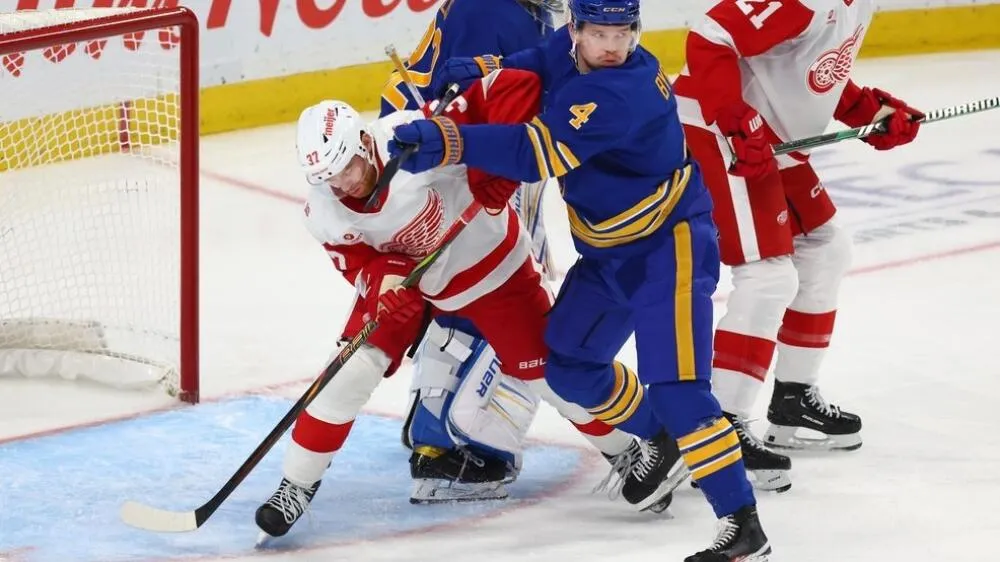
Jack Quinn’s breakthrough performance highlights Buffalo Sabres 4-2 Detroit Red Wings takeaways
Jack Quinn’s three-point night demonstrated why the Sabres organization has maintained such high expectations for the young forward. After an injury-plagued 2023-24 season that saw his campaign ended prematurely by an Achilles injury, Quinn has shown remarkable resilience in returning to form. His goal and two assists against Detroit weren’t just about the numbers—they showcased the creativity, hockey IQ, and finishing ability that made him a first-round draft pick.
Quinn’s involvement in all three of Buffalo’s even-strength goals proved instrumental in securing the victory. He set up Jason Zucker on a textbook 2-on-1 rush in the second period, displaying excellent vision and patience with the puck. Later in that same frame, Quinn delivered a short pass that led to Tyson Kozak’s goal, demonstrating his ability to create opportunities in tight spaces.
The most impressive moment came early in the third period when Quinn unleashed a powerful one-timer from the point that beat John Gibson cleanly, giving Buffalo a 3-2 lead they wouldn’t relinquish. The shot showcased Quinn’s underrated ability to be a threat from multiple areas of the ice, not just as a net-front presence or rush contributor.
This performance could signal the long-awaited breakout season that Sabres fans have been anticipating. Quinn’s ability to impact the game in multiple ways—as a playmaker, finisher, and even from the point—makes him a versatile weapon that head coach Lindy Ruff can deploy in various situations. If Quinn can maintain this level of play throughout the season, Buffalo’s top-six forward group suddenly looks far more dangerous.
The timing of Quinn’s emergence couldn’t be better for a Sabres team that has received limited production from stars like Tage Thompson and Alex Tuch in recent games. Having secondary scoring step up when primary offensive weapons are struggling is the hallmark of teams that make legitimate playoff pushes.
Colten Ellis shines in NHL debut as part of Buffalo Sabres 4-2 Detroit Red Wings takeaways
Colten Ellis’s NHL debut will be remembered as one of the most impressive first starts in recent Sabres history. The 25-year-old goaltender, claimed off waivers from St. Louis earlier this month, stopped 27 of 29 shots against one of the league’s hottest offensive teams. Ellis became the eighth Nova Scotia-born goalie in NHL history and the ninth goaltender in Sabres franchise history to win his debut, joining an exclusive club that speaks to the significance of his performance.
What made Ellis’s debut even more impressive was the quality of chances he faced. Despite not seeing a shot in the opening 10 minutes, Ellis was thrust into action when he stuffed Marco Kasper on a dangerous breakaway late in the first period. That save set the tone for the remainder of his evening and gave his teammates confidence that their rookie netminder wouldn’t be overwhelmed by the moment.
Early in the second period, Ellis faced another critical test when he denied Dylan Larkin on a breakaway attempt. Larkin, who entered the game riding a seven-game season-opening point streak, is one of the league’s most dangerous offensive weapons, particularly in one-on-one situations. Ellis’s ability to stay patient and make the save prevented Detroit from potentially seizing momentum at a crucial juncture.
The challenges didn’t stop there. With Detroit trailing late in the game, John Gibson was pulled for an extra attacker with approximately three minutes remaining. Ellis withstood a flurry of shots and maintained his composure under intense pressure, preserving the victory for his new team. This poise under fire is exactly what the Sabres have been searching for in their goaltending depth chart.
Ellis’s successful debut continues what has been an unexpectedly strong start to the season for Buffalo’s goaltending corps. With Ukko-Pekka Luukkonen sidelined by injury, Alex Lyon has been stellar between the pipes, emerging as one of the league’s top performers in the early going. Now with Ellis proving capable of handling NHL-caliber opponents, the Sabres suddenly have goaltending depth that could sustain them through the long season ahead.
Defensive lapses remain a concern in Buffalo Sabres 4-2 Detroit Red Wings takeaways analysis
While the Sabres secured an important victory, the game exposed continuing defensive vulnerabilities that could prove problematic if left unaddressed. Both Detroit goals came as a direct result of net-front defensive breakdowns, a recurring issue that has plagued Buffalo throughout the early portion of the season. These lapses represent a systematic problem rather than isolated incidents, suggesting that coaching adjustments and improved discipline will be necessary moving forward.
J.T. Compher’s first-period goal exemplified the type of breakdown that infuriates defensive coaches. Rasmus Dahlin, typically one of Buffalo’s most reliable defenders, accompanied Compher to the net area but inexplicably disengaged from his coverage at the critical moment. This left Compher completely alone in front of Ellis, where he corralled a pass from Albert Johansson and had time to make a nifty move to his forehand before beating the rookie goaltender.
The second Detroit goal proved even more egregious from a defensive standpoint. Emmitt Finnie drove to the net between three Buffalo defenders without being touched, taking a pass from Larkin and tying the game at 2-2 late in the second period. Three defenders in the vicinity and none made meaningful contact with Finnie—a recipe for disaster in today’s NHL where net-front real estate is so highly contested.
These defensive breakdowns put unnecessary pressure on Buffalo’s goaltenders, who have otherwise performed admirably. Ellis had no realistic chance on either goal, as both came from point-blank range with opposing players enjoying complete freedom in the most dangerous scoring area on the ice. Even elite goaltenders struggle when opponents are granted that level of access to the crease area.
The Sabres are hoping that the return of Michael Kesselring from injury can help address some of these issues, but the problem appears to be more systematic than personnel-related. Buffalo needs to establish a more physical, demanding presence in front of their own net, making life difficult for opposing forwards who attempt to camp out in the slot. Until this issue is resolved, the Sabres will continue to make things harder on themselves defensively.
Red Wings’ streak ends despite continued excellence from key players
Detroit’s five-game winning streak came to an end, but the Red Wings showed why they’ve been one of the Eastern Conference’s most impressive teams early in the season. Dylan Larkin’s assist on Finnie’s goal extended his season-opening point streak to seven games, making him the first Detroit player with such a streak since Brian Rafalski in 2008-09. This historical context underscores just how well Larkin has performed to start the campaign.
John Gibson, who came to Detroit in the offseason, made 27 saves and kept the Red Wings competitive throughout the contest. While he certainly would have liked to have a couple of the goals back, Gibson’s positioning and rebound control were generally solid. The veteran goaltender has provided Detroit with the stability they needed after questions about their crease heading into the season.
The Red Wings’ depth scoring continued to be a positive, with contributions coming from players like Compher and Finnie. This balanced offensive attack has been a hallmark of Detroit’s early success and represents a significant evolution from teams that relied too heavily on their top line in recent seasons. Even in defeat, the Red Wings demonstrated the offensive firepower that has made them such a difficult matchup.
Detroit’s immediate challenge will be to respond positively to this loss. With a game against the New York Islanders coming up the following night as part of a back-to-back, the Red Wings need to quickly flush this result and refocus. How they handle adversity after such a strong start will reveal much about this team’s maturity and championship aspirations.
The loss also serves as a reminder that winning streaks inevitably end, but the true measure of a team is how they respond. Detroit has built enough positive momentum through the first portion of the season that one road loss shouldn’t derail their progress. The systems and structure that produced five consecutive victories remain intact.
Buffalo’s secondary scoring provides crucial depth
Beyond Quinn’s standout performance, the Sabres received important contributions from players who haven’t always been consistent offensive threats. Tyson Kozak scored for the second consecutive game, showing that his previous goal wasn’t a fluke. The young forward is beginning to establish himself as a reliable depth option who can chip in offensively while playing a responsible two-way game.
Josh Doan’s insurance goal late in the third period showcased his finishing ability, beating Gibson from the left circle to make it 4-2 and essentially seal the victory. Doan has been finding his rhythm in Buffalo’s lineup, and goals like this one will help him build the confidence necessary to become a regular contributor at the NHL level.
Jason Zucker’s goal in the second period was particularly well-executed, as he capitalized on Quinn’s setup during a 2-on-1 rush. Unfortunately, Zucker left the game in the second period with an upper-body injury, which could impact Buffalo’s forward depth if he’s forced to miss significant time. The nature and severity of Zucker’s injury will be something to monitor in the coming days as the Sabres prepare for their upcoming games.
This depth scoring has become increasingly important given the relatively quiet starts from established offensive stars Thompson and Tuch. While both players remain crucial to Buffalo’s long-term success, having other forwards step up and produce allows the Sabres to win games even when their top players aren’t dominating the scoresheet. This balance is essential for any team with playoff aspirations.
The ability of Buffalo’s coaching staff to maximize production from throughout the lineup speaks to improved systems and player deployment. When teams can roll four lines that opposing coaches must respect, it creates matchup problems and sustained offensive pressure that wears down opponents over 60 minutes of play.
The Sabres now face a critical home-and-home series against the Toronto Maple Leafs, a team that has historically dominated this matchup over the past decade. If Buffalo can split those games or, better yet, win both, it would represent a significant statement about their progress as an organization. The momentum from victories over quality opponents like Florida and Detroit provides a foundation for confidence heading into these important divisional showdowns. As the season progresses, performances like the one against the Red Wings will need to become the standard rather than the exception if Buffalo hopes to end their lengthy playoff drought and establish themselves as legitimate contenders in the competitive Atlantic Division.

Par Mike Jonderson
Mike Jonderson is a passionate hockey analyst and expert in advanced NHL statistics. A former college player and mathematics graduate, he combines his understanding of the game with technical expertise to develop innovative predictive models and contribute to the evolution of modern hockey analytics.