


The IIHF World Junior Championship 2025 witnessed two nations punch their tickets to the quarterfinals through decisive victories that showcased the global growth of junior hockey. Switzerland and Latvia, programs with different histories but shared determination, secured their places in the knockout stage with wins over Germany and Denmark respectively, proving that the traditional powerhouses no longer have a monopoly on success in this prestigious tournament.
While the United States, Canada, Sweden, and Finland continue to dominate headlines, the advancement of Switzerland and Latvia represents a significant milestone. Both nations navigated challenging preliminary rounds in Ottawa, overcoming setbacks early in the tournament to position themselves among the world’s eight best junior teams. Their qualification underscores the depth of talent emerging across Europe and the increasing competitiveness of nations that once served as mere footnotes in junior hockey’s premier event.
How Switzerland clinched their quarterfinal berth at the IIHF World Junior Championship 2025
Switzerland’s journey to the quarterfinals culminated in a commanding 4-0 victory over Germany at the Grand Casino Arena. Kimi Koerbler emerged as the hero with two goals, including the game-winner just 68 seconds into the second period. The Swiss attack overwhelmed German goaltender Lennart Neisse with 47 shots, while Elijah Neuenschwander stood tall with a shutout performance, turning aside all 20 German attempts.
The Swiss campaign began with adversity, dropping their opener 5-1 to Czechia before falling 2-1 to Slovakia. However, the maturation of their young roster became evident in a hard-fought 4-2 victory over Kazakhstan, where they displayed resilience by scoring twice in the final period. The win against Germany exemplified their tactical growth, with coach Thierry Paterlini implementing a structured forecheck that stifled the German transition game throughout the contest.
Group B proved exceptionally competitive, with Sweden and Czechia establishing themselves as the class of the division. Switzerland’s path required them to outlast a dangerous Slovakia squad that featured Dalibor Dvorský, who finished the preliminary round with nine points. The Swiss penalty kill unit, which improved dramatically after surrendering three power-play goals in their opening two games, delivered a perfect performance against Germany when it mattered most.
Leon Muggli and Lars Steiner set up Jamiro Reber’s power-play goal that gave Switzerland a 2-0 lead late in the first period, demonstrating the depth scoring that would become crucial. Ludvig Johnson’s third-period marker sealed the victory, sending the Swiss into the quarterfinals as the fourth seed from Group B with three points and a minus-five goal differential that belied their competitive nature.
Latvia’s emotional advancement to the quarterfinals at IIHF World Junior Championship 2025
Latvia’s qualification story featured even greater drama, as they needed every point earned through perseverance and timely scoring. Krisjanis Sarts opened the scoring late in the first period against Denmark, triggering a celebration that resonated throughout the Latvian diaspora watching from Riga to Ottawa. Alberts Smits delivered the decisive blow with two power-play goals in the second period, showcasing Latvia’s special teams excellence when pressure mounted highest.
The Baltic nation entered their final preliminary game knowing only a regulation win would secure advancement, having earned four points through two overtime losses and a shootout defeat. Their resilience throughout Group A became the defining narrative, pushing Canada to a shootout in a 3-2 thriller and forcing Finland into overtime before falling 3-0. These near-misses against traditional powers proved Latvia belonged on this stage.
Antons Macijevskis, Bruno Osmanis, and Kristers Ansons added goals against Denmark, with Osmanis and Olivers Murnieks contributing two assists apiece. The 6-3 victory gave Latvia four points and the fourth seed from Group A, setting up a quarterfinal date with Sweden. Head coach Artis Ābols praised his team’s mental fortitude: “These young men showed the heart of Latvian hockey—never backing down regardless of the opponent’s pedigree.”
Linards Feldbergs’ goaltending proved instrumental throughout the preliminary round, facing 226 shots and maintaining a 92.92% save percentage despite allowing 16 goals. His performance against Denmark, making 31 saves, gave Latvia the stability needed to play with offensive confidence. The team’s penalty kill, which succeeded in 12 of 14 opportunities during group play, neutralized Denmark’s special teams advantage in the decisive match.
Tournament format and the significance of quarterfinal advancement
The IIHF World Junior Championship employs a format where ten nations compete in two groups of five, with the top four from each advancing to knockout play. This structure ensures that every preliminary game carries weight, as demonstrated by Switzerland and Latvia’s final-day drama. The tournament served as Ottawa’s first time hosting since 2009, with games split between the 18,655-seat Canadian Tire Centre and the intimate 8,585-seat TD Place Arena.
For Switzerland, reaching the quarterfinals represents validation of their development pipeline that has produced NHL talents like Nico Hischier and Roman Josi. The Swiss Ice Hockey Federation invested heavily in junior coaching and facilities over the past decade, and this generation of players—featuring six returning from the previous year’s tournament—demonstrated those investments are bearing fruit. Their disciplined defensive structure and opportunistic offense mirror the template that has made them competitive at senior-level world championships.
Latvia’s qualification carries even greater weight for a nation of just 1.8 million people. Despite limited indoor rinks and financial resources compared to hockey’s traditional powers, Latvia consistently punches above its weight class by emphasizing skill development and international competition exposure. The quarterfinal appearance marks Latvia’s third consecutive trip to the knockout stage, establishing them as a legitimate threat rather than a Cinderella story.
Both nations benefited from the tournament’s reseeding system for semifinals, which rewards preliminary round performance. While neither could crack the top three in their groups, the experience of playing meaningful games against elite competition provides invaluable development for players hoping to transition to professional careers. The tournament also serves as a scouting bonanza for NHL clubs, with every game streamed internationally and analyzed by front offices preparing for future drafts.
Quarterfinal matchups and future implications for Switzerland and Latvia
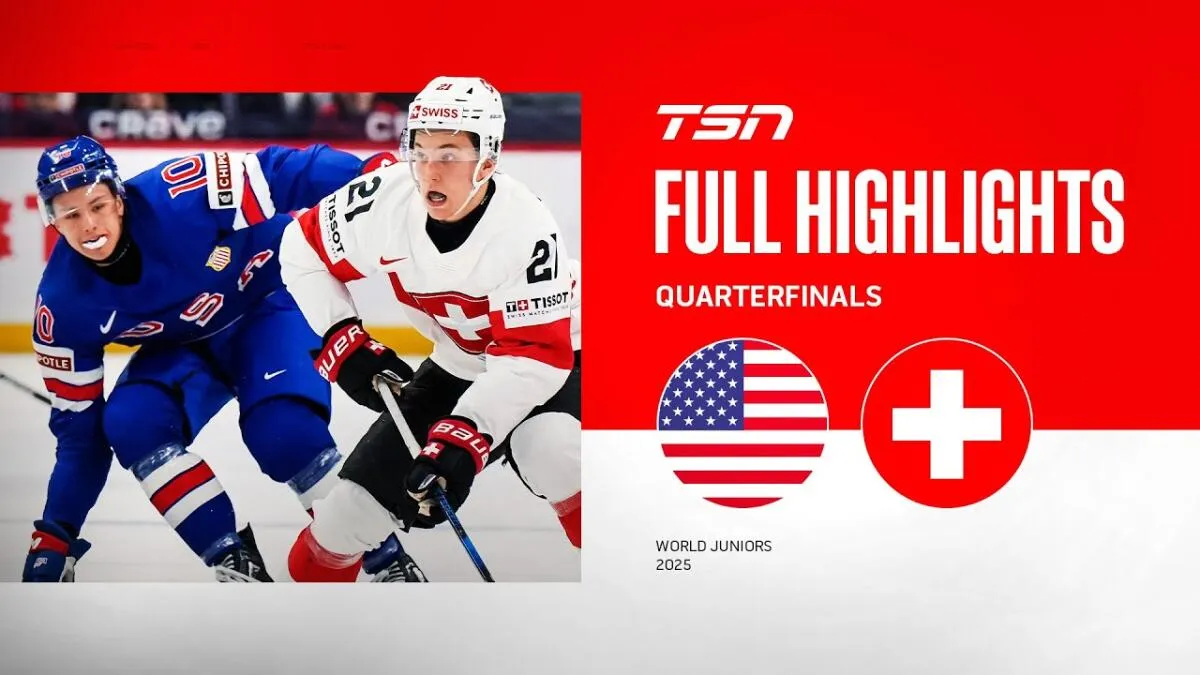
The reward for Switzerland’s advancement was a daunting quarterfinal matchup against the United States, who entered the tournament as defending champions and showcased offensive firepower led by Cole Hutson and Ryan Leonard. The Americans defeated Switzerland 7-2 in the quarterfinals at Canadian Tire Centre on January 2, overwhelming the Swiss with their depth and transition speed. While the result disappointed Swiss fans, the experience of competing against the eventual gold medalists provided a measuring stick for the program’s continued growth.
Latvia faced Sweden in their quarterfinal at TD Place Arena, where the Tre Kronor’s talent advantage proved decisive in a 3-2 victory. Despite the loss, Latvia’s competitive performance against a nation that finished fourth overall demonstrated their ability to challenge elite programs. Eriks Mateiko scored twice for Latvia, continuing his impressive tournament that saw him finish among the top scorers, while the Latvian penalty kill successfully negated all three Swedish power-play opportunities.
These results, while not advancing either nation further, set the stage for important relegation-round victories that secured their places in the 2026 tournament. Switzerland defeated Kazakhstan 3-1 and Latvia edged Germany 4-3 in overtime, ensuring both nations return to the top division alongside the world’s hockey elite. The ability to maintain top-tier status allows both federations to continue accessing IIHF development funds and provides their best young players with the platform to showcase their talents.
Looking ahead, Switzerland’s roster featured eight players eligible for the 2025 NHL Draft, including defenseman Leon Muggli and forward Ludvig Johnson, whose performances against top competition likely boosted their draft stock. Latvia’s Eriks Mateiko, already drafted by the Chicago Blackhawks, used the tournament to demonstrate his offensive upside, while goaltender Linards Feldbergs attracted attention from European professional clubs seeking young netminders.
The broader impact of Switzerland and Latvia’s advancement extends beyond individual careers. Both nations proved that systematic development, coaching excellence, and tactical discipline can overcome resource disparities. Their success stories provide roadmaps for other emerging hockey nations like Denmark and Kazakhstan, who faced relegation, illustrating the pathways to competitiveness at hockey’s highest junior level.
The 2025 IIHF World Junior Championship reaffirmed that hockey’s global landscape continues evolving. Switzerland and Latvia’s quarterfinal berths weren’t miracles but rather the product of dedicated development programs that have methodically closed the gap with traditional powers. While the United States captured their second consecutive gold medal, defeating Finland 4-3 in overtime, the tournament’s most encouraging storylines emerged from nations that proved the future of hockey belongs to more than just the usual suspects.
Junior tournaments serve as crystal balls for the sport’s future, and the performances from Swiss and Latvian players suggest both nations will remain competitive forces. The experience of playing under pressure in packed Canadian arenas, where even neutral fans appreciate underdog stories, provides psychological benefits that extend far beyond statistics. As these players transition to professional hockey, they carry with them the confidence earned by competing with—and occasionally defeating—the world’s best young talent. For Switzerland and Latvia, the 2025 tournament wasn’t just about reaching the quarterfinals; it was about announcing their permanent residence among hockey’s elite development nations.
Frequently Asked Questions

Par Mike Jonderson
Mike Jonderson is a passionate hockey analyst and expert in advanced NHL statistics. A former college player and mathematics graduate, he combines his understanding of the game with technical expertise to develop innovative predictive models and contribute to the evolution of modern hockey analytics.