





The Carolina Hurricanes have weathered an early-season storm without their defensive cornerstone, but the wait appears to be nearing its end. Jaccob Slavin, who has missed 20 consecutive games since October 11 with a lower-body injury, remains the most significant absence on a roster that has seen its defensive depth tested repeatedly through the first quarter of the 2025-26 campaign. While the Hurricanes have managed to stay competitive atop the Metropolitan Division, the difference between their current 21st-ranked penalty kill and the elite unit that has defined recent seasons rests largely on one man’s return.
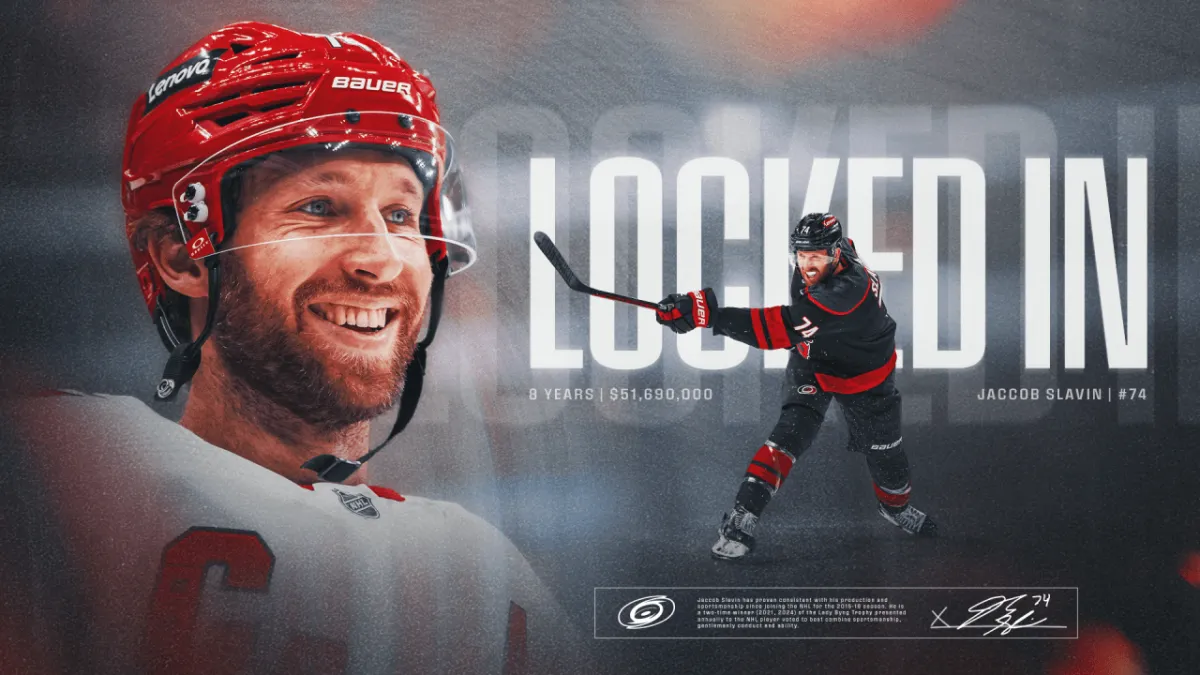
The gaping hole in Carolina’s defensive structure
The Hurricanes’ penalty kill has become the most visible casualty of Slavin’s absence. Through 22 games, the unit sits at 78.6 percent efficiency, having surrendered 15 power-play goals on 70 opportunities. This marks a dramatic fall from the dominant shorthanded groups that have historically ranked among the league’s best. The 2023-24 season saw Slavin average a team-leading 2:38 of shorthanded ice time per game, where his combination of positioning, stick work, and hockey IQ routinely disrupted opposing power plays before they could generate dangerous chances.
Rod Brind’imour’s system demands mobile defensemen who can close gaps quickly while maintaining structural integrity, and Slavin’s 24.19 miles per hour top speed from last season placed him in the 99th percentile league-wide. That elite skating ability allows him to cover for pinching partners, recover from turnovers, and eliminate transition opportunities that have occasionally burned the Hurricanes during his absence. Alexander Nikishin has admirably shouldered heavy minutes—logging a career-high 27:33 against Vegas—but the rookie’s emergence highlights how much Carolina has needed to overextend its remaining defenders.
The defensive zone possession metrics tell an equally stark story. In 2024-25, Slavin’s defensive zone time percentage of 36.6 placed him in the 94th percentile, while his 44.8 offensive zone deployment ranked in the 90th percentile. These numbers reflect a player who dictates territorial play through clean breakouts and intelligent positioning rather than brute physicality. Without him, the Hurricanes have been forced into a more conservative approach, limiting the offensive involvement of their remaining defensemen and placing additional pressure on forwards to support zone exits.
Slavin’s unique skillset beyond traditional metrics
What makes the Jaccob Slavin injury return impact on Hurricanes defense so profound extends well beyond conventional statistics. His 52.5 Corsi for percentage from last season demonstrates his ability to tilt the ice in Carolina’s favor, but it’s the subtle elements of his game that teammates and coaches emphasize when discussing his value. Two Lady Byng Trophies underscore a discipline that saw him commit just eight penalty minutes total across 80 regular season games and the entire 2024-25 playoff run—zero infractions in the postseason.
This clean play isn’t passive; it reflects perfect technique and decision-making under pressure. While other top-pairing defensemen might cross-check or trip opponents when beat, Slavin’s recovery skating and active stick prevent those desperate situations from developing. That discipline matters significantly when the Hurricanes already play a structured, low-penalty style that relies on staying out of the box to maintain momentum.
His sneaky offensive contributions also factor heavily into Carolina’s transition game. Despite being primarily a shutdown defender, Slavin’s ability to join rushes at the right moment and make intelligent first passes has helped the Hurricanes become one of the league’s most dangerous counter-attacking teams. His absence has forced Sean Walker and Shayne Gostisbehere into more defensive responsibilities, limiting their offensive freedom and reducing the blue line’s overall point production.
Coping mechanisms: How Carolina has survived without its anchor
The Hurricanes’ ability to maintain a 14-6-2 record and plus-13 goal differential speaks to organizational depth and coaching adaptability. Sean Walker has seen his ice time spike dramatically, often playing top-pairing minutes against opposing stars while maintaining solid possession numbers. The early-season experiment pairing him with Alexander Nikishin showed promise before Gostisbehere’s brief return and subsequent re-injury forced another reshuffle.
General manager Eric Tulsky has had to dig deep into the organization’s reserves, with players like Mike Reilly and Jalen Chatfield playing larger roles than initially projected. The defensive group has essentially operated with four top-four caliber defensemen instead of the usual six, forcing Brind’Amour to ride his best players hard. The impact on the development of young players like Alexander Nikishin has been significant, as the rookie defenseman has been asked to step up in ways that would have been developmental stretch goals in a normal season.
The penalty kill has relied heavily on forward support, with Jordan Staal and Jordan Martinook taking additional shorthanded shifts to compensate for the absence of a dedicated penalty-killing specialist on the back end. While effective in stretches, this approach has increased wear on the forward group and contributed to occasional second-period lulls where the team appears fatigued from shouldering heavier defensive burdens.
Projecting the return: What changes when Slavin re-enters the lineup
When Slavin finally returns, the ripple effects will transform every aspect of Carolina’s defensive approach. The penalty kill should immediately jump back toward the top 10, as his ability to pressure points, block passing lanes, and clear pucks under duress will reduce the workload on both the remaining defensemen and the forward group. Tim Gleason’s unit has been solid structurally but lacked the elite disrupting presence that Slavin provides.
Even-strength defense pairs will stabilize significantly. A healthy Slavin allows Brind’Amour to return to his preferred balanced approach, likely slotting back alongside Brett Pesce while moving Walker into a second-pairing role where he can be more offensive-minded. This cascading effect would push Nikishin to a more appropriate third-pairing deployment with sheltered offensive zone starts, accelerating his development without overexposing him.
The return also impacts roster construction and trade deadline strategy. Tulsky has had to keep extra defensemen on the active roster, limiting forward depth. With Slavin back, Carolina can carry its typical compliment of 13 forwards and 7 defensemen, giving Brind’Amour more flexibility in game situations and reducing the risk of further injuries from fatigue.
The broader implications for Carolina’s championship window
The Jaccob Slavin injury return impact on Hurricanes defense extends beyond tactical adjustments to fundamental questions about this team’s championship viability. A healthy Slavin transforms the Hurricanes from a strong defensive team with depth concerns into a legitimate Stanley Cup contender with few weaknesses. His presence enables the aggressive forechecking and transition game that makes Carolina dangerous against any opponent.
The timing also proves critical as the Metropolitan Division has tightened considerably. While Carolina currently sits first with 30 points, the Devils trail by just one point and the Islanders by two. Dropping points during Slavin’s absence could prove costly in division seeding, which becomes increasingly important as the playoff format rewards higher seeds with more favorable matchups.
Rod Brind’Amour’s system has been described as “defense through possession,” and Slavin is the engine that drives this philosophy. His ability to retrieve pucks, make the first clean pass, and support the offense allows the Hurricanes to control territorial play in ways that few teams can match. As the season grinds toward the playoffs, having their defensive leader back at full strength will determine whether this team can convert its perennial regular-season success into the deep postseason run its fanbase craves.
A defense restored: What Slavin’s comeback means for Carolina’s title hopes
The return of Jaccob Slavin represents more than just a key player coming back to the lineup—it signals the restoration of the Hurricanes’ identity. This is a team built on mobile defense, disciplined play, and overwhelming territorial dominance, and Slavin is the prototype for that philosophy. While the team has admirably survived his absence through depth, adaptability, and excellent goaltending, surviving isn’t the same as thriving.
With the defense returning to full strength, Carolina can shift from damage control to strategic optimization. The penalty kill should climb back into the league’s elite tier, even-strength possession numbers will improve markedly, and the coaching staff can return to their preferred lineup construction. Most importantly, Slavin’s return reduces the injury risk to players like Walker and Nikishin, who have been playing above their optimal deployment level.
As December approaches and the playoff race intensifies, the Hurricanes will need every advantage in a crowded Metropolitan Division. Getting their rock-solid defensive anchor back gives them something more valuable than any trade deadline acquisition: the return of the player who makes everyone around him better. The championship window remains open, and Jaccob Slavin’s return might be what finally pushes Carolina through it.
Frequently Asked Questions

Par Mike Jonderson
Mike Jonderson is a passionate hockey analyst and expert in advanced NHL statistics. A former college player and mathematics graduate, he combines his understanding of the game with technical expertise to develop innovative predictive models and contribute to the evolution of modern hockey analytics.