







The Carolina Hurricanes have been navigating treacherous waters this season, yet they’ve managed to stay afloat and thrive despite a relentless wave of injuries that would sink most NHL teams. With key players sidelined across the roster—from star defenseman Jaccob Slavin to goaltenders Frederik Andersen and Pyotr Kochetkov, and forwards Seth Jarvis and Jesperi Kotkaniemi—the Hurricanes have had to lean heavily on their organizational depth. What’s remarkable isn’t just that they’re surviving; it’s that they’re excelling, maintaining a playoff position while their depth players seize opportunities and demonstrate why Carolina’s development system is among the league’s best.
The true test of any championship-caliber organization isn’t how they perform at full strength, but how they respond when adversity strikes. The Hurricanes are passing that test with flying colors, as their next-man-up mentality has transformed from a cliché into a competitive advantage that’s keeping them in the Metropolitan Division hunt.
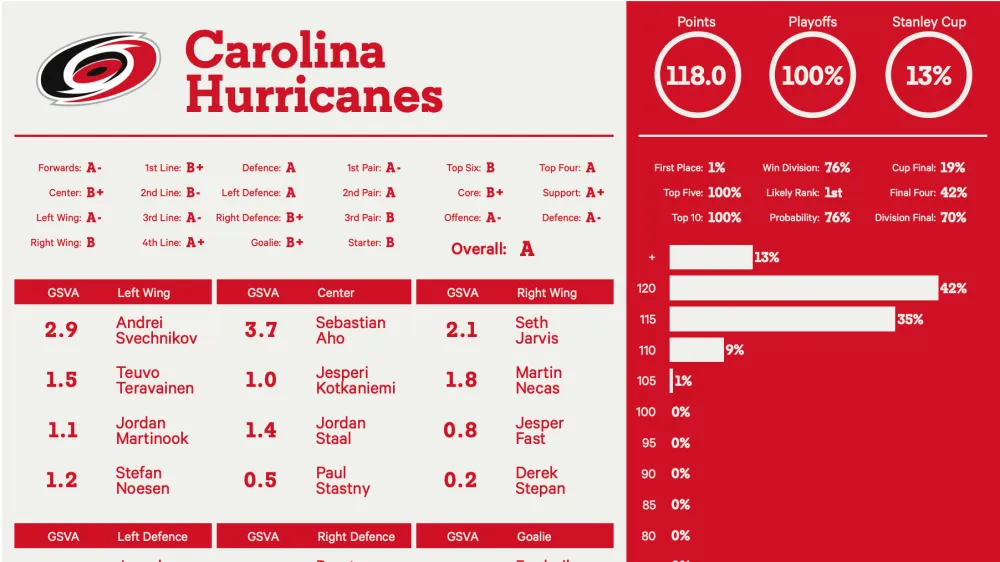
How Carolina Hurricanes injury depth players stepping up has fueled offensive production
One of the most surprising developments during Carolina’s injury crisis has been their offensive output. Historically, the Hurricanes have been a defense-first team that grinds out victories through Rod Brind’Amour’s structured system. This season tells a different story. As of mid-November, the Hurricanes ranked fifth in the NHL with 64 goals through 17 games, a significant jump from their 10th-place finish in goal-scoring last season.
The offensive contributions have been remarkably balanced, with nearly every line contributing meaningfully. Sebastian Aho and Seth Jarvis continue to lead the charge, both hovering around a point-per-game pace. But the emergence of Jackson Blake has been particularly noteworthy, as the rookie has collected 11 points while filling a larger role than initially anticipated. Blake wasn’t expected to carry significant offensive responsibility, yet he’s proven capable of producing in elevated minutes.
Beyond the top line, secondary scoring has materialized from unexpected sources. Logan Stankoven, Nikolaj Ehlers, and Andrei Svechnikov have all maintained roughly 0.5 points per game, providing the depth scoring that’s essential when key forwards are sidelined. Perhaps most impressively, K’Andre Miller has contributed eight points in nine games while adjusting to a new team and taking on increased defensive responsibilities.
The offensive surge hasn’t been accidental. With defensive depth stretched thin, the Hurricanes have embraced a “best defense is a good offense” mentality, outscoring their problems rather than trying to replicate the defensive structure they normally rely on. This approach would be unsustainable for most teams, but Carolina’s systematic approach and roster-wide buy-in has made it work. Every player understands their role needs to expand when injuries hit, and the offensive numbers reflect that collective commitment.
Jordan Martinook, typically a fourth-line energy player, has also chipped in offensively while maintaining his physical edge. This roster-wide contribution is what separates good teams from great ones—when everyone pulls their weight, injuries become less devastating. The Hurricanes are projecting toward a 115-point pace, a testament to how effectively they’ve compensated for missing key personnel through offensive firepower.
Carolina Hurricanes injury depth players stepping up on the blue line
The defensive corps has been hit hardest by injuries, yet somehow the Hurricanes have maintained their defensive integrity. Jaccob Slavin, widely regarded as one of the NHL’s best defensive defensemen, hasn’t played since the second game of the season. Shayne Gostisbehere has endured two separate stints on injured reserve. Jalen Chatfield received an illegal check to the head and remains out indefinitely. Even the injury replacements have been getting injured—Mike Reilly took a skate boot to a sensitive area, Joel Nystrom missed time after taking a puck to the face, and Charles Alexis Legault had his hand cut open by a skate blade, requiring surgery that will sideline him for three to four months.
In the absence of experienced NHL defensemen, Carolina has turned to their prospect pipeline, and the results have been nothing short of remarkable. Three different defensemen from the Chicago Wolves have been called up and thrust into significant roles: Charles Alexis Legault, Joel Nystrom, and Dominick Fensore. While Fensore’s role has been minimal and specialized for power-play situations, the other two have seized their opportunities with impressive maturity.
Joel Nystrom has evolved into one of Rod Brind’Amour’s most dependable options, particularly on the penalty kill. Stepping into penalty-killing responsibilities when Carolina’s established specialists are injured would be daunting for any young player, but Nystrom has embraced the challenge. His positioning and hockey IQ have allowed him to fill minutes in high-leverage situations without becoming a liability.
Charles Alexis Legault impressed during training camp and the preseason, making him a natural choice when injuries mounted. His physical, old-school approach might seem outdated in today’s NHL, but his skating ability ensures he fits Carolina’s up-tempo system. Before his unfortunate hand injury, Legault was making a strong case for permanent roster inclusion, playing a meaningful role in several confidence-building victories. His injury is a significant blow, as he was providing exactly the kind of physical presence and mobility the Hurricanes needed.
The emergence of Alexander Nikishin has been the defining story of Carolina’s defensive resilience. The Russian rookie was expected to contribute this season, but not to this extent. Originally slated for a gradual introduction to the NHL with a more prominent role developing later in the season, Nikishin has instead been thrown into a baptism by fire—and he’s thriving. Through the first 17 games, he’s recorded an assist in multiple contests and has demonstrated the skating ability, physicality, and offensive creativity that made him a highly-touted prospect. Most importantly, he’s helped fill the massive void left by Slavin’s absence, proving that Carolina’s patience in his development was well-founded.
How Carolina Hurricanes injury depth players stepping up validates organizational philosophy
Rod Brind’Amour’s system is famously simple to understand but physically demanding to execute. Unlike most NHL teams that employ zone defense and trade off coverage responsibilities, the Hurricanes play man-on-man defense that requires defensemen to stick with opposing forwards throughout the defensive zone. This approach demands excellent skating ability and tireless effort, as any lapse in concentration can lead to a scoring chance with no safety net beyond the goaltender.
The beauty of this system during an injury crisis is its plug-and-play nature. Because the responsibilities are straightforward—stay with your man, support the puck carrier, get pucks deep—players can step in and contribute quickly without requiring weeks to learn complex zone rotations. The physical demands are still significant, but the mental adjustments are minimal, allowing call-ups from the AHL to make immediate impacts.
This was evident during the 2021-22 season when a COVID-19 outbreak decimated Carolina’s roster. The organization recalled nearly the entire Chicago Wolves lineup and proceeded to beat the Los Angeles Kings and Detroit Red Wings with an emergency roster. Similarly, during the 2023 playoffs, the Hurricanes were without Teuvo Teravainen, Jack Drury, Max Pacioretty, and Andrei Svechnikov, yet AHL call-up Mackenzie MacEachern scored a goal while playing on the top line—a role he had no business being in under normal circumstances.
The consistency with which Carolina’s depth players succeed isn’t coincidental. It’s the result of a comprehensive organizational philosophy that emphasizes specific attributes in player acquisition and development. The Hurricanes’ three-goalie rotation approach exemplifies this forward-thinking mentality, turning perceived roster surplus into strategic depth that can be deployed when injuries inevitably occur. The organization prioritizes skating ability, hockey IQ, and work ethic over pure skill, knowing that these attributes translate across different lineup positions and situations.
General manager Eric Tulsky and his staff have built a roster where the gap between regular players and depth options is minimal. This is by design, as Carolina’s scouting and player development infrastructure focuses on identifying players who fit their system’s demands. The Chicago Wolves aren’t just an AHL affiliate; they’re a laboratory where prospects learn Carolina’s system and culture, ensuring seamless transitions when promotions occur. Players arrive in Raleigh already understanding what’s expected, dramatically reducing the typical adjustment period.
The emphasis on organizational culture cannot be overstated. Brind’Amour has fostered an environment where accountability and effort matter more than individual statistics or reputation. This creates a locker room where depth players aren’t intimidated by increased responsibility—they embrace it. When injuries create opportunities, there’s no sense of “trying to survive” until regulars return; instead, there’s a competitive drive to prove they belong. That mentality transforms depth players into legitimate contributors rather than placeholders.
Carolina Hurricanes injury depth players stepping up positions team for playoff success
The Hurricanes’ ability to maintain a 12-5-0 record through extensive injuries provides crucial insights into their playoff potential. Championship teams aren’t defined by their best players; they’re defined by their depth and resilience. Carolina is demonstrating both qualities in abundance. When the playoffs arrive and roster depth is tested through the physical grind of postseason hockey, the Hurricanes will have players with valuable high-leverage experience.
Joel Nystrom’s penalty-killing development is particularly significant. Playoff hockey is often decided by special teams, and having multiple players capable of killing penalties gives Carolina flexibility and redundancy. If injuries occur in the postseason—a near certainty over a potential four-round run—the Hurricanes won’t be scrambling to fill crucial special teams roles. They’ll have players who’ve already proven themselves under pressure.
Similarly, Alexander Nikishin’s rapid development could prove invaluable. Rookie defensemen typically struggle in the playoffs, where game speed and physicality increase dramatically. But if Nikishin continues his current trajectory, he’ll enter the postseason with 70-plus regular season games of experience, including significant minutes in high-pressure situations. That experience could make him a genuine playoff asset rather than a liability that opponents target.
The offensive contributions from depth forwards like Jackson Blake and Logan Stankoven also bode well for playoff success. Secondary scoring often determines playoff series, as opponents game-plan to neutralize top lines. Having multiple players who’ve produced in elevated roles throughout the regular season gives Carolina offensive options that many opponents can’t match. These players aren’t hoping to contribute in the playoffs—they’re expecting to, based on their regular season performance.
Perhaps most importantly, the injury adversity is building mental toughness and team cohesion. Every player in the locker room has been forced to contribute beyond their expected role, creating collective investment in the team’s success. This isn’t a roster where stars carry the load while depth players collect paychecks; it’s a group where everyone has contributed to keeping the season on track. That shared experience creates the kind of unity that championship teams possess.
There are legitimate concerns about sustainability. The Hurricanes are on a 115-point pace while missing their best defensive defenseman and juggling injuries across the roster. At some point, depth runs thin, and asking role players to produce like regulars becomes unrealistic. According to data from The Hockey Writers, the sheer volume of injuries—including multiple instances of injury replacements getting injured themselves—suggests Carolina may be pushing the limits of what organizational depth can accomplish.
However, there are reasons for optimism. Players are gradually returning from injury, with Eric Robinson, William Carrier, and Shayne Gostisbehere all recently rejoining the team for practice. As the roster returns to full strength, Carolina won’t be relying solely on depth players; instead, they’ll have a deeper roster with players who’ve proven capable of handling increased responsibility. This creates competition for ice time and roster spots, which typically elevates everyone’s performance.
The Hurricanes are proving that modern NHL success isn’t just about acquiring star players—it’s about building organizational depth and systems that maximize every player’s contribution. While teams like Toronto and Edmonton rely heavily on their superstars, Carolina has built a roster where the 10th-best forward and 6th defenseman can step in and maintain competitiveness. In a salary cap league where roster construction is constantly constrained, this approach provides a sustainable competitive advantage.
As the season progresses and injured players return, the Hurricanes will face new challenges. Reintegrating players into the lineup while maintaining chemistry with the depth players who’ve earned ice time will require careful management from Brind’Amour. But these are good problems to have, the kind that indicate organizational strength rather than weakness. The fact that difficult lineup decisions loom because multiple players are performing well speaks volumes about Carolina’s depth and player development success.
The Metropolitan Division remains highly competitive, with multiple teams capable of winning the conference. But the Hurricanes have demonstrated a crucial quality that separates contenders from pretenders: resilience. When adversity struck in the form of a devastating injury wave, Carolina didn’t collapse or make excuses. Their depth players stepped up, their systems held firm, and their organizational culture proved capable of weathering the storm. Whether this resilience translates to playoff success remains to be seen, but the foundation is undeniably strong. The next man up isn’t just a mentality in Carolina—it’s a proven strategy that’s keeping them in the championship hunt despite circumstances that would derail lesser organizations.
Frequently Asked Questions

Par Mike Jonderson
Mike Jonderson is a passionate hockey analyst and expert in advanced NHL statistics. A former college player and mathematics graduate, he combines his understanding of the game with technical expertise to develop innovative predictive models and contribute to the evolution of modern hockey analytics.