





The Toronto Maple Leafs find themselves in uncharted territory as the 2025-26 NHL season approaches its quarter mark. With a record hovering around .500 and the Atlantic Division basement staring them in the face, the organization faces mounting pressure to turn things around. The recipe for disaster has been equal parts injuries, underperformance, and systemic failures on special teams. Yet amid the chaos, William Nylander has emerged as both a beacon of hope and a symbol of the team’s fragility after his recent lower-body injury. This 3 Up 3 Down analysis examines what’s working, what’s broken, and whether this talented roster can dig itself out of an early-season hole that no one predicted when training camp opened.
The three biggest positives for Toronto in 2025-26
Nylander’s career-year pace before injury setback
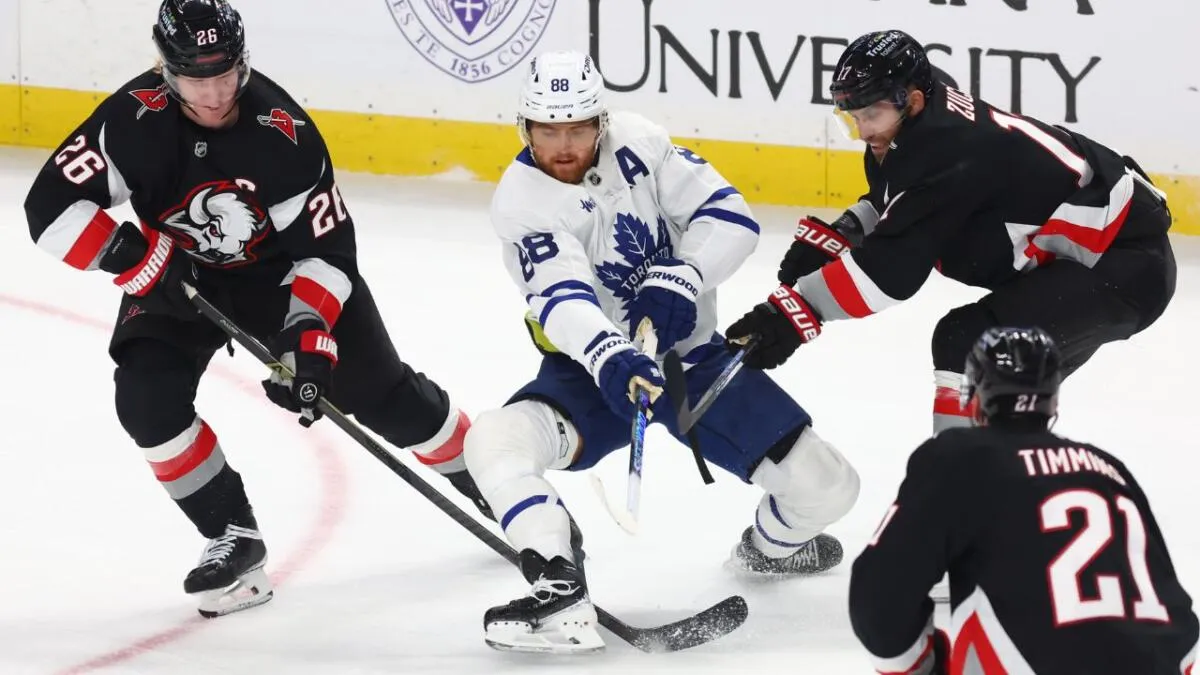
William Nylander has been the one constant in a sea of mediocrity for the Maple Leafs through the first 22 games. Before his recent lower-body injury forced him to miss time, the Swedish winger was on an absolute tear, posting 29 points in just 19 games, including 10 goals and 19 assists. That production placed him firmly in the NHL’s top-five scorers and put him on pace for what would easily be a career-high 128-point season. More impressive than the raw numbers has been his evolution into the team’s true offensive engine in the absence of Mitch Marner. Nylander has shown a confidence with the puck that suggests he’s ready to be the guy in Toronto, controlling play through the neutral zone and making high-skill plays in tight spaces that few players in the league can execute. His ability to generate offense independent of Auston Matthews has proven that his $11.5 million cap hit isn’t just justified—it’s becoming a bargain.
The advanced metrics back up the eye test. Nylander has been driving possession at a 56% rate and creating high-danger scoring chances at a clip the Maple Leafs haven’t seen from a winger since Marner’s prime. He’s been particularly dangerous on the rush, using his elite skating and puck-handling to create odd-man situations that favor Toronto’s skill players. Even more encouraging for a player sometimes criticized for defensive lapses, Nylander has shown improved commitment to backchecking and supporting his defensemen in transition, a development that hasn’t gone unnoticed by Craig Berube’s coaching staff.
Nick Robertson’s emergence in top-six role
If there’s a silver lining to the Maple Leafs’ salary cap constraints and player departures, it’s Nick Robertson finally getting his opportunity. The 23-year-old forward, who seemed destined for a trade during the offseason after reports surfaced that Toronto offered him to Columbus for Yegor Chinakhov, has seized his chance with both hands. Through 21 games, Robertson has posted 11 points while establishing himself as a legitimate top-six forward who can play with speed and tenacity. His evolution has been most evident in his puck management—gone are the days of panic plays and unnecessary turnovers. Instead, Robertson has shown the poise to carry the puck into the offensive zone, protect it along the boards, and wait for prime shooting lanes to develop.
What makes Robertson’s emergence so critical is his chemistry with the remaining core players. He’s found a home alongside Tavares and Nylander on the second line, providing the kind of secondary scoring that championship teams require. His defensive game has also taken a significant step forward, as he’s no longer a liability in his own end and has cut down significantly on the undisciplined penalties that plagued his earlier seasons. For a team that’s been searching for homegrown talent to supplement its expensive stars, Robertson’s development represents a rare win for Toronto’s player development system and gives the organization a cost-controlled asset who can contribute meaningful minutes in high-leverage situations.
McCabe’s injury scare provides veteran stability
While the Maple Leafs have been devastated by injuries to their star players, they’ve at least received good news regarding Jake McCabe. The veteran defenseman took a frightening puck to the face against Columbus, prompting fears of a significant absence that would further deplete an already thin blue line. However, McCabe escaped with only a minor injury and missed just one game before returning to the lineup, providing a stabilizing presence that Toronto desperately needs with Chris Tanev and Brandon Carlo both on the shelf. His ability to play heavy minutes against top competition while logging significant penalty kill time has made him arguably the team’s most valuable defenseman in this crisis period.
McCabe’s importance extends beyond his on-ice contributions. As one of the few veterans in the locker room who has experienced adversity throughout his career, he’s taken on a larger leadership role, particularly with younger players like Topi Niemela and Fraser Minten getting unexpected NHL reps. His calm demeanor and professional approach to preparation have set a standard that Berube has praised publicly, calling McCabe “a guy you can count on every single night.” With the uncertainty around when Tanev and Carlo might return, having McCabe healthy and available to anchor the top pairing with Morgan Rielly gives the coaching staff at least one reliable combination they can turn to in crucial situations.
The three biggest negatives threatening playoff hopes
Injury crisis has decimated the core
No analysis of Toronto’s struggles would be complete without acknowledging the catastrophic impact of injuries. The Maple Leafs have six regulars on injured reserve or long-term injured reserve, including captain Auston Matthews, emerging star Matthew Knies, shutdown center Nicolas Roy, defensive stalwarts Chris Tanev and Brandon Carlo, and starting goaltender Anthony Stolarz. That’s over $35 million in salary cap hit unable to dress for games, forcing Toronto to rely on AHL call-ups and players in roles they’re not suited for. The Maple Leafs’ injury crisis has reached epidemic proportions, with the team unable to establish any lineup consistency or build chemistry between linemates.
The ripple effects have been devastating. Without Matthews, the power play has collapsed, dropping to 26th in the league at just 15.5% efficiency through 22 games. The absence of Knies has removed the team’s fastest forechecker and one of its most effective penalty killers. Roy’s injury has forced Tavares into more defensive responsibilities, limiting his offensive contributions. Perhaps most damaging has been the loss of both Tanev and Carlo, which has turned the Maple Leafs’ once-formidable penalty kill into a sieve, ranking 29th in the NHL at 72.4%. General manager Brad Treliving has remained publicly calm, insisting that the team will benef rom the process of adversity, but privately, the front office must be questioning whether this roster construction can withstand the rigors of an 82-game season.
Power play failures despite elite talent
For all the offensive firepower that Toronto possesses, their power play has been nothing short of abysmal. Through the first 22 games, the Maple Leafs have converted just 9 of 58 opportunities for a success rate of 15.5%, placing them 26th in the league. This represents a shocking underperformance for a unit that features elite talents like Nylander, Tavares, and Rielly, and it’s particularly galling given the organization brought in Marc Savard specifically to fix these exact issues. The problems are multi-faceted: there’s been poor zone entries, stagnant puck movement, a reluctance to shoot from prime scoring areas, and an over-reliance on individual creativity rather than systematic execution.
The eye test shows a power play that’s completely lacking in confidence and structure. Players are hesitating when they should be shooting, forcing passes through lanes that aren’t there, and generally playing with the kind of tentativeness that signals deeper issues. Savard’s system, which was supposed to maximize movement and create confusion for penalty killers, has instead looked predictable and easy to defend. Opponents have figured out that they can pressure Nylander at the point, force the puck to the half-walls, and then collapse down low to take away passing lanes. Until the coaching staff makes significant adjustments or the injured stars return to provide more options, this power play will continue to cost the Maple Leafs crucial points in a tight Eastern Conference race.
Slow start creates uphill playoff battle
Toronto’s 9-10-3 record through 22 games has them sitting in the Atlantic Division basement, a position no one envisioned for a team with this much talent. While they’re only six points out of first place thanks to the competitive nature of the division, the slow start has already created a significant uphill battle. Historically, teams that dig this deep a hole in the first quarter of the season have less than a 50% chance of making the playoffs, even with a strong finish. The Maple Leafs have been plagued by inconsistent efforts, playing well in stretches but then completely collapsing for five-minute spans that swing games. Their inability to close out third-period leads has been particularly concerning, with the team surrendering late goals in seven games already this season.
The underlying numbers paint an even more worrying picture. Toronto’s expected goals percentage sits at just 48.2%, indicating they’re being outplayed at even strength. Their goaltending, even before Stolarz’s injury, was below league average with a team save percentage of .897. The defensive structure that Berube was brought in to establish has shown flashes but hasn’t been sustained, with the team giving up too many odd-man rushes and failing to clear the front of the net consistently. With five teams in the Atlantic looking like legitimate playoff contenders, the margin for error is essentially gone. The Maple Leafs will need to play at a 100-point pace for the remaining 60 games just to secure a wild card spot, a tall order with their current injuries.
Nylander’s injury impact and timeline
The latest blow came when William Nylander suffered a lower-body injury on October 25 against Montreal, forcing him to miss critical games during Toronto’s five-game losing streak. The injury occurred when he collided with a teammate on his way back to the bench, a freak accident that exemplified the bad luck consuming this franchise. Initial reports suggested it might be a day-to-day situation, and Nylander’s injury update provided some optimism for worried fans. He returned to action on October 29 against Winnipeg, registering an assist in 18:49 of ice time and demonstrating that the injury wasn’t serious enough to keep him out long-term.
However, the brief absence highlighted just how dependent this team has become on Nylander’s production. During the games he missed, Toronto’s offense managed just two goals total, and the power play looked completely lost without its primary puck distributor. Since returning, Nylander has been effective but not quite at his previous dominant level, with the injury seemingly limiting his explosiveness and willingness to drive the middle of the ice. The medical staff has been monitoring his minutes closely, and Berube has acknowledged that while Nylander is healthy enough to play, they’re being cautious about pushing him too hard given the team’s already depleted state.
What the future holds for Toronto’s playoff push
Despite the mountain of problems facing the Maple Leafs, the path forward isn’t completely dark. The Atlantic Division is so competitive that no team has pulled away, meaning Toronto remains within striking distance despite their poor start. The impending return of Matthews could provide the jolt this team needs, particularly for the power play and overall offensive structure. His presence alone would force opponents to change their defensive schemes, creating more space for Nylander and Tavares to operate. Additionally, the experience that young players like Robertson, Minten, and Niemela are gaining during this crisis period could pay dividends later in the season when depth becomes crucial.
The front office also has options to address the defensive and goaltending issues through trade. With the injury situation creating cap space through LTIR, Treliving has flexibility to add a veteran defenseman or a more reliable backup goaltender without moving major salary. The trade market typically heats up around American Thanksgiving, and Toronto’s position as a buyer could allow them to acquire reinforcements before the playoff race intensifies. However, this assumes the team can stay within touching distance of a playoff spot while their stars recover, a proposition that becomes more tenuous with each loss.
The next 20 games will define this season. If the Maple Leafs can navigate through their current health crisis and emerge with a record around .500, they’ll have a realistic chance to make a second-half push when their full roster is available. But if the losses continue to pile up and the gap to playoff position widens, hard questions will need to be asked about the core’s ability to deliver in Toronto. For now, William Nylander remains the team’s best hope for salvation, but even his brilliance can’t mask the structural issues that have plagued this franchise for far too long. The 2025-26 season hangs in the balance, and time is running out for a team that was supposed to contend for a Stanley Cup.
Frequently Asked Questions

Par Mike Jonderson
Mike Jonderson is a passionate hockey analyst and expert in advanced NHL statistics. A former college player and mathematics graduate, he combines his understanding of the game with technical expertise to develop innovative predictive models and contribute to the evolution of modern hockey analytics.