








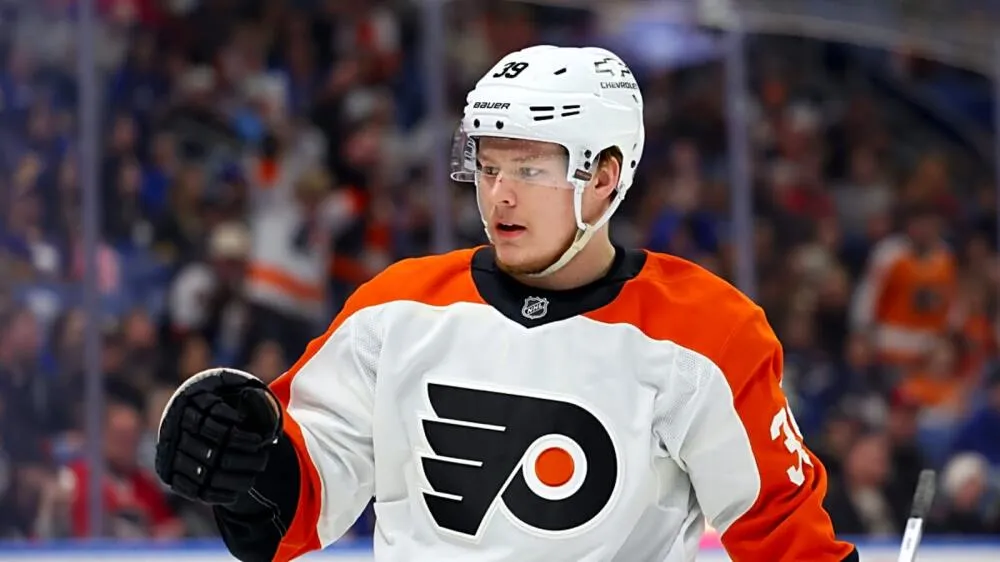
The Philadelphia Flyers find themselves at a crossroads that few NHL franchises face: their prized prospect has become a source of division rather than unity. Matvei Michkov, the seventh overall pick in the 2023 NHL Draft, was supposed to be the savior who would lead the Flyers out of their playoff drought. Instead, his sophomore season has exposed a fundamental rift within the organization and its fan base, creating two distinct factions with irreconcilable visions for the team’s future.
What started as optimism surrounding Michkov’s arrival from the KHL has devolved into a contentious debate about identity, coaching philosophy, and whether the young Russian forward fits into head coach Rick Tocchet’s defensive-minded system. The solution, as counterintuitive as it may sound, might be to trade the player many considered untouchable. Such a move could paradoxically maximize fan morale by giving each faction what they truly want, even if neither side would admit it publicly.
The Philadelphia Flyers trade Matvei Michkov to maximize fan morale: understanding the system-first faction
The first group of Flyers supporters has fully embraced Rick Tocchet’s vision for sustainable, playoff-caliber hockey. With the team sitting at 8-5-1 through their first 14 games, this faction sees tangible results from a coach who preaches accountability and defensive structure. They’ve watched the Flyers secure a wildcard position, something that felt impossible during recent rebuilding years, and they’re willing to sacrifice individual star power for collective success.
This perspective isn’t rooted in animosity toward Michkov personally. Rather, it’s grounded in pragmatism. Tocchet signed a five-year contract extension in May, making it abundantly clear that the organization has committed to his methodology for the long haul. If a player can’t or won’t adapt to that system, regardless of his draft pedigree, then he becomes expendable. The coach’s track record with the Florida Panthers’ Paul Maurice-style approach has proven that tough love can yield championships.
The system-first supporters point to Michkov’s ice time as evidence of his shortcomings. Playing under 15 minutes per night isn’t punishment—it’s earned playing time based on performance and adherence to team concepts. When Travis Konecny struggles but maintains top-line usage, they argue it’s because he buys into the defensive responsibilities that Tocchet demands. Michkov, conversely, has found himself in the proverbial doghouse multiple times despite occasional offensive flashes.
Trading Michkov would validate this faction’s belief system entirely. The return package could include players who fit Tocchet’s mold immediately, along with draft picks to bolster an already impressive prospect pool that includes 2025 sixth overall selection Porter Martone. Imagine adding those assets to a roster already featuring Trevor Zegras, who has thrived under the new regime’s structure. The Flyers could accelerate their timeline from hopeful rebuilder to legitimate contender.
The accountability message would resonate throughout the locker room. No player, regardless of talent or draft position, stands above the team’s identity. This philosophy mirrors successful organizations that have won Stanley Cups in recent years by prioritizing culture over individual accolades. For fans who’ve endured mediocrity since the 2020-21 season, watching a cohesive unit compete for playoffs now beats waiting for a gifted player to maybe reach his ceiling in three or four years.
Furthermore, this group sees Michkov’s current production—one goal and five assists through 13 games—as confirmation that he isn’t ready for expanded responsibilities. His rookie season numbers of 26 goals and 37 assists were respectable, but finishing fourth in Calder Trophy voting suggests he wasn’t the transformative talent some projected. If the Flyers can extract maximum value now before his trade value potentially diminishes, they should strike while the iron is hot.
Why the Philadelphia Flyers trade Matvei Michkov to maximize fan morale for offense-first supporters
On the opposite end of the spectrum sits a passionate contingent that believes the Flyers are squandering generational talent. These fans watched Michkov dominate under interim head coach Brad Shaw at the end of last season, posting 12 points in nine games when given first-line minutes and offensive freedom. They see a 20-year-old with superstar potential being stifled by a coach whose defensive-first philosophy actively suppresses the creativity that makes hockey entertaining.
This faction draws comparisons to Connor Bedard and Macklin Celebrini, the first overall picks from 2023 and 2024 respectively, who are currently first and second in NHL scoring with over 22 points each. The Chicago Blackhawks and San Jose Sharks have empowered their young stars with significant ice time and offensive deployment, allowing them to develop confidence and showcase their elite skills. Meanwhile, Michkov languishes on the third line, his ice time restricted and his offensive instincts neutered by rigid systems.
The frustration intensifies when considering Tocchet’s documented history with Russian players and offensive-minded forwards. Multiple star players have either declined or stagnated under his coaching, raising legitimate questions about whether he’s the right person to nurture Michkov’s development during these crucial formative years. The phrase “tough love” has become a euphemism for what appears to be fundamental incompatibility between coach and player.
According to reports from David Pagnotta of The Fourth Period, the organization has already held discussions with Michkov to address their concerns. While team sources maintain they’re “incredibly high” on the player, the need for such conversations so early in the season indicates deeper problems. For fans who prioritize skill and entertainment value, this represents organizational malpractice—attempting to force a square peg into a round hole rather than adapting systems to maximize talent.
These supporters also question the sustainability of the Flyers’ current success. The team has relied heavily on elite goaltending from Dan Vladař to compensate for low-event, defensive hockey that produces little offensive excitement. While the record looks impressive on paper, the underlying metrics and eye test suggest a team playing close to the vest, hoping not to make mistakes rather than imposing their will on opponents. This conservative approach may yield short-term playoff appearances but lacks the dynamic offensive weaponry needed for deep postseason runs.
A Michkov trade would liberate these fans from the cognitive dissonance of cheering for an organization that doesn’t share their values. They could continue supporting the Flyers while also adopting Michkov’s new team as a secondary rooting interest, following his development under coaches who appreciate offensive creativity. Whether he lands with a rebuilding team that can showcase him or a contender that deploys him on the power play, watching his career flourish elsewhere would provide more satisfaction than witnessing his nightly benching in Philadelphia.
The offense-first faction also recognizes that this situation benefits nobody as currently constructed. Discussions around whether Daniel Brière is sabotaging Michkov’s career have become commonplace in fan forums and social media circles. The longer this tension festers, the more it damages both the player’s development and the organization’s reputation. A clean break might represent the most humane solution for all parties.
How the Philadelphia Flyers trade Matvei Michkov to maximize fan morale could reshape the franchise
The practicalities of executing such a blockbuster deal would require careful navigation of trade mechanics and public relations. General manager Danny Brière would need to frame the transaction as addition by subtraction—emphasizing what the Flyers gain rather than what they’re losing. The return package would likely include a combination of NHL-ready players who excel in Tocchet’s system, high-end prospects, and premium draft picks.
Potential trade partners might include teams with established infrastructures seeking offensive catalysts. The Montreal Canadiens possess multiple first-round picks and could offer Nick Suzuki’s former linemate Cole Caufield as a centerpiece, though their own Russian player situation complicates things. The Chicago Blackhawks could pair Michkov with Connor Bedard in a dynamic offensive duo, sending back defensive assets the Flyers covet. The Anaheim Ducks, having already dealt Trevor Zegras to Philadelphia, might circle back with Mason McTavish and additional pieces.
The immediate aftermath would test both fan factions’ convictions. System-first supporters would need their new acquisitions to produce tangibly better results than what Michkov provided. If the Flyers miss the playoffs despite the roster overhaul, second-guessing would be inevitable and brutal. Conversely, offense-first fans would need Michkov to thrive in his new environment, validating their belief that coaching and deployment were the primary obstacles to his success.
From a hockey operations perspective, trading Michkov could actually increase organizational cohesion. The current situation has created uncomfortable dynamics where players wonder about their own security and coaching staff faces constant scrutiny over ice-time decisions. Removing the source of friction allows everyone to focus on collective goals without the distraction of a high-profile benching narrative dominating media coverage.
The move would also send a clear message throughout the NHL about Philadelphia’s organizational identity. The Flyers are building around Tocchet’s principles, full stop. Young players entering the system would know exactly what’s expected, and veteran free agents would understand the culture they’re joining. This clarity, while potentially limiting in terms of attracting certain player types, eliminates ambiguity and sets concrete expectations.
Financial considerations play a role as well. Michkov’s entry-level contract runs through the 2026-27 season with a $950,000 cap hit, making him one of the league’s best values if he reaches his potential. However, that same affordability makes him attractive trade bait, as acquiring teams could build around him without cap constraints. The Flyers, meanwhile, could redirect that salary room toward veterans who immediately elevate their playoff chances.
The Philadelphia Flyers trade Matvei Michkov to maximize fan morale: precedents and parallels
NHL history offers cautionary tales and success stories for organizations that moved on from high-profile prospects due to philosophical differences. The Ottawa Senators traded Alexei Yashin at the height of his powers, and while the return didn’t pan out perfectly, it allowed the franchise to build the culture that reached the 2007 Stanley Cup Final. More recently, the Winnipeg Jets traded Pierre-Luc Dubois after clearly losing faith in his commitment, a move that looked questionable initially but ultimately proved correct.
The Peter Forsberg trade remains the gold standard for extracting value from elite young talent. The Philadelphia Flyers themselves were on the receiving end of that 1992 blockbuster that brought Eric Lindros to Pennsylvania. While Lindros never delivered a Stanley Cup, he gave the organization its identity for nearly a decade. The Flyers could seek a similar transformational return, even if it means accepting that Michkov becomes a perennial All-Star elsewhere.
Conversely, the Toronto Maple Leafs’ refusal to trade disgruntled prospects has generally served them well. Both Mitch Marner and William Nylander faced trade rumors during contract disputes, yet the organization’s patience was rewarded with star players who evolved into core pieces. The difference lies in coaching compatibility—those players thrived under the systems they were asked to execute. Michkov’s situation more closely resembles a fundamental mismatch than typical growing pains.
Current reporting suggests the Flyers remain committed to Michkov despite the friction. Analysis of the debate surrounding fan factions indicates organizational awareness of the delicate situation, but no concrete trade discussions have surfaced publicly. However, the fact that team officials felt compelled to meet with Michkov to address performance concerns signals that all options remain on the table if the situation deteriorates further.
The Trevor Zegras acquisition provides an interesting case study within the same locker room. The 24-year-old center arrived from Anaheim with questions about his defensive commitment and consistency, yet he’s flourished under Tocchet’s guidance. According to The Hockey Writers, Zegras has been “dominant” while Michkov struggles to find his footing. This contrast suggests the issue isn’t entirely systemic—some players adapt while others don’t.
League-wide trends also favor trading high-picks before their value completely evaporates. The Buffalo Sabres held onto their prospects too long, watching them stagnate in perpetual rebuilding. The Carolina Hurricanes, conversely, have repeatedly traded prospects and picks for established players, building a perennial contender. The Philadelphia approach under Brière has attempted to balance both philosophies, but Michkov’s situation may force a definitive choice.
What trading Matvei Michkov means for the Philadelphia Flyers’ championship window
The ultimate measure of any franchise decision comes down to Stanley Cup potential. Trading Michkov would require the Flyers to land pieces that accelerate their timeline rather than simply maintaining the status quo. The return package must include players who can contribute immediately to playoff runs while Tocchet remains in his prime coaching years and the current roster core stays intact.
If executed properly, the move could transform Philadelphia from hopeful playoff participant to legitimate Eastern Conference threat. Adding a top-four defenseman, a two-way forward who can play in all situations, and a future first-round pick gives the organization depth and flexibility. More importantly, it eliminates the daily distraction of ice-time controversies and allows the team to focus on execution rather than politics.
The risk, of course, is that Michkov blossoms into the superstar many projected and the Flyers spend the next decade regretting their impatience. This possibility haunts every trade discussion, particularly with prospects who showed flashes of brilliance like Michkov did under Brad Shaw. However, organizational alignment often matters more than pure talent. Better to trade a potentially great player who doesn’t fit than force an incompatible situation that damages everyone involved.
For the fan base, the psychological relief might prove just as valuable as the on-ice returns. Currently, every Flyers game generates heated post-game debates about Michkov’s ice time, Tocchet’s decisions, and whether management made a mistake hiring this particular coach. These arguments create toxicity that extends beyond hockey forums into family living rooms and workplace break rooms. Removing the source of conflict allows fans to unite behind a clear vision, even if they initially disagreed with the direction.
The trade would also provide closure for both factions in different ways. System-first supporters could watch their team compete with players who embody the values they champion, vindicated in their belief that culture trumps individual talent. Offense-first fans could follow Michkov’s career without the weekly frustration of watching him underutilized, perhaps even taking satisfaction if he proves the Flyers wrong. Sometimes the best outcome for a relationship is recognizing its fundamental incompatibility before irreparable damage occurs.
As the Flyers navigate the 2025-26 season, the Michkov situation will continue generating headlines and dividing opinions. The organization faces a choice: persist with a challenging development project that may never align with their coaching philosophy, or make the difficult decision to maximize value while relationships remain salvageable. Either path carries significant risk, but only one offers the chance to unite a fractured fan base by giving each faction what they’ve been arguing for all along—just not in the way they expected.

Par Mike Jonderson
Mike Jonderson is a passionate hockey analyst and expert in advanced NHL statistics. A former college player and mathematics graduate, he combines his understanding of the game with technical expertise to develop innovative predictive models and contribute to the evolution of modern hockey analytics.