





The Philadelphia Flyers’ Tyson Foerster first line promotion has become a topic of heated debate among fans and analysts alike. The 23-year-old winger has spent the majority of his NHL career anchoring the Flyers’ third line alongside Noah Cates and Bobby Brink, forming one of the most effective trios in the league. However, as the 2025-26 season progresses, questions about whether Foerster deserves elevated minutes and opportunities with more skilled linemates have intensified. His combination of elite shooting ability, physical presence, and defensive reliability suggests he may have outgrown his current role.
The argument for promoting Foerster to the first line isn’t just about rewarding individual performance—it’s about maximizing the team’s offensive ceiling during a critical rebuild phase. While chemistry with Cates and Brink has been undeniable, Foerster’s unique skill set could unlock new dimensions when paired with the Flyers’ top offensive weapons like Travis Konecny, Matvei Michkov, and Trevor Zegras. As Philadelphia looks to take the next step in its rebuilding process, the decision about Foerster’s deployment could prove pivotal.
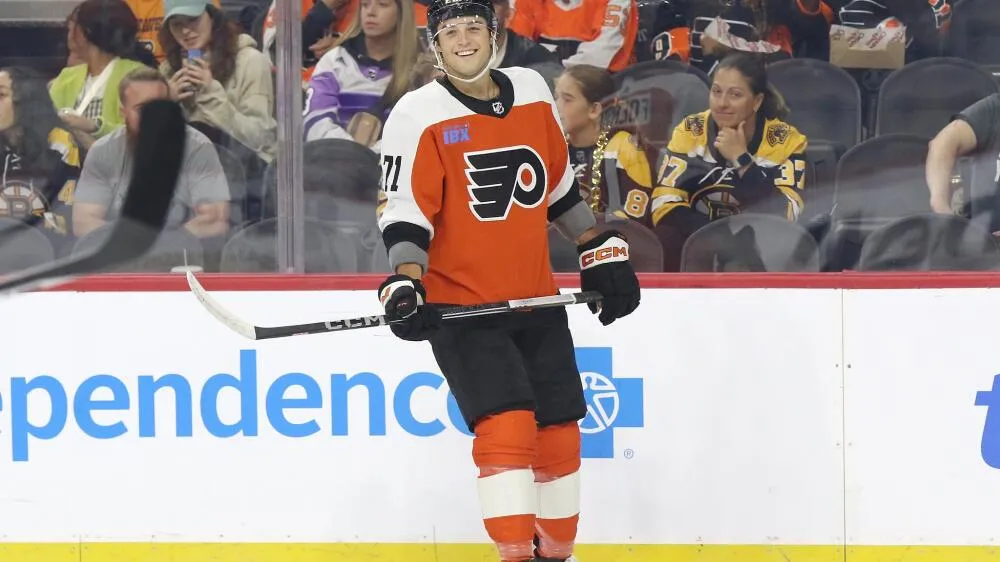
Why the Philadelphia Flyers Tyson Foerster first line promotion makes sense
Tyson Foerster’s credentials for a promotion are backed by both tangible production and underlying analytics. The 2020 first-round pick (23rd overall) showcased his potential last season with 20 goals and 13 assists in his sophomore campaign, establishing himself as one of the team’s most reliable two-way forwards. His high-end shot stands out as perhaps the most lethal pure finishing ability on the roster outside of Michkov.
What separates Foerster from many of his peers is his versatility. He excels in puck battles along the boards, consistently wins physical confrontations despite not being the biggest player, and maintains strong defensive positioning. These attributes have made him a favorite of the coaching staff, earning him consistent power-play time where his one-timer from the high slot has become a weapon opponents must respect.
The eye test confirms what the numbers suggest. When Foerster gets open looks in dangerous areas, he converts at an elite rate. His release is quick, accurate, and powerful—the kind of shot that can beat NHL goaltenders clean from distance. On the power play, he’s become the trigger man, but those opportunities remain limited at 5-on-5 when playing on a checking line that typically faces defensive assignments against opponents’ best forwards.
Perhaps most compelling is the limited sample size of Foerster playing away from the Cates-Brink duo. According to data from The Hockey Writers, in just over eight minutes of ice time separated from that line, Foerster posted a ridiculous 95.95% expected goals share while outscoring opponents 3-0. When paired specifically with Konecny, Michkov, and Zegras in brief stints, he maintained over a 70% expected goal share with each player. While small sample sizes require caution, the dominance is impossible to ignore.
The chemistry with more skilled players makes intuitive sense. Foerster doesn’t need the puck on his stick constantly to be effective—he finds soft spots in coverage, gets open for one-timers, and finishes chances created by elite playmakers. Pairing him with Konecny’s speed and vision, Michkov’s creativity, or Zegras’s playmaking could elevate everyone involved. He would provide the shooting threat those players need to open up space while contributing defensively in ways many pure offensive wingers cannot.
Moreover, Foerster’s pace and playmaking—often cited as the only weaknesses in his game—become less concerning when playing alongside faster, more creative centers and wingers. He doesn’t need to generate offense independently; he needs to complement it. His shot and positioning would create dangerous scoring chances nightly if given prime opportunities.
The Chemistry Line’s proven success complicates the Philadelphia Flyers Tyson Foerster first line promotion
Breaking up the trio of Foerster, Cates, and Brink presents a significant dilemma for head coach Rick Tocchet. Since being assembled on November 25, 2024, this line has been statistically dominant at both ends of the ice. According to MoneyPuck data cited by The Philadelphia Inquirer, among lines with at least 70 minutes together, they rank sixth in expected goals percentage (61.3%), third in expected goals against (2.4), and second in expected goals against per 60 minutes (1.5).
This isn’t a case of empty statistics, either. The trio consistently draws matchups against opponents’ top lines and not only holds its own but thrives in those situations. They cycle effectively, support each other defensively, and create scoring chances through relentless forechecking and board play. Bobby Brink’s playmaking, Noah Cates’s defensive responsibility and faceoff prowess, and Foerster’s finishing ability create a balanced unit that opposing coaches struggle to contain.
The line’s success represents more than chemistry—it reflects a collective buy-in to the systems and responsibilities demanded by NHL coaching staffs. Cates has emerged as one of the league’s premier shutdown centers, regularly tasked with neutralizing elite opposing forwards. Brink, once criticized by former coach John Tortorella for his inability to “check,” has transformed into a complete player who wins battles despite his 5-foot-8 frame. Foerster provides the scoring punch while maintaining defensive integrity.
Disrupting this balance carries inherent risk. The Flyers haven’t had many lines this effective in recent seasons, and chemistry of this caliber is rare. When three players develop instinctive reads on each other’s positioning and tendencies, breaking that up can diminish everyone’s effectiveness. The unknown factor looms large: What if promoting Foerster doesn’t work, and the dominant third line is sacrificed for minimal gain?
However, proponents of the Philadelphia Flyers Tyson Foerster first line promotion argue that Cates and Brink possess the versatility to succeed with other linemates. In limited time without Foerster since last season (approximately 60 minutes), the Cates-Brink duo has maintained a strong 57.06% expected goals share. While they’ve been outscored 3-1 in that span, poor puck luck (.850 PDO) appears to be the culprit rather than ineffective play. Both players excel at cycling, creating rush chances, and playing sound defensive hockey—skills that should translate with different wingers.
The rebuild mindset adds another layer to this consideration. If the Flyers are committed to developing young players and maximizing their potential, keeping Foerster in a role he’s potentially outgrown may be shortsighted. Giving him an opportunity to prove he can drive offense with elite talent serves both his development and the team’s long-term interests. Similarly, promoting younger players like Nikita Grebenkin into a third-line role vacated by Foerster would provide valuable experience and evaluation opportunities.
Deployment challenges and the Philadelphia Flyers Tyson Foerster first line promotion decision
The practical implementation of a Foerster promotion presents logistical challenges for Tocchet and the coaching staff. The Flyers’ current top-six forward group includes established players with defined roles, and shuffling the deck could create more problems than solutions if not handled carefully. Travis Konecny, the team’s offensive catalyst and top scorer, has found success with certain linemates while struggling with others. Matvei Michkov, the highly-touted rookie sensation, requires complementary players who can keep up with his creativity. Trevor Zegras, acquired via trade, is still finding his footing in Philadelphia’s system.
Creating the right combinations requires more than simply moving Foerster up the lineup. It demands consideration of playing styles, defensive responsibilities, and how different combinations affect depth throughout all four lines. If Foerster moves to the first line, who replaces him on the third? How does that affect the team’s ability to match lines against opponents? These questions don’t have easy answers.
One potential configuration would slot Foerster on the left wing alongside Konecny and Michkov or Zegras at center. This would create a dynamic offensive line with elite shooting (Foerster), playmaking (Michkov/Zegras), and two-way ability (Konecny). The defensive responsibilities might concern some analysts, but Foerster’s proven defensive acumen could offset any shortcomings from his more offensive-minded linemates. This line would be deployed primarily in offensive situations, taking advantage of matchups where scoring chances are abundant.
Another approach involves gradual integration rather than a full-time promotion. Tocchet could experiment with Foerster on the power play’s top unit more consistently, increase his even-strength ice time through additional shifts, and occasionally double-shift him with top-line players during crucial game situations. This phased approach would test the waters without completely dismantling the successful third line, allowing for adjustments based on results.
The coaching staff must also consider situational deployment. Perhaps Foerster begins games on the third line but moves up when the team trails late in games, providing a scoring boost when needed most. Or maybe the first line sees Foerster in offensive zone starts while he remains with Cates and Brink for defensive zone faceoffs. Modern hockey’s emphasis on line-matching and fluid combinations allows for creative solutions beyond traditional rigid structures.
Tocchet’s track record suggests a pragmatic approach. Since taking over mid-season, he’s shown willingness to adjust based on performance and results. His comments about players like Zegras—asking whether he’s “doing stuff for clicks on social media or doing stuff to win hockey games”—reveal a coach focused on substance over style. If Foerster earns a promotion through consistent excellence, Tocchet seems likely to reward it, provided the overall team structure benefits.
Long-term implications of the Philadelphia Flyers Tyson Foerster first line promotion
Beyond immediate tactical considerations, the decision about Foerster’s role carries significant implications for his development and contract status. After signing a two-year bridge deal worth $3.75 million annually in May 2025, Foerster enters a crucial period where his performance will determine his next contract’s value and term. Playing in an elevated role with better linemates could substantially impact his statistics and, consequently, his market value.
If Foerster thrives on the first line and posts, say, 30 goals and 60 points over a full season, he positions himself for a long-term extension at significantly higher compensation. Conversely, keeping him on the third line might artificially cap his offensive production, potentially saving the Flyers money short-term but limiting his growth as a player. From both the player’s and organization’s perspectives, maximizing his potential serves everyone’s interests during a rebuild focused on identifying core pieces.
The Flyers’ broader organizational philosophy also factors into this equation. General Manager Danny Brière has emphasized patience and development since taking control of hockey operations, but patience doesn’t mean complacency. Identifying which young players deserve expanded roles and which belong in supporting positions is critical to building a contender. Foerster’s promotion—or lack thereof—sends messages to the entire roster about how performance is rewarded and what the organization values.
There’s also the question of opportunity cost. Every game Foerster spends on the third line is a game where the Flyers potentially miss out on discovering whether he can be a true top-line scorer. At 23 years old, he’s entering his prime development years. While there’s no urgent timeline, waiting too long could mean missing the window to develop him into a first-line cornerstone. Other teams have historically made similar miscalculations, keeping talented players in limited roles only to watch them flourish elsewhere after trades or free agency departures.
The Philadelphia Flyers’ handling of the Tyson Foerster first line promotion question will reveal much about the organization’s commitment to aggressive development during this rebuilding phase. Foerster has earned consideration through exceptional two-way play, elite shooting ability, and promising results in limited time away from his regular linemates. While the risk of disrupting the chemistry line’s success cannot be dismissed lightly, the potential rewards of unlocking Foerster’s offensive ceiling with superior linemates may outweigh those concerns. Both Cates and Brink have shown enough individual ability to suggest they can maintain effectiveness with different wingers, making the transition less risky than it initially appears.
Ultimately, this decision transcends lineup shuffling—it represents a philosophical choice about how the Flyers approach player development and roster construction. If Tocchet and Brière believe Foerster possesses first-line talent, keeping him in a third-line role for the sake of preserving chemistry may prove shortsighted. The 2025-26 season offers an ideal testing ground for such experiments, with playoff expectations measured and development priorities paramount. Whether the promotion happens immediately, gradually, or not at all, how the Flyers manage Foerster’s ascension will likely influence his career trajectory and the team’s competitive window for years to come.

Par Mike Jonderson
Mike Jonderson is a passionate hockey analyst and expert in advanced NHL statistics. A former college player and mathematics graduate, he combines his understanding of the game with technical expertise to develop innovative predictive models and contribute to the evolution of modern hockey analytics.