









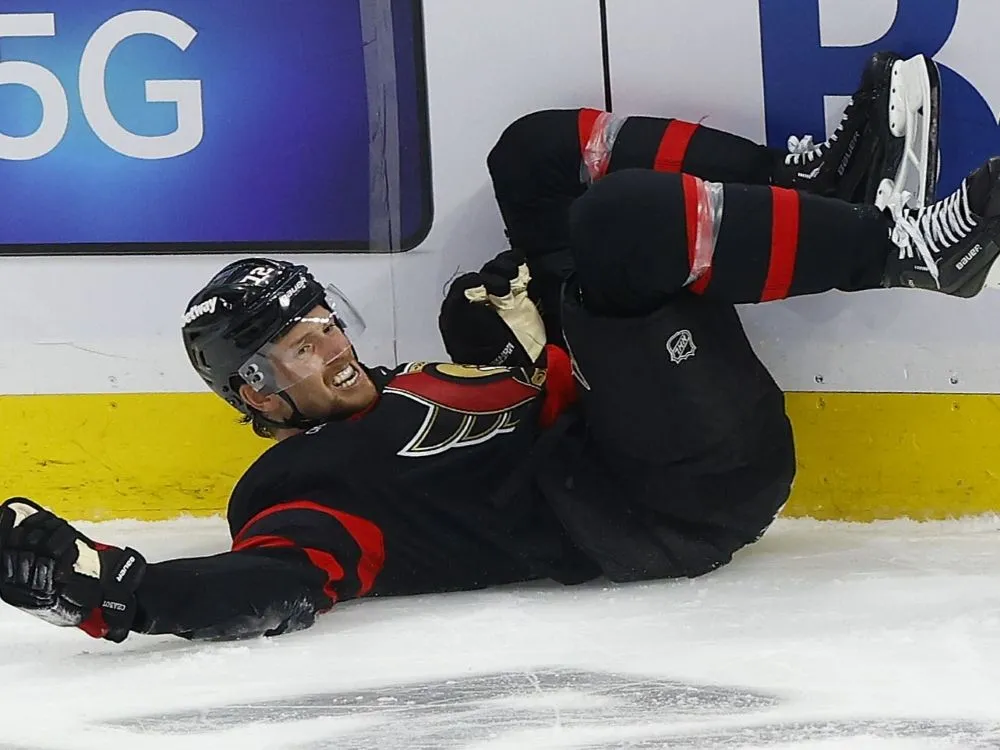
Ottawa Senators defenseman Thomas Chabot is facing a significant setback after suffering a broken bone in his right arm during Monday’s game against the New York Rangers.[1][2] The injury occurred late in the first period from a cross-check by Rangers captain J.T. Miller, who was not penalized. Coach Travis Green confirmed Chabot underwent surgery and will miss a minimum of one month, potentially up to eight weeks.[3]
Green summarized the situation bluntly: “He’ll be out for a while.”[4] At 29 years old, Chabot has been a cornerstone of Ottawa’s blue line this season. The Senators, clinging to the Eastern Conference’s final wild-card spot with 85 points, now face a tough road ahead without one of their top defensemen.[5]
The incident against the Rangers
The Senators secured a 2-1 victory over the Rangers on Monday, holding New York to the fewest shots by an NHL team since 2003.[https://nhlinsight.com/blog/senators-hold-rangers-to-fewest-shots-by-nhl-team-since-2003] Chabot’s injury came near the end of the first period when Miller delivered a stiff cross-check to his right arm, targeting the upper wrist area.[6] He did not return to the game, and updates soon confirmed the fracture.
Team officials provided limited details initially, but post-game reports indicated the need for surgery. A league executive suggested the injury’s severity pointed to a fracture, ruling out a quick turnaround.[7] Lassi Thomson also exited with a lower-body issue but is listed day-to-day.
The lack of a penalty on Miller drew some scrutiny from fans and analysts. Replays showed a forceful hit, yet officials let it go uncalled. Green focused on the win rather than controversy.
Ottawa’s defensive effort remained stout despite the losses. They limited high-danger chances and got timely saves to grind out the result.
This marks another blow in a season plagued by injuries for the back end. The team adapted quickly, leaning on depth players to close out the period.
Chabot’s strong 2025-26 season
Chabot entered the game with seven goals and 24 assists in 55 appearances, posting a plus-6 rating. His average ice time of 22:34 ranked second on the team behind Jake Sanderson’s 24:49.[7]
The veteran has been reliable in all situations, logging heavy minutes on the power play and penalty kill. His puck-moving ability has been crucial for Ottawa’s transition game.
Chabot’s production highlights his recovery from prior ailments. He has built chemistry with partners, contributing to the Senators’ improved defensive metrics.
Over his career, Chabot has tallied 58 goals and 206 assists in 360 games, establishing himself as a top-pair staple since 2019-20. This season’s pace projects another 40-point year.
Fans appreciate his leadership on the blue line. He often jumps into plays offensively while maintaining structure.
Missing him disrupts that balance. Ottawa must redistribute minutes without overtaxing others.
Defensive injury crisis deepens
Sanderson, Ottawa’s top defenseman, has been sidelined since March 7 with an upper-body injury but is nearing a return and traveling with the team. Nick Jensen and Dennis Gilbert remain out for another 2-3 weeks.
Thomson’s day-to-day status adds uncertainty. The rash of absences has forced rookies Carter Yakemchuk and Jorian Donovan into NHL debuts during Tuesday’s 3-2 win over the Detroit Red Wings.
Young players showed poise, contributing to the victory in a tight contest. Veterans like Jake Sanderson’s eventual return will help stabilize.
Ottawa’s blue line depth has been tested all season. Trades and recalls, such as those involving Lassi Thomson, have provided temporary fixes.[https://nhlinsight.com/blog/ottawa-senators-recall-halliday-thomson-road-trip/]
Coaches emphasize internal solutions over deadline moves. Green praised the group’s resilience post-Rangers.
The group now faces Pittsburgh at home on Thursday, a key divisional matchup.
Playoff race tightens for Senators
Holding the second wild-card spot with 85 points, Ottawa leads the New York Islanders and Detroit Red Wings.[https://nhlinsight.com/blog/projecting-eastern-wild-card-race-2026-nhl-playoffs/][5] Recent form includes a 13-3-2 stretch, fueling their push.[https://www.nhl.com/news/ottawa-still-in-playoff-mix-have-to-keep-pushing]
Chabot’s absence could extend into the postseason if recovery hits eight weeks. The Senators trail comfortably in the Atlantic but eye the wild cards.
Rivals like the Isles (40-27-5 projected) and Wings lurk close. Every point matters in March.
Ottawa’s recent wins over Vegas, Rangers, and Detroit showcase grit. Goaltending and timely scoring have carried them.
Management monitors the trade market but prioritizes youth development. A deep run hinges on health.
Fans remain optimistic amid the wild-card battle.[https://nhlinsight.com/blog/ottawa-senators-wild-card-push-2026-nhl-playoffs/]
Rookies rise to the challenge
Yakemchuk and Donovan impressed in their debuts against Detroit. Both handled NHL speed well, logging key shifts.
This opportunity accelerates their development. Paired with veterans, they eased the burden.
Ottawa’s prospect pool runs deep on defense. Recalls like those of Thomson have bolstered numbers before.[https://nhlinsight.com/blog/ottawa-senators-recall-halliday-thomson-road-trip/]
Success stories from past call-ups inspire. The kids’ poise bodes well for sustainability.
Coaches integrate them gradually, focusing on simple play. Early results encourage.
Long-term, this builds a stronger core for contention.
Chabot’s injury tests Ottawa’s resolve at a pivotal juncture. While the timeline threatens their wild-card hold, the team’s depth and recent momentum offer hope. Sanderson’s return and rookie contributions could keep them in the mix. As Green noted, they’ll grind through adversity—what it means for the playoffs depends on rallying around the challenge ahead.[https://www.nhl.com/news/nhl-status-report-news-and-notes-march-24-2026]
Frequently Asked Questions

Par Mike Jonderson
Mike Jonderson is a passionate hockey analyst and expert in advanced NHL statistics. A former college player and mathematics graduate, he combines his understanding of the game with technical expertise to develop innovative predictive models and contribute to the evolution of modern hockey analytics.