







The Toronto Maple Leafs entered the 2024-25 season with legitimate Stanley Cup aspirations, bolstered by significant upgrades to their defensive core and what appeared to be a solid goaltending tandem. However, the cruel reality of hockey injuries has exposed the fragility of even the best-laid plans. A cascading series of injuries to key defensive players and goaltenders has tested the team’s depth in ways few could have anticipated, transforming what should have been a strength into a concerning vulnerability.
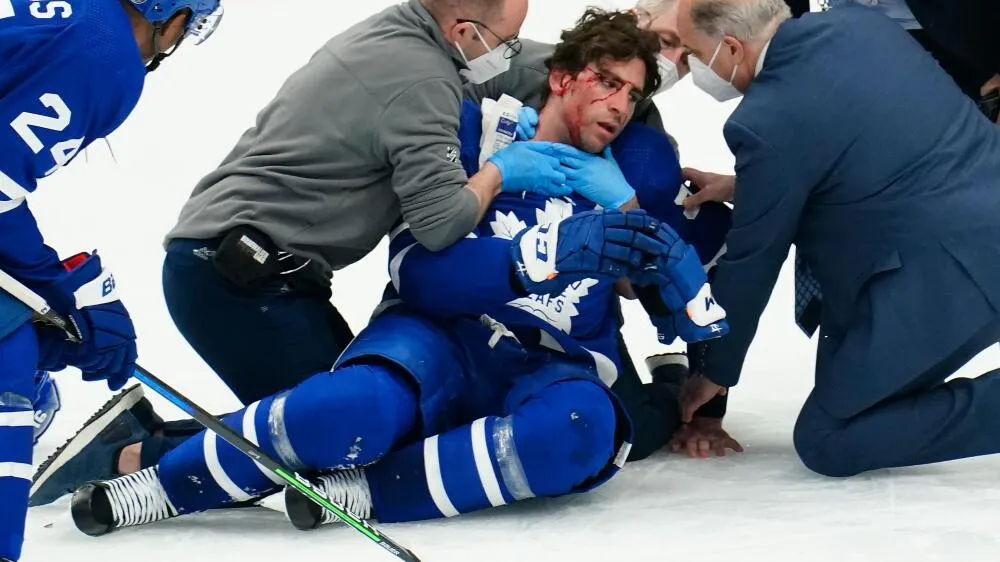
The impact has been swift and unforgiving. With star defenseman Chris Tanev sidelined following a frightening incident on the ice, and both goaltenders Anthony Stolarz and Joseph Woll battling injuries, Toronto finds itself navigating treacherous waters at a critical juncture of the season. These absences have forced head coach Craig Berube to shuffle lineups, rely on unproven depth pieces, and watch as the team’s defensive structure—so carefully constructed in the offseason—begins to show cracks under pressure.
How the maple leafs injury impact on defense and goaltending has reshaped the blue line
The defensive corps that looked so promising in training camp has been decimated by injuries, with Chris Tanev’s absence creating the most significant void. Tanev, acquired in the offseason to provide veteran leadership and shutdown defensive capabilities, suffered a scary upper-body injury after a collision with Philadelphia’s Matvei Michkov on November 1. The veteran defenseman had to be stretchered off the ice, a sight that sent shockwaves through the organization and fanbase alike.
Tanev’s impact on the Maple Leafs’ defensive structure cannot be overstated. His ability to neutralize opposing top lines, kill penalties, and provide a steadying presence during crucial moments made him an invaluable piece of Toronto’s playoff puzzle. Without him, the defensive pairings have been forced into uncomfortable configurations that leave gaps in coverage and expose less experienced players to matchups they’re not ready to handle.
The reshuffling has pushed players into elevated roles they weren’t prepared for at this stage of the season. Morgan Rielly, already carrying significant defensive responsibilities as the team’s number-one defenseman, has been forced to shoulder even more of the load. Jake McCabe has been asked to play harder minutes against tougher competition, while younger players like Timothy Liljegren have been thrust into situations where mistakes are magnified.
Perhaps most concerning is the ripple effect these injuries have had on special teams. The Maple Leafs’ penalty kill, which relied heavily on Tanev’s positioning and shot-blocking ability, has struggled to maintain its effectiveness. Teams have begun to exploit the defensive vulnerabilities, creating scoring chances that would have been shut down with a healthy blue line intact.
The defensive zone coverage has become increasingly chaotic, with breakdowns occurring at inopportune moments. The chemistry that takes weeks to develop between defensive partners has been disrupted repeatedly, forcing players to adapt on the fly during games rather than building continuity through practice and repetition.
Coach Berube has attempted to mitigate these issues by adjusting the system, but there’s only so much scheme can compensate for when talent and experience are missing from the lineup. The absence of a true number-one shutdown defender has forced Toronto to defend by committee, a strategy that works in theory but often fails under the bright lights of NHL competition.
The goaltending crisis threatening maple leafs injury impact on defense and goaltending stability
While defensive injuries have been problematic, the situation in goal has evolved into a full-blown crisis that threatens to derail the Maple Leafs’ season. Anthony Stolarz, who was brought in to provide stability and share the workload with Joseph Woll, has been forced to shoulder a heavier burden than anticipated—and the consequences of that overwork manifested in the worst possible way when he left the game against Boston with an upper-body injury.
Stolarz had been performing admirably in Woll’s extended absence, appearing in the majority of Toronto’s games through the first quarter of the season. However, the workload proved unsustainable. As noted by hockey analysts, the veteran goaltender was clearly overworked, a situation that not only affected his performance but ultimately led to injury. His departure from the Boston game after allowing three goals on just 10 shots in the first period underscored just how vulnerable the Maple Leafs had become between the pipes.
Joseph Woll’s situation has been equally frustrating for the organization. The young goaltender, who showed tremendous promise in a platoon role last season, has been dealing with injury issues that have kept him off the NHL roster for extended periods. According to reports from Sportsnet, management has been patiently supporting Woll through his recovery, but the timeline for his return has been uncertain and constantly shifting.
The organization attempted to address the depth issues by bringing in veteran options, but those moves have backfired spectacularly. James Reimer, once a fan favorite during his first stint with the Leafs, was signed as an emergency depth piece but struggled in limited action before being released. The experiment with Cayden Primeau was even shorter-lived, as the former Montreal draft pick failed to provide the reliability Toronto desperately needed.
This revolving door of goaltenders has created instability that extends beyond just the crease. Defensemen lose confidence when they’re unsure whether their goaltender will make routine saves. Forwards press more offensively, trying to outscore problems rather than playing a structured defensive system. The entire team dynamic shifts when goaltending becomes a question mark rather than an answer.
The conditioning stint Woll has been on with the AHL’s Toronto Marlies represents the organization’s attempt to get him game-ready without rushing him back to NHL action before he’s physically prepared. However, every game he spends in the minors is another game where Toronto’s depleted goaltending situation puts additional strain on both the starter and the team’s defensive structure.
Strategic adjustments amid maple leafs injury impact on defense and goaltending challenges
Facing this unprecedented injury crisis, Craig Berube has been forced to implement significant tactical adjustments to keep the Maple Leafs competitive. The coach, known for his emphasis on defensive responsibility and physical play, has had to balance his preferred style with the reality of missing key personnel who made that system function effectively.
One major shift has been the increased emphasis on offensive zone time as a defensive strategy. Without the personnel to consistently shut down opponents in their own zone, Toronto has attempted to play a possession-heavy game that keeps the puck away from their vulnerable areas. This approach requires significant energy expenditure and can leave the team exposed to counterattacks when turnovers occur in the offensive zone.
The power play has been tasked with carrying more of the offensive burden to compensate for defensive deficiencies. With goals against becoming harder to prevent, Toronto has leaned on their talented forward group—led by Auston Matthews, William Nylander, and Mitch Marner—to generate enough offense to outscore their problems. However, this approach is inherently unsustainable, particularly in playoff hockey where defensive structure becomes paramount.
Berube has also experimented with different defensive pairings, searching for combinations that can provide adequate coverage despite the absence of key players. This trial-and-error process has produced mixed results, with some pairings showing promise while others have been exposed by skilled opponents who recognize and exploit weaknesses.
The coaching staff has simplified some defensive zone coverage schemes, recognizing that complex systems break down more easily when players are unfamiliar with their partners or thrust into roles above their current capability. This simplification helps reduce egregious mistakes but also makes the team more predictable to opponents who can read and react to standard defensive structures.
Special teams have received particular attention, as the penalty kill’s struggles without Tanev have made every power play against a high-leverage situation. Berube has adjusted the PK personnel, giving opportunities to forwards who can provide speed and aggression to compensate for the loss of Tanev’s positional excellence and shot-blocking prowess.
Long-term implications of maple leafs injury impact on defense and goaltending depth
The current injury crisis has exposed fundamental questions about the Maple Leafs’ roster construction and depth chart that will have ramifications extending well beyond this season. General Manager Brad Treliving’s offseason moves were designed to address perceived weaknesses, but the fragility of the goaltending tandem and the lack of adequate defensive depth behind the top four have become glaring issues that demand attention.
The goaltending situation, in particular, raises concerns about the long-term viability of the current structure. Relying on a tandem where both goalies have significant injury histories was always going to be a gamble, and that bet is currently not paying off. The organization will need to seriously consider whether they can enter the playoffs with confidence in their ability to get consistent goaltending, or if external help via trade will be necessary.
The defensive depth, while stronger than in previous years, has proven insufficient when multiple injuries strike simultaneously. The gap between the top-four defenders and the depth options is too significant, leaving the team vulnerable to exactly the type of situation they’re currently experiencing. This will likely prompt trade deadline activity focused on acquiring another reliable defensive option who can step in when injuries inevitably occur again.
The salary cap implications of any potential moves add another layer of complexity to Toronto’s situation. With significant money committed to their core forwards and recent defensive additions, navigating trades while remaining cap-compliant will require creative financial maneuvering. This might involve moving out players or retaining salary in ways that compromise future flexibility for immediate help.
Youth development timelines may also need to be reconsidered. The organization had hoped to bring along prospects gradually, but the injury crisis may force younger players into NHL roles before they’re truly ready. While this can accelerate development in some cases, it also risks exposing players to situations where they struggle and lose confidence—a delicate balance the coaching staff must manage carefully.
The mental toll of navigating this adversity cannot be underestimated either. Professional athletes are conditioned to handle pressure, but watching teammates suffer injuries while being asked to compensate for their absence creates stress that compounds over the course of a long season. How the team responds psychologically to this challenging period may ultimately determine whether they emerge stronger or fractured when the calendar turns to spring.
The Toronto Maple Leafs entered this season with championship aspirations backed by what appeared to be a roster built for postseason success. The reality has been a harsh reminder that in hockey, depth is tested not by what happens when everyone is healthy, but by what happens when key players inevitably miss time. The way management addresses these goaltending and defensive vulnerabilities will define not just this season, but potentially the trajectory of this core group’s remaining championship window. As injuries to Tanev, Stolarz, and Woll continue to reshape the team’s identity, the organization faces critical decisions that could determine whether this year represents a speed bump on the road to a championship or a warning sign of deeper structural issues that must be addressed.
Frequently Asked Questions

Par Mike Jonderson
Mike Jonderson is a passionate hockey analyst and expert in advanced NHL statistics. A former college player and mathematics graduate, he combines his understanding of the game with technical expertise to develop innovative predictive models and contribute to the evolution of modern hockey analytics.