





Why the Edmonton Oilers should not trade Troy Stecher this season
The Edmonton Oilers find themselves in a familiar position—dancing along the salary cap ceiling while trying to maintain a championship-caliber roster. Recent reports from NHL insiders have placed veteran defenseman Troy Stecher squarely on the trade block, with Elliotte Friedman suggesting the 31-year-old could be moved to alleviate the team’s defensive depth crunch. While the rationale seems straightforward on the surface, trading Stecher would be a shortsighted mistake that could haunt the Oilers when they need reliable depth most during the playoff push.
Stecher’s contract carries a cap hit of just $787,500—barely above the league’s veteran minimum—making him one of the most cost-effective depth defensemen in the NHL. For a team constantly maneuvering to stay cap compliant, his value extends far beyond his on-ice contributions. Moving him now would address neither the team’s financial constraints nor their competitive needs in any meaningful way.
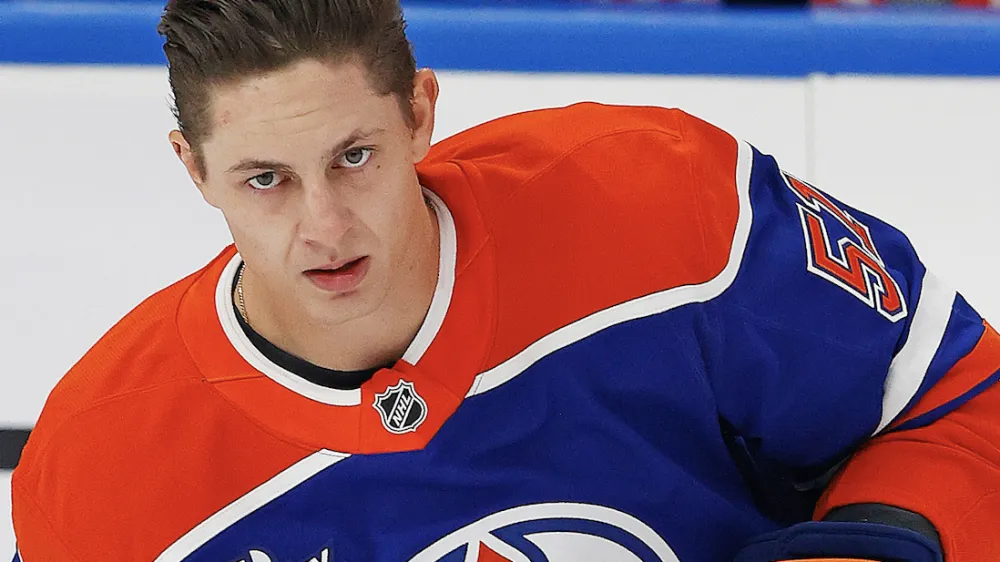
The Edmonton Oilers should not trade Troy Stecher for minimal cap relief
The Oilers’ salary cap situation has been well-documented, with the team routinely operating within hundreds of thousands of dollars of the upper limit. When roster decisions need to be made, general managers typically look to move contracts that provide the most financial flexibility. This is precisely why trading Stecher makes little sense from a cap management perspective.
At $787,500, Stecher’s contract represents one of the best value propositions on the roster. Moving him would clear less than $800,000 in cap space—hardly enough to make a significant addition at the trade deadline or address any pressing roster needs. If the Oilers genuinely need cap relief, there are far more logical candidates with higher salaries who could be moved.
Mattias Janmark, for instance, carries a cap hit of $1.45 million through next season. While Janmark has been a useful bottom-six forward, his $650,000 higher cap hit makes him a more sensible trade candidate if the team needs financial flexibility. Similarly, Ty Emberson’s $1.3 million cap hit over the next two seasons provides more meaningful savings potential than Stecher’s near-minimum deal.
The minimal cap savings from trading Stecher wouldn’t allow the Oilers to make any substantive roster improvements. Instead, they would be creating a hole on their blue line for virtually no financial benefit. For a team with Stanley Cup aspirations, sacrificing proven depth for negligible cap space represents poor asset management. The Edmonton Oilers trade rumors 2025-26 have focused on several players, but Stecher should not be among those actually moved.
Troy Stecher’s proven playoff value for the Edmonton Oilers should prevent any trade
Statistics and advanced metrics only tell part of Troy Stecher’s story with the Oilers. His true value became evident during Edmonton’s remarkable playoff run last season, when he stepped into a larger role and performed admirably under the brightest lights in hockey. These are the intangibles that don’t always show up on a stat sheet but become invaluable during a deep postseason run.
During the 2024 playoffs, Stecher demonstrated exactly why experienced depth defensemen are crucial for championship contenders. He was physical in the corners, strong on the puck, and refused to give opposing forwards any easy entries or scoring chances. His positioning was sound, his gap control was consistent, and he made the simple, smart plays that coaches value in high-pressure situations.
In 66 regular season games last year, Stecher averaged nearly one blocked shot per game while contributing 35 hits and finishing with a respectable minus-2 rating while playing third-pair minutes. These numbers reflect a player who understands his role and executes it effectively. He’s not asked to quarterback the power play like Evan Bouchard or provide offensive creativity—his job is to defend competently and move the puck efficiently, which he does consistently.
The Richmond, B.C., native has also proven to be a consummate professional throughout his career. He’s low-maintenance, understands the business side of hockey, and provides steady, reliable minutes whenever called upon. These qualities become exponentially more valuable during the grind of an NHL season and the subsequent playoff marathon. Teams that win championships typically have several players like Stecher who can step up when injuries inevitably occur.
The concern about Stecher not fitting into the regular lineup early this season is overblown. Defensive depth is never a problem to complain about—it’s a luxury that most contending teams covet. When the calendar turns to March and April, and the physical toll of the season mounts, having a seventh defenseman who can seamlessly slot into the lineup is invaluable.
The Edmonton Oilers should not trade Troy Stecher when return value is minimal
From a pure asset management perspective, trading Stecher at this juncture makes little strategic sense. The return the Oilers could reasonably expect for a 31-year-old depth defenseman on an expiring contract would be modest at best—likely a late-round draft pick or perhaps a similarly positioned depth player. Neither outcome improves the team’s current championship window.
Late-round draft picks, while always valuable in theory, rarely translate into NHL contributors for several years, if at all. The Oilers, with Connor McDavid and Leon Draisaitl in their prime, are operating in win-now mode. Trading a known commodity who has already proven he can contribute in playoff hockey for a speculative future asset contradicts the team’s immediate competitive timeline.
If Edmonton were to receive a depth forward in return, that also creates complications. The Oilers are currently deeper at forward than defense, making such a swap counterproductive. The team doesn’t need another bottom-six forward—they need to maintain defensive depth for when injuries or poor performance necessitate lineup changes.
Troy Stecher trade destinations 2025 have been discussed extensively, but the focus should be on why the Oilers would regret making such a move. The risk-reward calculation simply doesn’t favor Edmonton. They would be giving up a player who knows the system, has chemistry with his defensive partners, and has demonstrated playoff reliability—all for minimal return.
Perhaps more importantly, trading Stecher now removes an insurance policy the Oilers desperately need. Defensive injuries are inevitable over an 82-game season and playoffs. If the Oilers move Stecher and subsequently lose one or two defensemen to injury, they’ll be forced to rely on untested call-ups from the AHL or scramble to make an acquisition at inflated deadline prices. Keeping Stecher provides stability and prevents potential desperation moves later in the season.
Better trade alternatives exist for the Edmonton Oilers than moving Stecher
If the Oilers are genuinely committed to making a roster move to accommodate returning players like Janmark and Zach Hyman, there are several alternatives that make more sense than trading Stecher. The key is identifying moves that either provide more substantial cap relief or address positional needs more effectively.
Ty Emberson, while two years younger than Stecher, presents a more logical trade candidate from a financial perspective. His $1.3 million cap hit through next season provides meaningful savings compared to Stecher’s minimum-salary deal. NHL insider Frank Seravalli recently noted that Emberson “would have value for teams out there that are looking for a player,” specifically mentioning the injury-depleted Carolina Hurricanes as a potential fit.
While Emberson may have slightly more upside due to his age, Stecher’s playoff experience and professional approach make him more valuable to a contending team right now. Emberson still has development potential that could be better realized elsewhere, while Stecher is a finished product who knows exactly what he needs to do. For a team in Edmonton’s championship window, proven reliability trumps potential upside.
Janmark represents another alternative worth exploring. The Swedish forward has been a useful contributor, but at 33 years old with a $1.45 million cap hit through next season, he provides nearly double the cap savings of Stecher. With Edmonton’s forward depth already solid, moving a bottom-six forward makes more positional sense than weakening an already-thin blue line.
The Oilers could also explore more complex multi-player deals that address multiple needs simultaneously. Rather than making a one-for-one swap of Stecher for minimal return, packaging him with another asset in a larger trade could bring back a more significant piece. However, even in that scenario, Stecher’s value to Edmonton likely exceeds what they would receive in return.
General manager Stan Bowman needs to think beyond the immediate roster crunch and consider the entire season arc. Yes, having extra defensemen creates short-term lineup decisions, but that depth will be desperately needed by March and April. Trading away that depth for minimal return now could create major problems later when the games matter most.
Defensive depth separates contenders from champions in the Edmonton Oilers’ pursuit
The difference between Stanley Cup contenders and actual champions often comes down to organizational depth. Teams that survive the grueling playoff gauntlet typically have 8-9 defensemen they trust, not just six starters. The Oilers experienced this reality firsthand during last season’s run to the Finals, when having players like Stecher available to spell injured or struggling regulars proved crucial.
NHL playoffs are wars of attrition. The physical intensity ramps up exponentially, and injuries accumulate with each passing round. Teams that maintain their defensive structure throughout four rounds are those with reliable depth pieces who can step in seamlessly. Stecher has already demonstrated he can be that player for Edmonton.
The current “problem” of having too many defensemen is a luxury that will evaporate quickly once the season progresses. Between injuries, suspensions, and performance fluctuations, the Oilers will inevitably need to dip into their defensive depth. When that moment arrives, they’ll be grateful to have Stecher available rather than scrambling to find a replacement.
Young defensemen like Alec Regula show promise and deserve opportunities to develop, but relying exclusively on unproven players during a championship push is unnecessarily risky. Stecher provides the perfect safety net—a veteran who won’t complain about reduced ice time but will be ready when his number is called. That’s exactly the type of player championship teams need on their roster.
The Edmonton Oilers find themselves in an enviable position despite the current roster crunch. Having more NHL-caliber defensemen than roster spots is a problem most teams would gladly accept. Rather than hastily trading Troy Stecher for minimal return, the organization should embrace this depth and trust that it will prove valuable as the season unfolds.
Stecher’s combination of affordable cap hit, proven playoff performance, and professional approach makes him far more valuable to Edmonton than what they could reasonably acquire in a trade. The Oilers are operating within a narrow championship window with McDavid and Draisaitl—now is not the time to sacrifice proven depth for negligible gains. If roster moves must be made, there are better alternatives that provide either more substantial cap relief or address positional needs more effectively. Keeping Stecher isn’t just the smart move; it’s the necessary one for a team with legitimate Stanley Cup aspirations.

Par Mike Jonderson
Mike Jonderson is a passionate hockey analyst and expert in advanced NHL statistics. A former college player and mathematics graduate, he combines his understanding of the game with technical expertise to develop innovative predictive models and contribute to the evolution of modern hockey analytics.