




The Edmonton Oilers entered the 2025-26 season with Stanley Cup aspirations fresh off another deep playoff run, but the early months have delivered a sobering reality check. Through their opening stretch of games, the Oilers have struggled to find the consistency that defined their recent postseason success, posting a mediocre record that has left fans questioning whether this team can recapture its championship form. While patience was preached in training camp given the roster turnover, the underlying issues plaguing this squad have become impossible to ignore as November unfolds.
From goaltending instability to defensive breakdowns and an alarming lack of even-strength production, the Oilers face multiple challenges that threaten to derail their season before winter arrives. This comprehensive Edmonton Oilers early season struggles 2025-26 analysis examines the key factors behind their disappointing start and what must change for the team to salvage their campaign.
The goaltending crisis deepens for Edmonton Oilers early season struggles 2025-26 analysis
Perhaps no issue has dominated the conversation around the Oilers’ early season woes more than their goaltending situation. The tandem of Stuart Skinner and Calvin Pickard has failed to provide the stability required for a legitimate Stanley Cup contender, with both netminders posting inconsistent results that have cost Edmonton crucial points in the standings.
Skinner’s Jekyll-and-Hyde performances have become emblematic of the team’s broader struggles. In some games, he appears capable of stealing victories with timely saves and composed positioning. In others, he looks overwhelmed by the pace of play, allowing soft goals that deflate his teammates’ confidence. This lack of reliability has exposed what many observers have long suspected: Skinner is fundamentally a backup goaltender being thrust into a starting role beyond his capabilities.
The situation with Pickard has reached a breaking point. At 33 years old, his performance has regressed to the point where he no longer appears to be an NHL-caliber option. His inability to provide even adequate relief work has placed additional pressure on Skinner, who has been forced to shoulder a heavier workload than his game can sustain. The 9-1 shellacking at the hands of the Colorado Avalanche served as the most glaring example of the goaltending deficiencies that plague this roster.
While head coach Kris Knoblauch has stated publicly that goaltending isn’t the team’s biggest problem, the numbers tell a different story. When compared to other playoff-caliber teams, the Oilers’ save percentage and goals-against average paint a picture of a team that simply cannot rely on consistent performances between the pipes. The challenge facing general manager Stan Bowman is that acquiring a legitimate starting goaltender mid-season comes with a hefty price tag, and Edmonton’s cupboard of trade assets has been depleted by years of win-now moves.
Names like Juuse Saros and Ilya Sorokin represent the ideal solution but remain firmly in the “unrealistic” category given their contract situations and the asking price their respective teams would demand. More attainable options like Sam Montembault or even a reunion with Cam Talbot could provide a modest upgrade, though neither represents a transformative addition. The harsh reality is that the Oilers may need to navigate the majority of this season with their current goaltending situation, which means the rest of the roster must elevate its play to compensate.
Defensive lapses define Edmonton Oilers early season struggles 2025-26 analysis
While goaltending has captured headlines, the Oilers’ defensive play has been equally problematic. The blue line that looked so formidable during last spring’s playoff run has regressed significantly, with nearly every defenseman experiencing consistency issues that have left the team vulnerable to opponent attacks.
Darnell Nurse stands at the epicenter of Edmonton’s defensive struggles. Despite carrying a cap hit exceeding $9 million annually through 2030, Nurse has been arguably the team’s worst defender through the opening weeks. His advanced metrics paint a damning picture: poor defensive zone coverage, an inability to win board battles, declining physical engagement, and a propensity for turnovers at critical moments. The analytics clearly show that whichever partner is paired with Nurse sees their own statistics crater, suggesting his struggles have a cascading negative effect on the entire defensive structure.
The frustration among fans stems not just from Nurse’s poor play, but from the apparent double standard in how his mistakes are treated compared to Evan Bouchard. While Bouchard’s occasional pinching errors at the offensive blue line generate intense scrutiny, Nurse’s far more consequential defensive breakdowns often escape similar criticism from coaches and management. This discrepancy has created tension within the fan base, as supporters wonder why Nurse continues to receive top-four minutes despite consistently being a liability.
Bouchard himself has experienced a sluggish start by his lofty standards, though his situation differs fundamentally from Nurse’s. The offensive-minded defenseman thrives when his confidence is high and the team controls possession, allowing him to activate from the blue line and generate scoring chances. When the team struggles defensively and Bouchard is forced to play extended minutes in his own zone, his limitations become more apparent. History suggests he will elevate his game as the season progresses, particularly if the team can recapture its offensive identity.
The depth defensive corps has also failed to provide consistency. Mattias Ekholm, Jake Walman, Ty Emberson, and Brett Kulak have all shown flashes of competent play, but none has strung together enough quality performances to establish himself as a reliable option. Troy Stecher’s struggles early in the campaign led to speculation about his roster future, and the team appears poised to move him to clear cap space for other acquisitions. The departure of assistant coach Paul Coffey, who had successfully transformed this defensive group into one of the league’s better units, looms large over these struggles. While bringing in fresh voices was deemed necessary after the team fell short of winning the Stanley Cup, the timing of Coffey’s exit couldn’t be worse given the current state of the blue line.
Even-strength scoring drought in Edmonton Oilers early season struggles 2025-26 analysis
The most alarming aspect of the Oilers’ early season performance has been their complete inability to generate offense at even strength. For a team built around Connor McDavid and Leon Draisaitl—arguably the most dangerous one-two offensive punch in hockey—the lack of 5-on-5 production represents an existential crisis that threatens to define their season.
The statistics are shocking in their severity. Edmonton’s offensive struggles at even strength have placed them near the bottom of the league in multiple key categories, including goals per 60 minutes, high-danger scoring chances, and expected goals. When a team possesses less offensive firepower at even strength than rebuilding franchises, something has gone fundamentally wrong with the system or personnel.
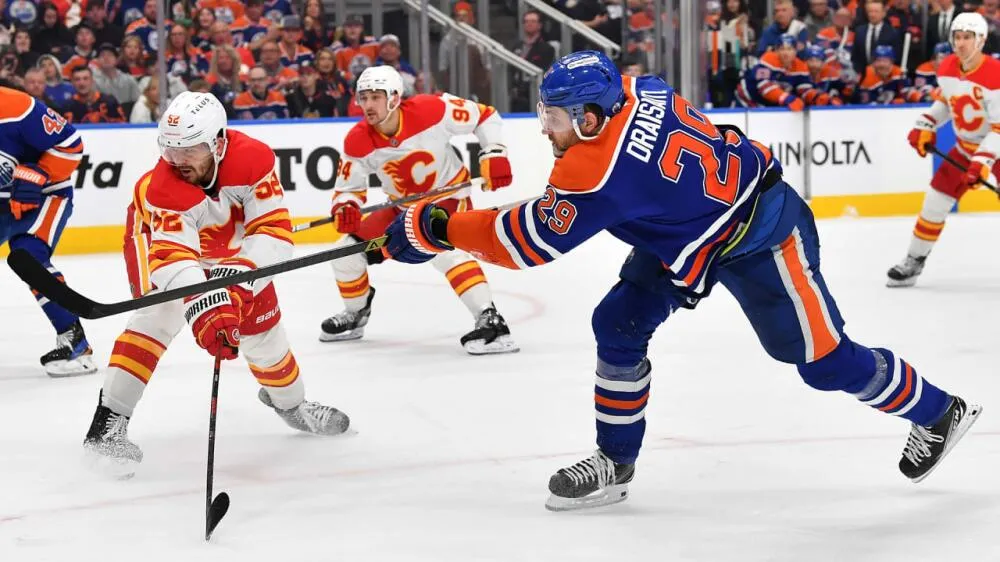
The Oilers rank 31st in the NHL in high-danger chances per 60 minutes at 5-on-5, a statistic that should be impossible given their talent level. Even the Calgary Flames, a team in transition with far less offensive depth, generate more dangerous opportunities than Edmonton. This suggests the problem runs deeper than individual slumps or injury absences—the team is struggling to create quality scoring chances in the offensive zone, relying almost exclusively on their power play to generate goals.
Several factors contribute to this even-strength drought. The extensive roster turnover in the offseason disrupted the chemistry that had developed during previous seasons. Veterans like Corey Perry, Connor Brown, and Evander Kane departed, replaced by rookies and new acquisitions still learning how to play within the system. While additions like Andrew Mangiapane and Jack Roslovic brought pedigree and skill, integrating them into established line combinations has proven more challenging than anticipated.
The rookies, particularly Isaac Howard and Matthew Savoie, have struggled to make an impact despite arriving with considerable hype. Howard’s offensive instincts are apparent, but defensive lapses have limited his ice time. Savoie has shown willingness and effort but hasn’t found the scoresheet with any regularity. Both players have found themselves trapped in limited minutes roles, creating a development dilemma. Without adequate playing time, they cannot grow into impact players, yet the team is reluctant to give them expanded opportunities while desperately searching for wins.
McDavid himself has been uncharacteristically hesitant to shoot the puck, instead looking to set up teammates who haven’t been finishing chances. While his playmaking remains elite, the Oilers need their captain to adopt a more aggressive shooting mentality to unlock the offense. Draisaitl and Ryan Nugent-Hopkins have been among the few forwards producing at acceptable levels, but hockey remains a team game, and two productive players cannot carry an entire forward group for an entire season.
Special teams paradox in Edmonton Oilers early season struggles 2025-26 analysis
One of the few bright spots in Edmonton’s disappointing start has been their power play, which currently ranks second in the NHL behind only Pittsburgh. After bringing in a new power play coach during the offseason, concerns existed that the unit might struggle to adapt to new systems and approaches. Instead, the man-advantage has been lethal, continuing to showcase the ridiculous skill level McDavid and Draisaitl bring when operating with an extra attacker.
However, this power play success has created a dangerous dependency that masks deeper structural problems. When a team can only score consistently on the power play, they become vulnerable to opponents who maintain discipline and avoid taking penalties. Playoff hockey typically features tighter officiating and fewer power play opportunities, meaning the Oilers cannot rely on special teams excellence to carry them through a postseason run.
The penalty kill has presented its own set of challenges, with Edmonton’s defensive structure breaking down when down a man. This represents a complete reversal from previous seasons when the penalty kill was a strength, generating shorthanded chances and rarely allowing momentum-swinging goals against. The inability to kill penalties effectively places additional pressure on the goaltending and defense, creating a vicious cycle of negative momentum that has defined too many games this season.
Coaching decisions under scrutiny in Edmonton Oilers early season struggles 2025-26 analysis
Kris Knoblauch earned significant credibility by guiding the Oilers to the Stanley Cup Final in his first season behind the bench, and he received a contract extension that signaled management’s confidence in his leadership. However, some of his decisions during this early season struggle have raised legitimate questions about his player management and game-to-game adjustments.
The handling of Howard and Savoie has generated the most controversy. Both young forwards arrived with expectations of playing meaningful minutes and contributing to the team’s depth scoring. Instead, they’ve been relegated to fourth-line duty with minimal ice time, often appearing for fewer than 10 minutes per game. When young players are given such limited opportunities, they cannot build rhythm or confidence, leading to tentative play that reinforces coaching staff concerns about their readiness.
Knoblauch’s reluctance to significantly shuffle his veteran lineup despite poor results has also puzzled observers. Line combinations that clearly aren’t working have been given extended auditions, while promising alternatives remain unexplored. The ice time distribution has favored established players regardless of performance, with Nurse continuing to log heavy minutes despite being the team’s worst defenseman by virtually every metric.
These critiques come with important context. Knoblauch inherited a talented but flawed roster and has proven capable of making in-season adjustments that unlock the team’s potential. Last season’s transformation from a slow start to a Cup Final appearance demonstrated his ability to solve problems and maximize his players’ strengths. Patience remains warranted, but the clock is ticking, and every lost point in October and November makes the path to playoff positioning more treacherous.
Path forward for Edmonton Oilers early season struggles 2025-26 analysis
The Oilers stand at a crossroads. The talent exists on this roster to compete for a championship, but multiple systemic failures must be addressed before that potential can be realized. The imminent return of Zach Hyman from injury should provide an immediate boost to the even-strength offense, reuniting a top line that terrorized opponents during last year’s playoff run. Hyman’s net-front presence and ability to finish chances from McDavid’s passes has been sorely missed, and his return cannot come soon enough.
Beyond Hyman’s return, the team must make difficult decisions about its goaltending future. Whether that means making a trade to acquire an upgrade, giving Connor Ingram an opportunity once he’s healthy from his AHL conditioning stint, or riding with Skinner while hoping his game stabilizes remains unclear. What is certain is that the current tandem has not performed to the standard required for playoff success.
The defensive corps needs to rediscover the structure and consistency that carried them through last year’s postseason. This may require Knoblauch to reduce Nurse’s minutes regardless of his contract status, elevating players who are performing better in the present tense. Difficult conversations may be necessary about defensive pairings and roles, prioritizing results over reputations or salary considerations.
Most importantly, the Oilers must solve their even-strength scoring crisis. This requires a combination of system adjustments, line combination experimentation, and individual players rediscovering their finishing touch. The talent exists within this forward group to score goals in bunches—they proved it for most of last season. Whether it’s rust, bad luck, lack of chemistry, or deeper systemic issues remains to be determined, but time is not on their side.
The Pacific Division has proven to be highly competitive, with several teams exceeding preseason expectations. Every game lost to preventable mistakes or systemic failures makes the path to a division title or home-ice advantage more challenging. The Oilers have historically been a second-half team that peaks at the right time, but even their comeback abilities have limits. Banking too many early-season losses could doom this team to a wild-card spot or, worse, fighting for a playoff position down the stretch.
The Edmonton Oilers’ early season struggles in 2025-26 represent a confluence of goaltending instability, defensive inconsistency, and offensive dysfunction that has left fans anxious about their championship aspirations. While the talent level remains elite and the coaching staff has proven capable of making adjustments, the margin for error continues to shrink with each passing week. The return of key injured players like Hyman should help, but systemic issues around even-strength production and defensive reliability require more comprehensive solutions.
History suggests the Oilers possess the ability to overcome slow starts and build momentum as the season progresses. McDavid and Draisaitl remain two of the game’s most dominant forces, and when this team is clicking, few opponents can match their firepower. However, championship windows are finite, and every season represents a precious opportunity that cannot be recovered. The time for excuses and patience has nearly expired—results must follow, and soon, or this promising season risks slipping away before it truly begins. The next month will determine whether the 2025-26 Oilers can salvage their campaign or whether this year becomes a cautionary tale of unfulfilled potential.

Par Mike Jonderson
Mike Jonderson is a passionate hockey analyst and expert in advanced NHL statistics. A former college player and mathematics graduate, he combines his understanding of the game with technical expertise to develop innovative predictive models and contribute to the evolution of modern hockey analytics.